

Why the ancient art of gleaning is making a comeback across England
“It’s like a vegetable treasure hunt,” says Jenni Duncan, 54, ankle deep in mud, looking at the rows of cauliflower plants stretching out in front of her as the Cornish drizzle gets heavier by the minute.
This field near Hayle in west Cornwall has already been harvested, but not all the produce met supermarket standards and so some was left unpicked. This is where Duncan and her team of volunteers come in, working down the rows, peeling back the leaves of plants that have been left behind, hoping to find small but perfectly formed cauliflowers still tucked deep inside.
They are resurrecting the ancient practice of gleaning – harvesting surplus crops to redistribute to those in need. It was common from biblical times up until the 18th century, when landowners began closing off land and restricting access to fields.
Duncan and the Gleaning Cornwall network are part of a growing number of volunteer groups taking to the fields once more to harvest leftover produce that would otherwise go to waste.
Groups have formed up and down England, including in Kent, Sussex, Southampton, Birmingham, Bristol, Exeter and London, each approaching local farmers to ask about harvesting produce they cannot sell. The gleaners then give it to food banks, community kitchens and food projects, which distribute it as raw produce or cooked meals, soups, pickles and preserves.
The Cornwall network started last year with a grant from Feedback, a national charity that supports local gleaning groups. “We wouldn’t say that gleaning will resolve the problem of food waste or food insecurity. But it’s a positive and practical way for people to get a sense of the food system and make a really tangible difference,” Phil Holtam of Feedback said.
Nick Haigh began gleaning in Bristol in September 2020, collecting leftover swede from a community farm to give to various charitable food projects in the city. He’s now running the Avon Gleaning Network, a list of 200 volunteers who have carried out gleans on 15 farms across Somerset, collecting around eight tonnes of surplus produce.
“Last week we got chard and beetroot; this week we’re doing a glean of jerusalem artichoke. Soon we’ll start getting brassicas – cabbage, kale and cauliflower,” said Haigh. “I started this from an environmental perspective. But it’s become about something much more than reducing waste. It’s about connecting people with food and farming, getting people outdoors and seeing where their food comes from.”
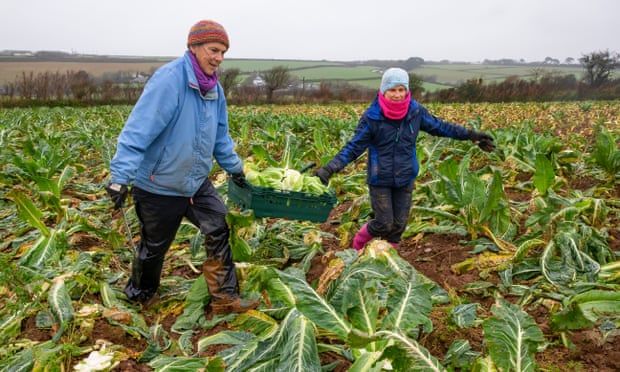 Volunteers Pip Evans (right) and Lucy Zawadzki glean unwanted cauliflowers from a farm in Hayle, Cornwall.
The Glean for Brum network in Birmingham is also expanding its war on waste after a challenging start last year. “The hardest thing has been finding farms to glean from. Many of the farmers around us in the West Midlands are cereal growers or livestock. But we are finding more community and pick-your-own farms which have surplus and are happy for us to come in,” said Katherine d’Apice, who helps run the network. “There is such a big detachment among individuals and their food. Gleaning is a great way to get people on to agricultural sites to experience it themselves.”
Research from Feedback has found that up to 16% of a crop can be wasted due to a range of factors that are often beyond a farmer’s control, such as produce not being the right shape or size for supermarkets, unexpected weather patterns changing harvest times or labour shortages.
This is the first time Cornish grower Simon Whear has invited gleaners into his fields, having been contacted by the local group only a couple of weeks ago.
“You get to a point with a commercial crop where there are too few pieces left in the field to make it financially viable to come back in again and cut what’s left,” said Whear. “There’s always some left, and I thought this would be a good way for people to make use of it. It’s better that it gets picked than just ploughed back into the field.”
What is a small amount of waste to Whear in retail terms is providing rich pickings for the gleaners. Duncan and her volunteers have managed to fill 66 crates of perfect, albeit small, cauliflower in just six hours. “This one’s a little too yellow for the supermarkets; this one’s too small. This one has started to blow, which means it’s just opened up a little too much. The farmer couldn’t sell these but they are perfectly edible,” she says, raking through the crates. “It’s difficult for farmers as they are tied into the demands of retailers and all their commercial pressures. But this is beautiful fresh produce that shouldn’t go to waste. We’re so grateful to our farmers for letting us come and do this – and the food banks are so grateful too.”
As the crates are loaded into a van and taken off to food banks and community food projects across the county, Pip Evans, 55, reflects on only her second volunteer glean. “I was out for a walk over Christmas with my husband and I could smell rotting cauliflower in the fields. I just thought: what a waste. There are so many people who are hungry who need this amazing produce,” she says.
She came across the gleaning group on Facebook and signed up to volunteer:“To play a part in the chain of getting food out of the ground and into the mouths of people who need it, to be part of this growing movement of people doing this – it just makes me feel so good. I will walk away from this field buzzing with joy.”