London Daily

Focus on the big picture.
Saturday, Jul 18, 2026

UK increasingly reliant on fruit and veg from climate-hit countries

UK increasingly reliant on fruit and veg from climate-hit countries

Researchers say trend could lead to supply problems and hinder efforts to promote healthy eating

The UK is increasingly reliant on fruit and vegetables imported from countries most vulnerable to the effects of the climate crisis, which could lead to supply problems, experts say.

A study published in Nature Food on Monday found that the proportion of fruit and vegetables supplies in the UK that was grown domestically dropped from 42% in 1987 to 22% in 2013. At the same time, the proportion imported from “climate-vulnerable” countries – those worst hit by climate breakdown – increased from 20% to 32%.

The research was carried out by the Centre on Climate Change and Planetary Health at the London School of Hygiene & Tropical Medicine (LSHTM). The lead author, Dr Pauline Scheelbeek, said a combination of trade patterns and the escalating climate crisis meant the supply of fruit and vegetables in the UK was increasingly insecure.

“The increased reliance on fruit and vegetable imports from climate-vulnerable countries will, if no adequate climate change adaptation measures are taken in the production countries, lead to fruit and vegetable supply problems in the UK and potentially affect price and consumption of such foods,” she said.

“This could be a major challenge in our efforts to promote higher fruit and vegetable consumption in the UK, both for health and environmental reasons.”

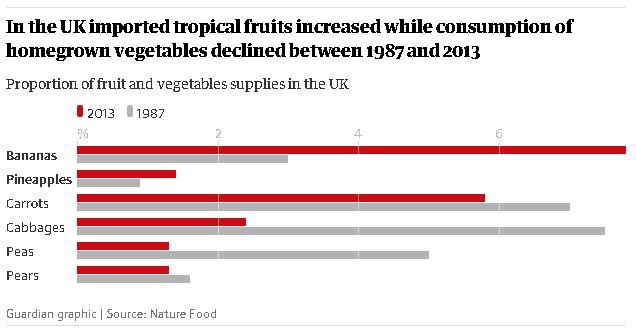
The team found that there had been major shifts in the types of fruits and vegetables eaten in the UK, with imported tropical fruits such as pineapples and bananas on the rise while consumption of homegrown vegetables such as cabbages, carrots and peas declined.


Prof Alan Dangour, the director of the LSHTM climate centre, said: “The government cannot ignore these trends or it will be failing in its primary duty to protect its people from future shocks. [It must] do more now to support national food production, build resilience into the national food system and ensure the supply of healthy and sustainable diets for all.”

In 1987, 21 crops accounted for 80% of all fruit and vegetables supplied to the UK. The figure rose to 27 crops in 2000 and 34 in 2013, according to the study.

Over this period, pineapples increased from 0.9% to 1.4% of overall fruit and vegetable supply, and bananas from 3% to 7.8%. Cabbages declined from 7.5% to 2.5% of the total, peas from 5% to 1.3%, and carrots from 7% to 5.8%.

The research team said the findings were particularly important as ministers attempt to hammer out post-Brexit trade deals and tackle obesity and wider public health.

“The implications of vulnerability of our trade strategy cuts across traditional policy silos such as diets, health, agriculture, economy and the environment,” Scheelbeek said. “We need to rethink our trade strategy to reduce dependency on climate vulnerable countries, import responsibly and look into possibilities to enhance consumption of sustainably grown fruit and vegetables, including those produced in the UK.”

Newsletter

Related Articles

0:00
0:00
Close
Ukrainian Drone Barrage Kills Eight and Strikes Russian Logistics Network
The Ten World Cup Finals That Defined Football History
Smartphones Are Getting More Expensive, Sales Are Collapsing, and Even Apple Admits: "Prices Will Rise"
The Monaco Bombing Has Become a Test of Ukraine’s Intelligence Accountability
Leadership Change and Strategic Rivalry Redraw the Political Map
Energy Risk, Uneven Growth and the New Geography of Global Capital
The AI Race Enters Its Infrastructure Era
Security and resilience remain long-term national priorities
Britain balances growth ambitions with public finance pressures
Regional devolution becomes a defining theme of the next Labour era
Industrial strategy returns to the centre of British economic policy
Political Instability Remains a Challenge for UK Investment Confidence
Brexit Economic Debate Continues as Public Concerns Over Long-Term Impact Remain
UK Climate Risks Rise as Met Office Warns Extreme Weather Is Becoming More Common
Housing Shortages and Regional Inequality Become Key Priorities Under Incoming Labour Leadership
National Health Service Reform Remains One of Britain’s Biggest Political Challenges
Bank of England Remains at Centre of UK Economic Debate Over Inflation and Growth
UK Economy Shows Recovery Signs but Households and Businesses Remain Under Pressure
Britain Deepens European Defence Cooperation as NATO Allies Seek Stronger Security Capabilities
United Kingdom Expands Sanctions Against Russian Cyber Networks Over Security Threats
UK Industrial Strategy Faces Test After Government Takes Control of British Steel
British Businesses Seek Policy Clarity as Andy Burnham Prepares to Lead Labour Government
Andy Burnham’s Labour Leadership Signals Major Shift Toward Regional Power and Devolution
British Steel Nationalisation Creates New UK-China Tensions Over Control of Strategic Industry
For 36 Years, He Scammed About 300 Luxury Hotels — Until He Was Caught
England's World Cup Exit Expected to Cost Hospitality and Retail £334 Million
Former ICC Prosecutor Aide Speaks Publicly About Allegations Against Karim Khan
Opposition Raises Questions Over June Heatwave Power Grid Pressures
Mastercard Explores Sale of Majority Stake in UK Payments Operator Vocalink
Boeing Forecasts Global Commercial Aircraft Fleet Will Double by 2045
London GP Surgeries Receive £18 Million to Expand Primary Care Capacity
Health Advisers Recommend Nationwide Meningitis B Vaccination for Teenagers
OECD Warns UK Economy Faces Slower Growth and Weak Productivity
Treasury Places Major Global Cloud Providers Under Direct Financial Oversight
Financial Markets Rally as Shabana Mahmood Emerges as Leading Treasury Candidate
Incoming Government Prepares Thames Water Nationalisation and New North Sea Drilling Approvals
UK Government Plans Deep Cuts to Bilateral Aid for African Nations
United States and Iran Exchange Direct Strikes for Seventh Consecutive Night
Incoming Prime Minister Andy Burnham Confirmed as Labour Leader Ahead of Downing Street Handover
Britain Nationalises British Steel to Protect Scunthorpe Production and Strategic Supply
Andy Burnham Takes Labour Leadership and Prepares to Become Britain’s Seventh Prime Minister in a Decade
Tech Companies Want to Move Computing Off Your Screen and Onto Your Body
White House Teleprompter Operator Earned More Than $100,000 From Bets Linked to the President's Speeches
French Prime Minister Survives No-Confidence Vote After Controversial Budget Cuts
European Commission Opens Excessive Deficit Procedure Against France
French Senate Blocks Key Immigration Reform Measures
French Government Pushes EU Action Against Ultra-Fast Fashion Imports
French Parliament Debates Expanded Autonomy Powers for Corsica
France Reopens Autonomy Talks With New Caledonia After Months of Unrest
Bordeaux Wine Producers Seek Three Hundred Million Euro Aid Package After Export Collapse
×