London Daily

Focus on the big picture.
Monday, Jun 01, 2026

The global race to produce hydrogen offshore

The global race to produce hydrogen offshore

Last year was a record breaker for the UK's wind power industry.

Wind generation reached its highest ever level, at 17.2GW on 18 December, while wind power achieved its biggest share of UK energy production, at 60% on 26 August.

Yet occasionally the huge offshore wind farms pump out far more electricity than the country needs - such as during the first Covid-19 lockdown last spring when demand for electricity sagged.

But what if you could use that excess power for something else?

"What we're aiming to do is generate hydrogen directly from offshore wind," says Stephen Matthews, Hydrogen Lead at sustainability consultancy ERM.

His firm's project, Dolphyn, aims to fit floating wind turbines with desalination equipment to remove salt from seawater, and electrolysers to split the resulting freshwater into oxygen and the sought-after hydrogen.
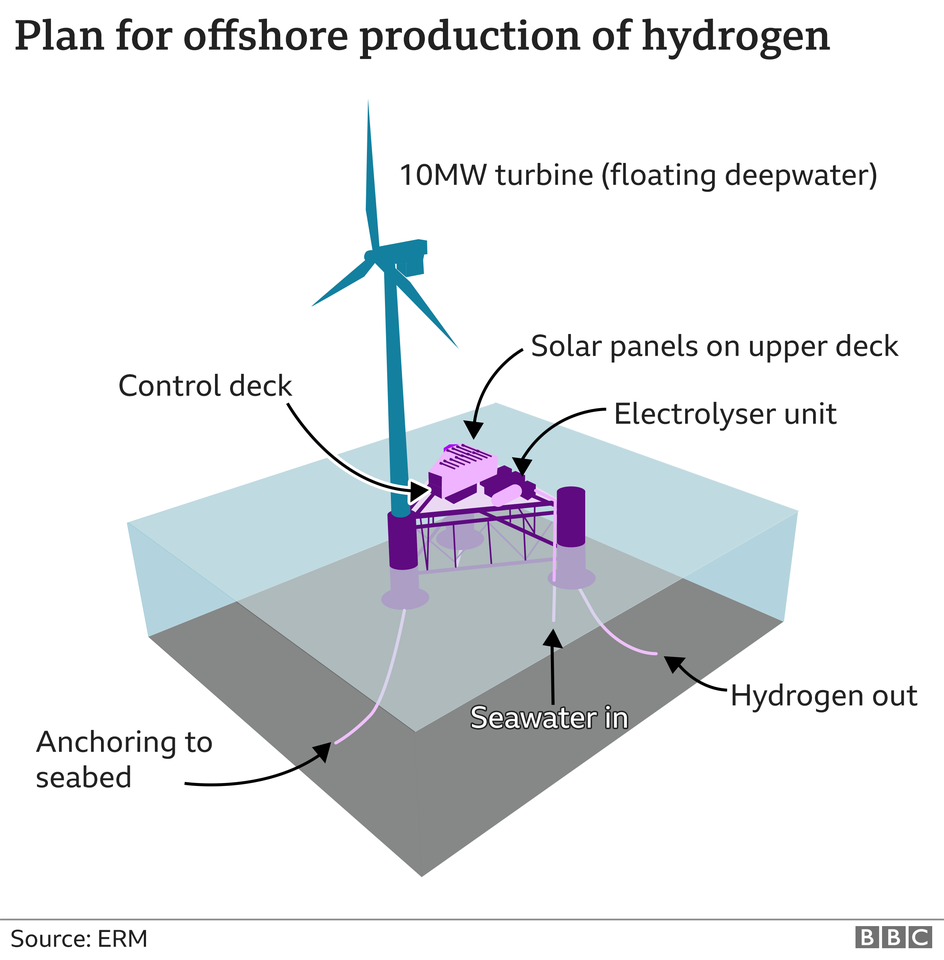

The idea of using excess wind energy to make hydrogen has sparked great interest, not least because governments are looking to move towards greener energy systems within the next 30 years, under the terms of the Paris climate agreement.

Hydrogen is predicted to be an important component in these systems and may be used in vehicles or in power plants. But for that to happen, production of the gas, which produces zero greenhouse gas emissions when burned, will need to dramatically increase in the coming decades.

Mr Matthews says his firm's project is just getting going, with a prototype system using a floating wind turbine of roughly 10 megawatt capacity planned, but not yet built.

It's possible that the system could be based in Scotland and the aim is to start producing hydrogen around 2024 or 2025.

But there are many other ventures in this area besides Dolphyn.

Wind turbine maker Siemens Gamesa and energy firm Siemens Energy are ploughing 120m euros ($145m; £105m) into the development of an offshore turbine with a built-in electrolyser.

German energy company Tractebel is exploring the possibility of building a large-scale, offshore hydrogen production plant powered by nearby wind turbines; and UK-headquartered Neptune Energy is seeking to convert an oil platform into a hydrogen production station, which will pump hydrogen ashore to the Netherlands via pipes that are currently transporting natural gas.
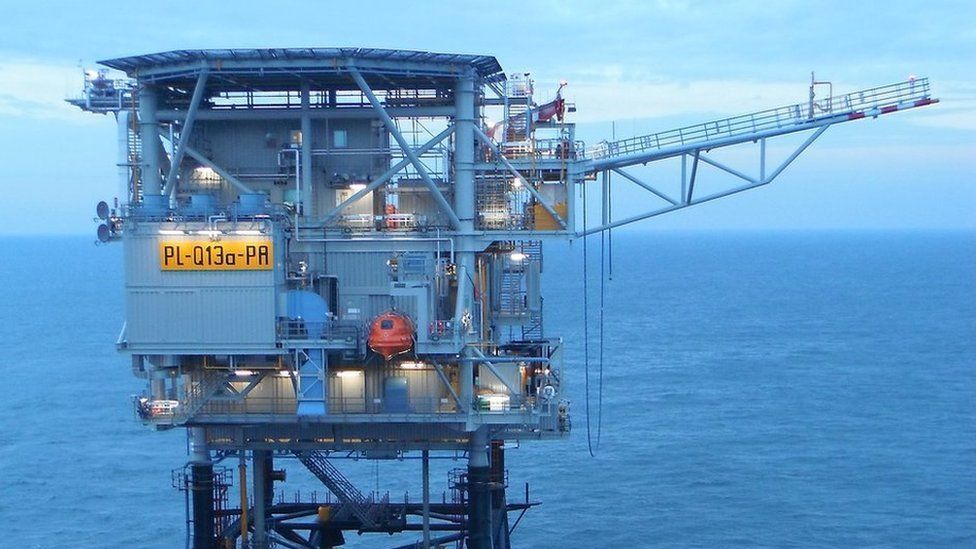
There are plans to convert this old North Sea oil platform into a hydrogen production plant
All of the excitement around hybrid wind energy and hydrogen generation systems is partly down to climate commitments but economics are also involved.

Large-scale hydrogen electrolysers are becoming more available while the costs of installing wind turbines has fallen "dramatically", says James Carton, assistant professor in sustainable energy at Dublin City University.

He and others think the time is right to kick-start large-scale hydrogen electrolysis at sea, though the idea has been around for many years.
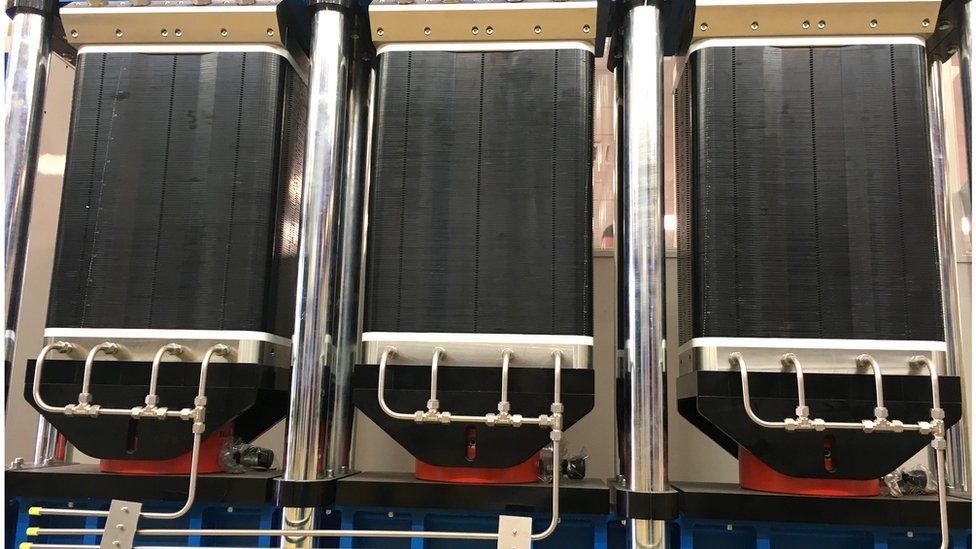
Electrolyser stacks break seawater down into hydrogen and oxygen
Oyster is yet another project in this area, and involves a consortium of companies including Danish energy firm Ørsted and British electrolyser specialists ITM Power, among others.

In the first instance, a wind turbine will power an onshore electrolyser that will churn out hydrogen. The device will be exposed to sea spray to simulate, to a degree, the harsh environment facing offshore equipment. ITM intends to design a system compact enough to fit into a single wind turbine.

The firm's chief executive, Graham Cooley, points out that it is much easier to store molecules such as hydrogen than electrons in batteries.

"All the renewable energy companies… they've realised they've got a new product," he adds. "Now they can supply renewable molecules to the gas grid and industry."

The Oyster consortium hopes to have shown off a demonstrator of its system within 18 months.
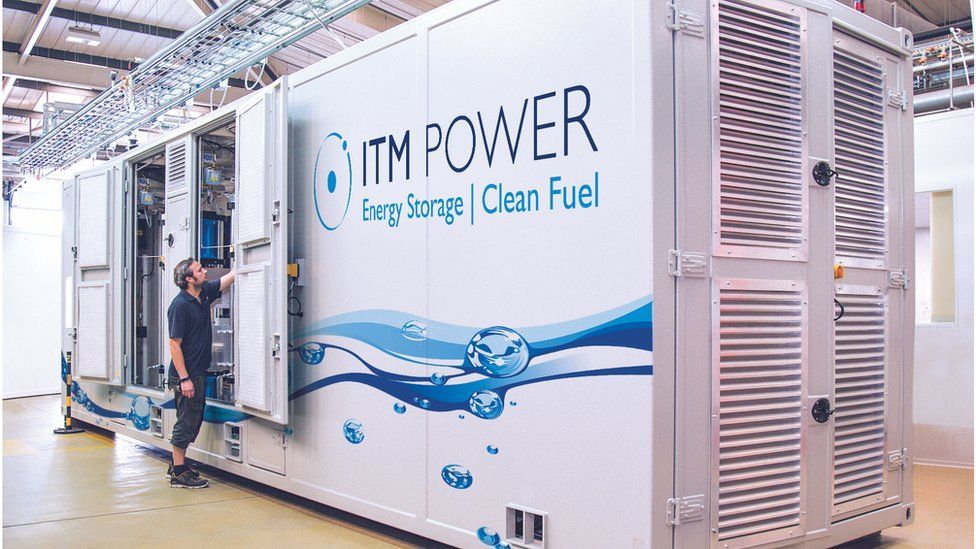
ITM plan to build a hydrogen-producing unit that can fit into a wind turbine
Among the many potential uses for hydrogen is as a fuel for gas-burning boilers in homes. Converting the domestic gas grid to provide hydrogen, and fitting homes with boilers capable of burning it, would be a huge task.

However, it would mean that excess wind energy could in principle be used to supply this giant system, meaning very little of that energy would go to waste, says Mr Carton, referring to the gas main pipes scattered around the UK and Ireland: "We have a big tank, it's just a really long tank in the ground."

For some, this is all very exciting. But there are hurdles yet to overcome. A spokesman for the wind energy industry body WindEurope says that while renewable hydrogen produced via wind-powered electrolysis is "future-proof", a decade or so of technological development is required before these systems will have a larger impact.

Jon Gluyas, Ørsted/Ikon chair in geoenergy, carbon capture and storage at Durham University, adds that the real question is whether it is cost-effective to set up such equipment at scale. Proponents, unsurprisingly, argue it is - but with energy systems the proof is only ever in the pudding. Ultimately, Prof Gluyas says a mix of different technologies and approaches will be needed for countries like the UK to be carbon neutral.

For Mr Carton, the vision remains tantalising. Schemes that solve the problem of wind's variability by using excess power to good use could be transformative, he argues: "It'll change the way we look at renewables."


Newsletter

Related Articles

0:00
0:00
Close
Japanese Technology Firm Fujitsu Launches Advanced Artificial Intelligence Tool for Corporate Disclosures
South Africa Officially Launches Nationwide Campaign for Highly Contested Local Government Elections
United Kingdom Commits Additional Funding for Unexploded Ordnance Clearance in Laos
Singapore Announces Stringent New Greenhouse Gas Regulations for Commercial Cooling Systems
Cambodia and Thailand Hold High-Level Border Security Talks at United Nations Headquarters
Myanmar Military Government and China Sign Major Agreement to Upgrade Media and Cultural Cooperation
Knife Attack at Swiss Train Station Leaves Three Injured in Suspected Act of Domestic Terrorism
Transnational Extortion Gang Threatens Canadian Police With Army of One Thousand Armed Operatives
Australia Imposes Forty-Two-Day Quarantine on Cruise Ship Passengers Following Deadly Hantavirus Outbreak
International Monetary Fund Unlocks Seven Hundred Million United States Dollars for Sri Lanka Following Economic Reforms
Australia Launches Record One Point Four Billion Dollar Lawsuit Against Chemical Giant 3M Over Contamination
China and Canada Foreign Ministers Meet in Ottawa in Effort to Stabilize Strained Diplomatic Ties
Indonesia Demands Urgent United Nations Security Council Reform Amid Escalating Global Conflicts
Extreme Weather Patterns Trigger Severe Drought in Madagascar and Destructive Flooding in East Africa
Indian State of Karnataka Faces Political Upheaval as Chief Minister Siddaramaiah Abruptly Resigns
Philippines and Japan Reaffirm Defense Ties as Crucial for Indo-Pacific Regional Stability
Norway Joins French Nuclear Deterrence Initiative in Major Shift for European Security Architecture
Global Critical Mineral Alliances Expand as Western Nations Move to Counter Chinese Supply Dominance
United States Imposes Fifty Percent Tariffs on Mexican Steel and Aluminum Ahead of Trade Pact Review
European Union and China Head Toward Major Trade Conflict Over Clean Technology Exports
United States Economic Growth Severely Downgraded to One Point Six Percent as Stagflation Fears Mount
World Health Organization Warns Central African Ebola Epidemic is Outpacing Containment Efforts
United States Treasury Department Conditions Sanctions Relief on Reopening of the Strait of Hormuz
Iranian Air Defenses Intercept and Destroy United States Military Drone Over Bushehr Province
Iranian Armed Forces Launch Ballistic Missiles Toward Unspecified Targets Prompting Regional Condemnation
United Nations Secretary-General Warns Global Order Facing Highest Level of Conflict Since 1945
Israel Issues Sweeping Evacuation Orders in Southern Lebanon Amid Intensified Hezbollah Conflict
Russia Announces Systemic Military Strikes Targeting Ukrainian Defense and Energy Infrastructure
United States and Iranian Negotiators Reach Draft Agreement to Extend Ceasefire and Resume Nuclear Talks
United Nations Security Council Deeply Divided Over United States Capture of Venezuelan President
US and Iran Exchange Direct Military Strikes Amid Fragile Gulf Ceasefire
World Health Organization Warns of Catastrophic Ebola Outbreak in DR Congo
Russia Threatens New Wave of Strikes on Ukrainian Infrastructure and Embassies
Scientists Warn Atlantic Ocean Currents Could Collapse Faster Than Projected
Anthropic Reaches $900 Billion Valuation in Historic AI Funding Round
Washington Imposes Crippling Sanctions on Iranian Maritime Authority
Japan and the Philippines Initiate Strategic Intelligence-Sharing Pact
Microsoft Deploys Autonomous Computer-Using AI Agents to Global Markets
Anthropic Secures $45 Billion Compute Infrastructure Agreement With SpaceX
U.S. Director of National Intelligence Resigns Amid Administration Shakeup
Micron Technology Crosses Trillion-Dollar Valuation Amid Unprecedented Hardware Demand
Canada and Germany Finalize Historic Long-Term LNG Export Agreement
China Expands International Travel Restrictions on Domestic AI Researchers
Japan Approves Sweeping Overhaul of National Intelligence Apparatus
Global Airlines Scramble Logistics as Middle East Airspace Remains Fractured
Japan's Naphtha Imports Plunge 47 Percent Amid Strait of Hormuz Closure
Global Crude Prices Retreat Below $96 as Gulf Tensions Momentarily Ease
Generative AI Outperforms Human Baselines in Landmark Global Creativity Study
NASA Partners With Private Aerospace to Unveil Permanent Lunar Base Architecture
South Korean Equity Markets Surge on Next-Generation Memory Chip Frenzy
×