London Daily

Focus on the big picture.
Monday, Jul 13, 2026

Strikes: Airport, rail and driving test staff resume action

Strikes: Airport, rail and driving test staff resume action

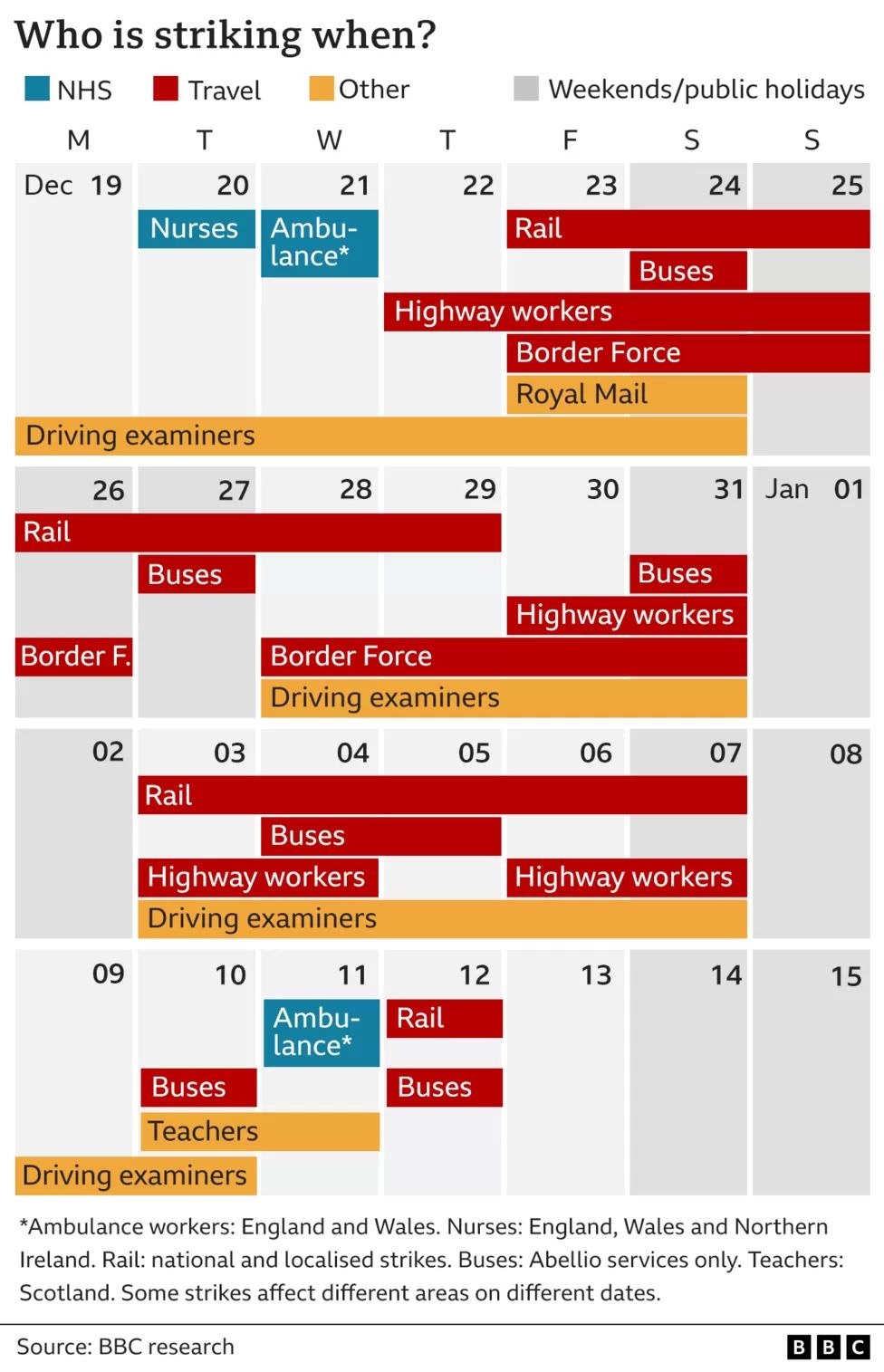
Border Force staff have begun the second in a series of strikes at UK airports until New Year's Eve.

Around 1,000 members of the PCS union, many of whom work in passport control, are walking out from 28-31 December.

Rail disruption will also continue on Wednesday and Thursday, with TSSA union members at Great Western Railway and West Midlands Trains on strike.

Driving examiners are continuing a rolling walkout which will continue into January.

The Border Force strikes have been called over pay, jobs, and conditions as the cost of living rises.

Civil servants will join military personnel to cover absent striking workers at Heathrow, Gatwick, Manchester, Birmingham, Cardiff and Glasgow airports, as well as the Port of Newhaven.

Earlier strikes, which ran from 23-26 December, caused minimal disruption.

A spokesperson for Gatwick Airport, in West Sussex, said: "Flights to and from Gatwick are expected to arrive and depart as normal during today's strike.

But the official added: "Passport checks for arriving passengers may, however, take longer and queues may form."

A spokesperson for Heathrow said immigration halls for travellers were "free-flowing" and that the airport experienced "no issues" resulting from the first series of strikes.

Mark Serwotka, general secretary of the PCS, said: "The government could resolve this dispute today by agreeing to meet us and putting some money on the table."

Meanwhile, driving examiners and rural payment officers at more than 250 sites across the UK are holding rolling strikes from 13 December to 16 January.

Members of the PCS union at 71 driving test centres in eastern England and the Midlands will be on strike over five days from Wednesday.

The PCS is calling for a 10% pay rise, better pensions, job security and no cuts to redundancy terms for all its members - but the government has said the requested pay rises are "unaffordable".

Downing Street has once again urged unions to call off strike action, saying it wants an end to disruption.

The Prime Minister's deputy spokesman said meetings aimed at mitigating disruption were continuing, but added: "We are disappointed about disruption to many people's lives - particularly around Christmas"


'Damaging dispute'


TSSA members, who work for Great Western Railway and West Midlands Trains, will walk out from midday on Wednesday (28 December) until midnight on Thursday (29 December). Talks between the union and two rail firms have yet to result in an agreement.

Nadine Rae, organising director at the TSSA, told the BBC the union believed negotiations had been progressing - but, after almost four weeks of talks, the outcome was "completely different from what we were talking about".

The latest stance suggested the government "had interfered with the negotiation process", said Ms Rae.

A spokesperson for the Department for Transport said the transport secretary and rail minister had "worked hard to facilitate a fair and reasonable offer, and it is incredibly disappointing that some continue to strike".

"We urge them to step back, reconsider and get back round the table, so we can start 2023 by ending this damaging dispute."

Separately, members of the TSSA employed by Network Rail - which owns and maintains the UK's rail system - have already agreed a deal over pay and conditions. They will get at least a 9% wage rise over two years and there will be no compulsory redundancies until the end of January 2025.

The latest wave of rail staff strikes is expected to disrupt journeys for those travelling back to work after Christmas, or heading off for New Year breaks.

Disruption to travel is also expected during forthcoming rail strikes in January.

RMT union members at Network Rail will resume their strike action over pay and conditions on 3 and 4 January. They will walk out again on 6 and 7 January, and there is a ban on any overtime for RMT members from 18 December to 2 January.

Members of Aslef will strike on 5 January and Southeastern has warned that no trains will run on that day. In addition, the train company has warned there will be very limited Southeastern services for the entire week, due to the RMT strike affecting the Dartford lines, the Sevenoaks line and the highspeed route via Ashford.

The Rail Delivery Group (RDG) said the striking RMT rail staff would mean only around 20% of services will operate and "half of the network will shut down".

"There are likely to be even fewer services on 5 January due to a strike by drivers who belong to [the union] Aslef," the RDG warned.

Newsletter

Related Articles

0:00
0:00
Close
United Kingdom Financial Markets Monitor Business Response to Economic Policy Changes
Scottish Renewable Energy Expansion Highlights Need for Faster Grid Development
Wales and Regions Strengthen Focus on Economic Development Through Tourism and Investment
Retail Industry Warns High Street Businesses Remain Under Pressure
Police Chiefs Highlight Growing Challenges Managing Protests and Public Order
Agriculture Leaders Seek Clarity on Post-Brexit Farming Support and Environmental Rules
Transport Unions Warn of Further Industrial Action Over Pay and Working Conditions
Welsh Tourism Sector Reports Strong Growth Driven by Domestic and International Visitors
National Infrastructure Review Gains Support as Leaders Seek Faster Project Delivery
Financial Markets Assess Impact of United Kingdom Corporate Tax Policy Changes
Northern Ireland Assembly Debates Cross-Border Trade and Infrastructure Cooperation Plans
Government Opens Consultations on Housing Reform and Planning System Changes
Scottish Government Faces Pressure to Accelerate Offshore Wind and Grid Expansion
National Energy System Operator Warns Grid Investment Is Needed for Future Electricity Demand Growth
United Kingdom Research Council Invests in Artificial Intelligence and Biotechnology Innovation Hubs
United Kingdom Expands Oversight of Skilled Worker Visa Sponsors Amid Migration Debate
Cross-Party MPs Call for National Infrastructure Strategy Review to Accelerate Economic Growth
Prime Minister Announces One Billion Pound NHS Funding Package Ahead of Winter Pressures
Bank of England Signals Cautious Approach to Interest Rates as Inflation Remains Above Forecasts
World Cup Visitors Turn American Big-Box Stores Into Souvenir Stops
Netflix Weighs Always-On Channels, Bundles and Short-Form Video
Passenger Is Pulled Partly Outside Ryanair Jet After Window Fails Mid-Flight
Innovation-led growth strategy
Public service reform pressure
Defence and industrial security
Labour leadership transition and economic reset
Northern England Pushes for Greater Influence in Britain’s Future Economic Model
UK Technology Strategy Focuses on Life Sciences, Digital Innovation and Research Investment
Britain and United States Maintain Focus on Pharmaceuticals Cooperation and Industrial Growth
UK Public Services Face Continued Pressure as Government Promises Visible Improvements
Regional Economic Power Becomes Key Theme in Britain’s Next Political Phase
Britain Expands Support for Small Businesses as Firms Seek Better Access to Finance
UK Economy Remains Central Political Challenge as Cost of Living and Growth Concerns Persist
National Health Service Introduces New Workplace Reviews to Improve Conditions for Healthcare Staff
UK Life Sciences Sector Secures More Than Three Billion Pounds in Investment to Support Innovation
Britain Strengthens Defence Strategy as Security Concerns Reshape Military and Industrial Policy
Andy Burnham Promises Stronger UK Defence Industry and Expanded Domestic Production
UK Government Faces Difficult Spending Choices as Labour Leadership Transition Approaches
Rachel Reeves Warns Andy Burnham of Immediate Economic Challenges After Expected Leadership Change
Andy Burnham Prepares to Lead UK Government With Plans for Regional Power Shift and Economic Reset
Government Creates Emergency Support Scheme for Financially Struggling Universities
United Kingdom Replaces Traditional Farm Subsidies With Payments Linked to Environmental Performance
National Grid Reports First Week of Electricity Generation Without Fossil Fuels
United Kingdom Financial Regulator Introduces Tougher Capital Rules for Cryptocurrency Exchanges
Belfast Harbour Expands Operations to Attract Investment Through United Kingdom and European Union Market Access
Scottish Government Threatens Legal Challenge Over Westminster Cuts to North Sea Transition Funding
United Kingdom Accelerates Trans-Pennine High-Speed Rail Project Linking Northern Cities
United Kingdom Secures Ten Billion Pound Investment for Cambridge Quantum Computing Campus
Port Talbot Steelworks Wins Support for Green Hydrogen Transition and Protection of Industrial Jobs
United Kingdom Sends Royal Navy Carrier Strike Group to Indo-Pacific as Regional Security Focus Expands
×