London Daily

Focus on the big picture.
Tuesday, Apr 21, 2026

Shinzo Abe death: Shock killing that could change Japan forever

Shinzo Abe death: Shock killing that could change Japan forever

Since news broke this morning of Shinzo Abe's shooting, messages have been pouring in from friends and contacts, all asking the same question: how could this have happened in Japan?

I felt much the same myself. Living here you get used to not thinking about violent crime.

The identity of the victim only makes the news more shocking.

Shinzo Abe may no longer be Japan's prime minister, but he's still a huge figure in Japanese public life, and probably the most recognisable Japanese politician of the last three decades.

Who would want to kill Abe? And why?

I'm trying to think of an equivalent - of another act of political violence that would be similarly shocking to the local population. The one that comes to mind is the shooting of Swedish Prime Minister Olof Palme in 1986.

When I say people don't think about violent crime here, I'm not exaggerating.

Yes, there are the Yakuza, Japan's famously violent organised crime gangs. But most people never come in to contact with them. Even the Yakuza shy away from guns because the penalties for illegal possession are just not worth it.

Owning a gun in Japan is extremely difficult. It requires no criminal record, mandatory training, psychological evaluation, and extensive background checks including police interviewing neighbours.

Consequently, gun crime virtually doesn't exist here. On average, there are fewer than 10 gun-related deaths in Japan each year. In 2017, there were just three.

Little wonder then that much of the attention has been focused on the gunman and the weapon he used.

Who is he? Where did he get the gun from? Japanese media is reporting that the 41-year-old is a former member of the country's self-defence forces, the equivalent of an army.

But closer inspection shows he only spent three years in the navy. The gun he used is more curious. Pictures of it lying on the ground after the shooting show what looks like a home-made weapon. Two bits of steel pipe stuck together with black gaffer tape, with some sort of handmade trigger. It looks like something fashioned from plans downloaded off the internet.

So, was this a deliberate political attack, or the act of a fantasist, someone who wanted to become famous, by shooting someone famous? So far, we don't know.
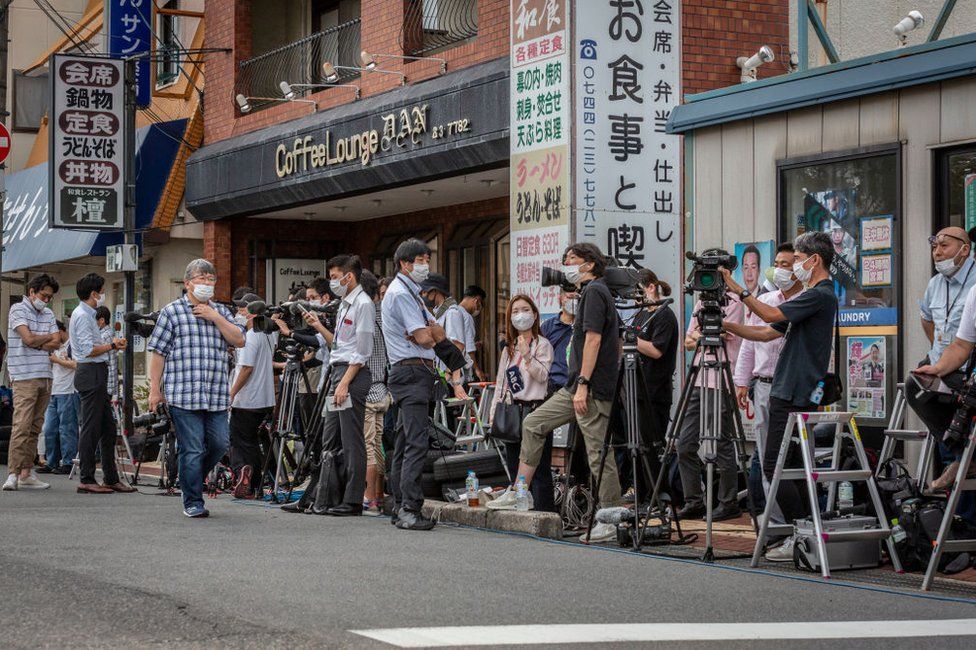
The news has shocked a country that prides itself on public safety


Japan has certainly had its share of political assassinations. The most famous was in 1960 when the leader of Japan's socialist party, Inejiro Asanuma, was stabbed in the abdomen by a right-wing fanatic wielding a samurai sword. Although right-wing extremists still exist in Japan, Abe, a right-wing nationalist, would be an unlikely target.

In recent years, we have seen another type of crime becoming more common here. The quiet, lonely male with a grudge against someone or something.

In 2019, a man set fire to a building housing a popular animation studio in Kyoto, killing 36 people.

The man told police he had a grudge against the studio because it had "stolen his work".

In another case in 2008, a disgruntled young man drove a truck into a crowd of shoppers in Tokyo's Akihabara district, then got out and started stabbing onlookers. Seven people were killed.

Before carrying out the attack he had posted a message online saying, "I will kill people in Akihabara" and "I don't have a single friend, I am ignored because I'm ugly. I am lower than trash".

It's not clear yet whether Abe's shooting fits in to the first or the second category. But it seems certain that the assassination will change Japan.

Given how safe Japan is, security here is very relaxed. During election campaigns, like the ongoing one, politicians literally stand on street corners giving speeches and shaking hands with shoppers and passers-by.

It's almost certainly why Abe's attacker was able to get so close and discharge the weapon he had cobbled together.

That surely has to change after today.

Newsletter

Related Articles

0:00
0:00
Close
News Roundup
Microsoft lost 2.5 millions users (French government) to Linux
Privacy Problems in Microsoft Windows OS
News roundup
Péter András Magyar and the Strategic Reset of Hungary
Hungary After the Landslide — A Strategic Reset in Europe
Meghan Markle Plans Exclusive Women-Focused Retreat During Australia Visit
Starmer and Trump Hold Strategic Talks on Securing Strait of Hormuz Amid Rising Tensions
Unofficial Australia Visit by Prince Harry and Meghan Expected to Stir Tensions with Royal Circles
Pipeline Attack Cuts Significant Share of Saudi Arabia’s Oil Export Capacity
UK Stocks Rise on Ceasefire Momentum and Renewed Focus on Diplomacy
UK to Hold Further Strategic Talks on Strait of Hormuz Security
Starmer Voices Frustration as Global Tensions Drive Up UK Energy Costs
UK Students Voice Concern Over Proposal for Automatic Military Draft Registration
Rising Volatility Drives Uncertainty in UK Fuel and Petrol Prices
UK Moves to Deploy ‘Skyhammer’ Anti-Drone System to Strengthen Airspace Defense
New Analysis Explores UK Budget Mechanics in ‘Behind the Blue’ Feature
Man Arrested After Four Die in Channel Crossing Tragedy
UK Tightens Immigration Framework with New Sponsor Rules and Fee Increases
UK Foreign Secretary Highlights Impact of Intensified Strikes in Lebanon
UK Urges Inclusion of Lebanon in US-Iran Ceasefire Framework
UK Stocks Ease as Ceasefire Doubts in Middle East Weigh on Investor Confidence
UK Reassesses Cloud Strategy Amid Criticism Over Limited Support Measures
UK Calls for Full and Toll-Free Access Through Strait of Hormuz Amid Rising Tensions
Starmer Signals Strategic Shift for Britain Amid Escalating Iran-Linked Tensions
UK Issues Firm Warning to Russia Over Covert Underwater Military Activity
OpenAI Halts Stargate UK Project, Casting Uncertainty Over Britain’s AI Expansion Plans
Starmer Voices Frustration Over Global Pressures Driving UK Energy Costs Higher
UK Deploys Military Assets to Protect Undersea Cables From Suspected Russian Threat
Canada Aligns With US, UK and Australia as Europe Prepares Major Digital Border Overhaul
Meghan Markle’s Planned Australia Appearance Sparks Fresh Speculation
Starmer Warns Sustained Effort Needed to Ensure US–Iran Ceasefire Holds
UK to Partner with Shipping Industry to Rebuild Confidence in Strait of Hormuz, Cooper Says
UK Interest Rate Expectations Ease Following US–Iran Ceasefire Agreement
Starmer Signals Major Effort Needed to Fully Reopen Strait of Hormuz During Gulf Visit
UK Fuel Prices Face Ongoing Volatility Amid Global Pressures and Domestic Factors
Kanye West’s Planned Italy Festival Appearance Draws Debate After UK Entry Ban
Smuggling Routes Shift Toward Belgium as Migrant Crossings to UK Evolve
Ceasefire Offers Potential Relief for UK Fuel and Food Prices Amid Ongoing Uncertainty
Iran Conflict Raises Questions Over UK’s Global Influence and Military Preparedness
Senator McConnell Visits Kentucky to Highlight Federal Investment in Local Projects
Kanye West Barred from Entering UK as Legal Grounds Come into Focus
UK Denies Visa to Kanye West After Sponsors Withdraw from Wireless Festival
Trump-Era Forest Service Restructuring Leads to Closure of UK Lab Focused on Kentucky Woodland Health
Foreign Students in the UK Describe Harsh Living Conditions and Financial Pressures
Reform UK Proposes Visa Restrictions on Nations Pursuing Reparations Claims
Public Reaction Divides Over UK Decision to Bar Kanye West
Calls Grow for UK to Review US Base Access Following Concerns Over Escalating Rhetoric
UK Indicates It Will Not Permit Use of Its Bases for Potential US Strikes on Iran’s Energy Infrastructure
UK Prime Minister Defends Decision to Bar Kanye West, Questions Festival Booking
×