

Richard Sharp: BBC chairman resigns over report into appointment
A report found Mr Sharp created the appearance of a conflict of interest by not fully disclosing his knowledge of the ex-PM's personal finances.
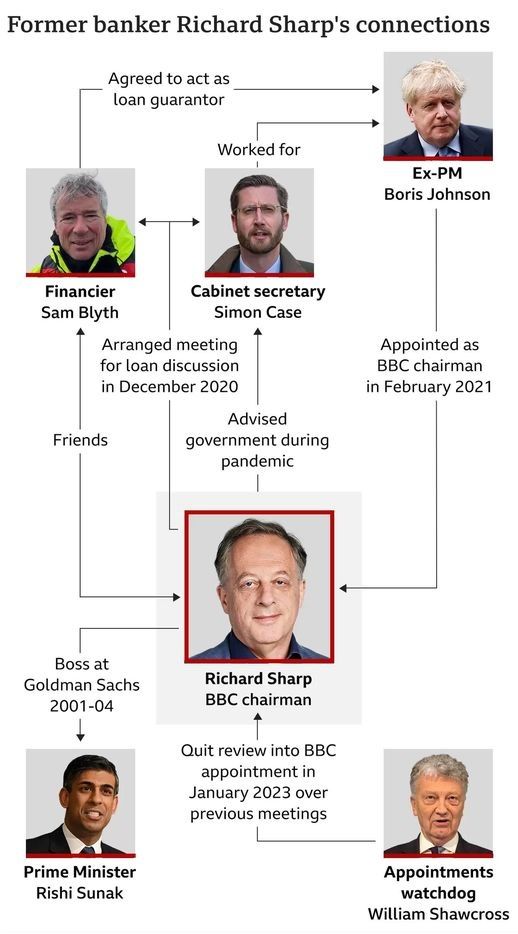
His position was scrutinised after it emerged he tried to secure a high-level government meeting for a businessman offering Mr Johnson financial help.
Mr Sharp defended his conduct but said he did not want to be a distraction.
A critical report led by barrister Adam Heppinstall was published on Friday, after months of speculation about Mr Sharp's position and a row about BBC independence.
The probe was set up after reports in the Sunday Times revealed Mr Sharp, a close associate of Mr Johnson, had played some role in the PM's personal finances at the same time as he was seeking to secure the senior BBC job.
In late 2020, Mr Sharp sought to arrange a meeting between Cabinet Secretary Simon Case and Sam Blyth, a distant cousin of Mr Johnson who had offered to support the PM financially, after reading press claims he was struggling to make ends meet.
The ex-investment banker and Conservative Party donor had already applied for the senior BBC job when he approached Mr Case and was appointed a few months later.
The report found he had failed to disclose two potential perceived conflicts of interest: first, by telling Mr Johnson he wanted to apply for the BBC role before doing so; and second, by telling the PM he intended to set up a meeting between Mr Case, the country's most senior civil servant, and Mr Blyth.
It notes that Mr Sharp does not accept the first conclusion, but he has apologised for the second, though described it as "inadvertent and not material".
The report found "there is a risk of a perception that Mr Sharp was recommended for appointment" because he sought to assist the PM in a private financial matter "and/or that he influenced the former prime minister to recommend him by informing him of his application before he submitted it".
It described his involvement in Mr Johnson's private financial affairs as "very limited" but concluded that it should have been declared anyway - even though the meeting between Mr Case and Mr Blyth did not subsequently take place.
The report did not make a judgement "on whether Mr Sharp had any intention of seeking to influence the former Prime Minister in this manner".
Mr Sharp has previously insisted he believed flagging his BBC application with Mr Case and agreeing to have no further involvement in any loan discussions resolved any conflict of interest issues, and therefore they did not need to be further disclosed - but the report disagreed with his position.
He said he did not play "any part whatsoever in the facilitation, arrangement, or financing of a loan for the former prime minister" but that he was quitting in order to "prioritise the interests of the BBC".
Mr Sharp conceded that with hindsight he should have disclosed his role in setting up a meeting between Mr Case and Mr Blyth to the appointments panel during the scrutiny process ahead of him taking up the senior role, and he apologised for the "oversight".
The report also called for an overhaul of the rules around public appointments, and criticised the leaking of ministers' preferred candidates for senior jobs to the media - pointing out there were reports about Mr Sharp being tipped for the BBC role in newspapers before the process was completed.
Mr Sharp's position came under further scrutiny in March following Gary Lineker's suspension over a tweet criticising government asylum policy, a decision which triggered a wider row about BBC impartiality.
Critics of the BBC's handling of the issue contrasted Lineker's suspension with how allegations against Mr Sharp were dealt with, pointing out the chairman was able to remain in post despite ongoing investigations.
Lineker tweeted on Friday the BBC chair should "not be selected by the government of the day... not now, not ever".
The BBC chair can only be appointed or sacked by the government. The BBC director general, the executive who has ultimate editorial control over the corporation, does not have the power to remove them.
Responding to the resignation, the BBC's former controller of editorial policy, Richard Ayre, said the matter came down to "the integrity and transparency" of Mr Sharp's application and that he "had to go".
He continued: "Meaningfully or not he had done a favour [for Mr Johnson]. He didn't declare that to the assessment panel."
Tim Davie, director-general of the BBC, said Mr Sharp had made a "significant contribution to the transformation and success of the BBC".
Prime Minister Rishi Sunak said he has not seen the report into Mr Sharp and did not guarantee a non-political figure would replace him.
Speaking to reporters in Glasgow, Mr Sunak said: "There's an appointments process that happens for those appointments. I'm not going to prejudge that."
Labour's shadow culture secretary Lucy Powell said: "The prime minister should have sacked him weeks ago. Instead it took this investigation, called by Labour, to make him resign."
Mr Sharp will remain in post until a successor is appointed in June.


