London Daily

Focus on the big picture.
Wednesday, Jul 15, 2026

Petrol prices see biggest daily jump in 17 years

Petrol prices see biggest daily jump in 17 years

The price of petrol saw its biggest daily jump in 17 years on Tuesday with a rise of more than 2p a litre.

The RAC motoring group said the average cost of filling a typical family car with petrol was now £99.40 and could exceed £100 as soon as Thursday.

Soaring fuel prices have been driven by the war in Ukraine and moves to reduce Europe's dependence on Russian oil.

With food and energy bills also surging, many households are under pressure.

The average price of petrol rose to 180.73p per litre on Tuesday, the RAC said.

Meanwhile, the average price of diesel rose by almost 1.5p to another record high of 186.57p per litre, making the cost of filling a 55-litre family car £102.61.

In March, the government announced a 5p per litre cut to fuel duty to help reduce costs for motorists.

However, motoring groups have raised concerns retailers are not passing on the cut to customers.

On Wednesday the prime minister's official spokesman said the government was "not confident" this was happening at all petrol stations.

He said the government was "continuing to look at all possible options" and "transparency may have an important role to play" in ensuring the cut is passed on.

It comes after a government source told the BBC a plan to name and shame petrol stations that fail to do so is "still in the works".

The government says any increases in VAT receipts it gets from rising fuel prices are likely to be largely offset by reduced household spending and VAT on other items.

The Competition and Markets Authority (CMA) said if it found sufficient evidence the 5p fuel duty cut had not been passed on to drivers, then it would launch an investigation that could lead to fines for offending retailers.


'Unprecedented'


RAC fuel spokesperson Simon Williams said the accelerating costs of forecourt fuel was "unprecedented", adding it appeared prices were "still some way from the peak".

But he said while the average price of diesel is heading towards £2 a litre, the cost of wholesale petrol had unexpectedly dropped by about 5p a litre on Tuesday, which if sustained, could stem the flow of "daily record petrol prices".

Retailers base their prices on the wholesale cost of petrol and diesel but there is typically a two-week lag for pump prices to reflect any changes in wholesale prices due to the time it takes for fuel to reach forecourts.

Mr Williams said the RAC's fuel watch data showed Asda had hiked its average petrol price by nearly 5p a litre in a single day, which he said was "unheard of".

In response, Asda said wholesale fuel prices had increased "at an unprecedented rate" and "we will do all we can to minimise the impact of rising wholesale prices on our customers".

Meanwhile, some forecourts are already selling petrol above £2 per litre, according to price comparison website PetrolPrices.

The highest price was found to be 202.9p at BP sites on the A1 near Sunderland, the M4 near Chippenham in Wiltshire and the M6 near Burton-in-Kendal, Cumbria.

The AA motoring group said the 2p litre rise was a "huge shock", but said the speculation that petrol prices could rise to £2 per litre on average "just gives the fuel trade licence to pile on extra cost and the misery".
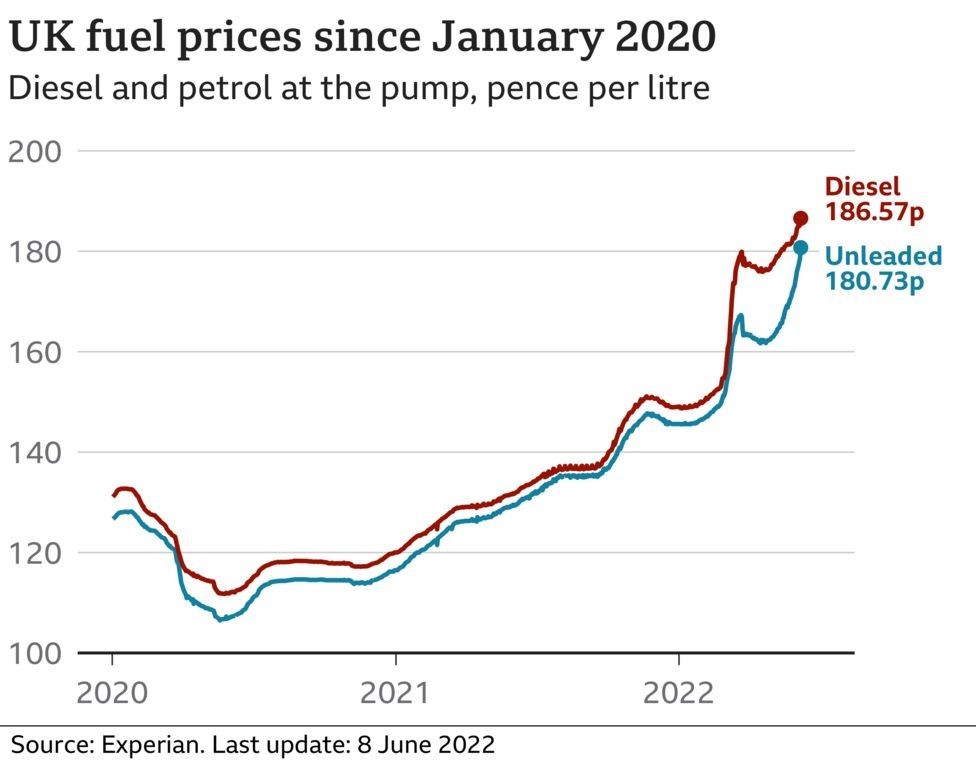

Fuel prices fell at the beginning of the Covid pandemic as many businesses temporarily closed and demand for energy collapsed.

But as global economies recovered, prices rose again and have surged further after Russia's invasion of Ukraine.

Changes in prices at the pump are mainly determined by crude oil prices and the dollar exchange rate, because crude oil is traded in dollars.

Russia is one of the world's major oil exporters and it is being targeted by economic and trading sanctions, which has led to potential supply concerns, pushing up oil prices.

EU leaders have said they will block most Russian oil imports by the end of 2022 to punish Moscow, which has also had an effect on prices.

The UK - which gets 8% of its oil needs from Russia - has pledged to phase out Russian oil by the end of the year and though it is not as dependent on Russian oil as the EU is, it is impacted when global prices rise.

Energy and food prices are also being driven higher by the war in Ukraine.

UK consumer prices are rising at their fastest rate for 40 years, with millions hit by an unprecedented £700-a-year increase to their energy bills in April.

Inflation - the rate at which prices rise - hit 9% in April and is expected to continue to rise this year.

Newsletter

Related Articles

0:00
0:00
Close
Spain in Ecstasy: "We Feel Unbeatable, We Taught the Whole World a Lesson"
Spain and UK Dismantle Gibraltar Border Following Landmark Schengen Integration Treaty
Forget Tinder: The Surprising Platform Where People Find Love
UK Government Faces Growing Debate Over Local Control of Immigration Enforcement
UK Biodiversity Forum Highlights Business Need to Protect Natural Environment
UK Parliament to Consider Workplace Temperature Limits Amid Climate Concerns
UK Parliament Considers Independent Immigration Appeals Authority Proposal
BBC Charter Renewal Scrutiny Intensifies as Parliament Reviews Broadcaster’s Future
Parliament Reviews Future of UK Maternity and Neonatal Care Services
UK-India Trade Accelerator Launched to Help Smaller Firms Expand Into Indian Market
UK Business Leaders Meet in Edinburgh to Address Economic Risks From Biodiversity Loss
UK Parliament Prepares for Sir Keir Starmer’s Final Prime Minister’s Questions Before Leadership Transition
Green Party-Led Lewisham Council Moves Against Cooperation With Home Office Immigration Raids
UK Government Faces Parliamentary Pressure Over Capita Contracts in Shared Services Programme
UK Economy Expected to See Modest Growth as OECD Highlights Fiscal and Global Risks
Public Accounts Committee Warns UK Government’s Four Point Three Billion Pound Shared Services Plan Risks Failure
EU and UK Sign Agreement Removing Gibraltar Border Controls After Years of Post-Brexit Uncertainty
OECD Warns UK Must Maintain Fiscal Discipline as Andy Burnham Prepares to Become Prime Minister
UK-India Free Trade Agreement Enters Into Force as Businesses Seek New Growth Opportunities
Harvard Astrophysicist to Lead U.S. Scientific Advisory on Unidentified Aerial Phenomena
On the Island That Did Not Yield to Trump, There Is No Electricity, and 10 Million Live in Darkness
Emergency Sirens Activated Across Bahrain as Interior Ministry Issues Shelter Directives
Key Trends to Watch
United Nations Expert Calls for Full Implementation of Supreme Court Ruling on Legal Definition of Sex
Industry Coalition Urges Labour Lawmakers to Back Continued North Sea Oil and Gas Production
Parliamentary Committee Calls for Tougher Restrictions on Unhealthy Food Advertising
Government Expands Awaab's Law to Cover Heat and Additional Housing Hazards
Energy Regulator Opens Independent Investigation Into National Grid Operator
United Kingdom and European Union Sign Landmark Gibraltar Border Agreement
Chancellor Unveils Financial Services Reform and Artificial Intelligence Strategy at Mansion House
Counterterrorism Police Take Over Investigation Into Killing of Former Minister Ann Widdecombe
Beer Industry Warns UK Rules Could Limit Growth of Alcohol-Free Market
Home Office Faces Legal Challenges Over Asylum Seeker Accommodation Closures
UK Heatwaves Linked to More Than Two Thousand Seven Hundred Deaths as Climate Debate Intensifies
Home Secretary Faces Pressure Over Political Security After Ann Widdecombe Murder Investigation
United Kingdom Opens Trade Consultation With Indonesia, Philippines, United Arab Emirates and Uruguay
Robert Jenrick Joins Reform UK After Leaving Conservative Party Leadership Role
Counter-Terrorism Police Take Over Investigation into Murder of Former MP Ann Widdecombe
Andy Burnham Secures Strong Labour Backing in Race to Succeed Keir Starmer
Global Markets Slide as Middle East Conflict Escalation Sends Oil Prices Higher
UK Prime Minister Keir Starmer Offers Condolences Following Death of Qatar’s Father Amir
UK Regional Innovation Policy Focuses on Research Clusters Across Scotland, Wales, and Northern England
UK Corporate Transparency Rules Set to Become More Strict Under Modern Slavery Reform Plans
UK Civil Service Estate Strategy Shifts Government Activity Away From London
UK Strengthens National Security Powers Through New Threat Designations
Greater Manchester Police Conduct Drink and Drug Driving Operations After Football Events
UK Government Advances Darlington Economic Campus With Construction Milestone
UK Authorities Increase Football-Related Security Operations After Tournament Fixtures
UK Invests Fifty-One Million Pounds in National Cryogenics Facility and Regional Innovation Hubs
UK Moves Toward Tougher Modern Slavery Reporting Rules With Corporate Penalties
×