London Daily

Focus on the big picture.
Saturday, Sep 19, 2026

Only 1% of complaints about police lead to proceedings, Home Office reveals

Only 1% of complaints about police lead to proceedings, Home Office reveals

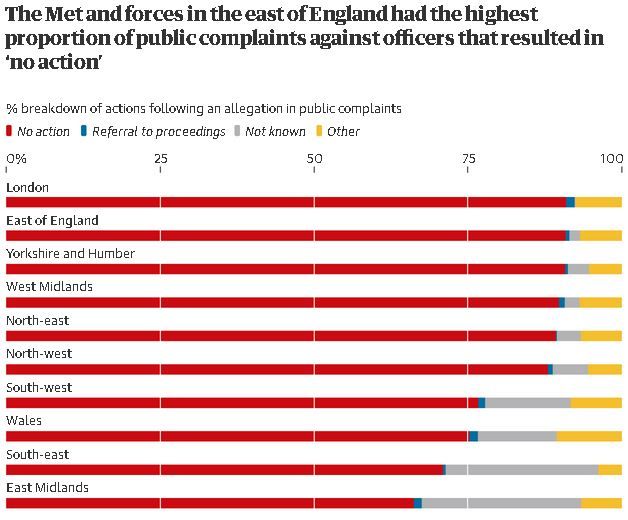
Figures for England and Wales show that in year to April 2021, 92% of complaints resulted in no action

Only one in every hundred complaints against police officers has resulted in misconduct proceedings, new figures disclose.

Data released on Wednesday by the Home Office showed that 14,393 complaints were made against officers in England and Wales in the year to 1 April 2021.

Of those, 92% faced no action and only 1% were referred to a formal process to hear cases, initiated when an officer has a case to answer for misconduct or gross misconduct.

Of those subjected to complaints, 1,675 were deemed to be “conduct matters” – where there was a claim that the officer had broken the law or should be disciplined.

Another 940 complaints accused an officer of conduct that had an adverse effect on a member of the public, including sexual offences, serious assaults or death or injury.

The figures have been released as the conduct of officers faces intense scrutiny in the wake of allegations of high-profile sex crimes by officers as well as the unauthorised strip searches of children.

Nicholas Taylor, an ex-detective at West Midlands police, was last week found guilty of gross misconduct after selling sexual services to strangers via an adult website, including threesomes at an hourly rate of £150.

The Metropolitan police officer David Carrick is due to go on trial in February charged with 44 offences against 12 women, including sexual assault, rape, and coercive and controlling behaviour.

Two teenage girls, known as Child Q and Olivia, were strip-searched by officers while they were menstruating in December 2020. Details of the cases prompted outrage and concerns that they had been treated differently because of their ethnicity. Child Q is black, and Olivia (not her real name) is of mixed ethnicity.

According to the data release, if a complaint was sent to a misconduct meeting – which hears less serious matters – the most common outcome was a written warning, with 67% of meetings involving officers resulting in this outcome.

Of the allegations against police officers that went to a misconduct hearing or accelerated hearing because of an allegation of gross misconduct, the most common outcome was dismissal, with 36% and 49% respectively resulting in this outcome.

Police officers have criticised the length of internal inquiries and the stress that they are often put under by the process.

Sgt Simon Kempton, of Dorset police, was given a final written warning for “gossiping” about the defence case submitted by the former police officer Wayne Couzens, who was subsequently found guilty of the murder of Sarah Everard.

A senior figure in the Police Federation, which represents rank and file members, Kempton shared details he was given by a journalist in an online group chat and was found guilty of misconduct in February after a yearlong inquiry.

Kempton’s misconduct hearing was told the officer started one message to his colleagues on the chat app Signal by saying, “Wait until you hear what his defence was.”

In an interview this week with Policing TV, Kempton said the “key thing” the Independent Office for Police Conduct (IOPC) should do was to focus on proportionality and timeliness of its investigations.

“It drives a wedge between the officer and the police service, so I’ve had to be very careful to make sure that wedge doesn’t force us too far apart,” he said. “It would be very easy to throw your hands up in the air and say: ‘Not for me any more.’”

A panel at the Police Federation’s annual conference last month was told that there are more than 300 cases with the IOPC that have been ongoing for more than 12 months.

Representing senior officers, Chief Constable Craig Guildford of Nottinghamshire police told the conference he was optimistic about the future of the complaints system. “We are committed to fairness and timeliness in conducting and concluding misconduct hearings. Every individual case of delay faced in misconduct hearings needs to be called out by federation representatives,” he said.


Newsletter

Related Articles

0:00
0:00
Close
England Tightens School Food Standards With Restrictions on Deep-Fried and High-Sugar Foods
Oxfordshire Village Votes Symbolically to Leave UK Over Proposed Asylum Centre
Michael Marra Elected Leader of Scottish Labour
BBC Cash Reserves Fall Sharply as Financial Pressures Mount
George Osborne Calls for UK to Rejoin EU Customs Union
UK Explores Joining Canada-Led Global Defence Bank
Thirlwall Inquiry Highlights Management Failures Surrounding Lucy Letby Crimes
Parliamentary Committee Calls for New UK Law to Address AI Risks to Human Rights
UK Considers Giving Regional Mayors Greater Oversight of Water Companies
UK Opposition Presses Burnham for Stronger Response to Russian Security Threats
Reform UK Faces Scrutiny Over £72 Million in Donations as Political Finance Rules Tighten
Millisecond Software Failure Behind UK Air-Traffic Outage That Cancelled More Than 2,000 Flights
Bank of England Holds Interest Rate at 3.75% as Energy Prices Complicate Inflation Outlook
Burnham Warns of Difficult Choices in October Budget as UK Inflation Rises to 3.1%
Addison Lee Founder Loses £20.5 Million Non-Domicile Tax Case
BrewDog Creditors Face Heavy Losses After Collapse
Thirteenth Metropolitan Police Officer Dismissed Over Charing Cross Conduct
Oxfordshire Village Votes Symbolically to Leave UK Over Asylum Accommodation Plan
NHS Approves Life-Extending Treatment for Women With Incurable Breast Cancer
Software Defect Blamed for Major UK Air Traffic Disruption
Twenty Women Underwent Unnecessary Mastectomies at County Durham NHS Trust
British Steel Costs Taxpayers £1.3 Million a Day as MPs Demand Long-Term Plan
UK Parliament Advances Sovereign Grant Reform Setting Royal Funding at £99.9 Million
King Charles Urges Human-Centred Approach to Artificial Intelligence at Scotland Summit
House of Lords Begins Scrutiny of Voting-Age and Political Finance Reforms
UK Labour Market Shows Growing Divide Between Younger and Older Workers
Nearly Seven in 10 UK Small Businesses Delay or Cancel Growth Plans as Costs Rise
Andy Burnham Reaffirms UK Net-Zero Target Amid North Sea Energy Debate
UK Parliament Demands Credible Financial and Decarbonisation Plan for British Steel
MPs Urge Government to Reject Thames Water Rescue Deal and Prepare Special Administration
Bank of England Holds Rate at 3.75% as Energy Shock Raises Inflation Risks
TUC Calls for Social Energy Tariff Funded by Higher Taxes on Bank Profits
UK Parliament Enters Conference Recess After Advancing Sovereign Grant Legislation
King Charles Hosts Artificial Intelligence Leaders at Dumfries House Summit
Nearly Seven in Ten UK Small Businesses Delay or Cancel Growth Plans as Costs Rise
Anthropic Details Malicious Use of Claude in Cyber, Weapons and Influence Operations
McLaren Announces £500 Million UK Investment and 1,000 New Jobs
Scotland and Wales Sign Cardiff Agreement to Deepen Cooperation on Shared Policy Priorities
UK Government Moves to Fully Fund Teacher Pay Award as Strike Threat Recedes
UK Competition Regulator Deepens Scrutiny of Microsoft’s Business Software and AI Market Position
NHS England Reforms Focus on Cutting Waiting Lists and Improving Digital Care
England Maintains Mandatory Housing Targets in Push for 1.5 Million New Homes
UK Government Plans Statutory Industrial Strategy Council to Strengthen Long-Term Economic Policy
Asthma Charity Warns of Major Gaps in Childhood Diagnostic Testing Across England
TUC Chief Paul Nowak Appointed to Bank of England Court
Bristol Opens £35 Million Deep-Tech Innovation Hub at Temple Quarter
Oxfordshire Village Votes Symbolically to Leave UK Over Asylum Housing Plan
Andy Burnham Deepens UK Defense and AI Cooperation With NATO and Canada
UK Government Announces Neonatal Safety Reforms After Thirlwall Inquiry
Bank of England Weighs Rate Decision as UK Inflation Rises to 3.1%
×