

'No-one joined the dots' - grandad who exposed an NHS scandal
When his phone beeped at around 4am, Derek Richford assumed it would be good news.
His son Tom and wife Sarah had gone into hospital the previous day to have their first child, so an early morning text message was not unexpected.
But it read: "Baby is struggling". Alarmed and anxious, Derek and his wife Nikki sped off towards the Queen Elizabeth the Queen Mother Hospital in Margate.
By the time they arrived, it was clear something had gone very wrong.
Over the next few years, the awful events of those night-time hours in early November 2017 would give Derek a new, unexpected purpose.
That first week was a blur, with a rollercoaster of emotions. Baby Harry had been born pale and floppy. His mother Sarah, having endured a slow, agonising labour, was eventually rushed to theatre for an emergency Caesarean section - which a locum doctor botched.
To compound the family's distress, the neonatal team then failed to properly carry out a vital resuscitation procedure on Harry, struggling for 26 minutes to insert a life support tube.
"We were instantly transported into a bubble we knew nothing of," says Derek. "We visited Harry every day - you couldn't hold him as he had tubes coming out of him and he was attached to monitors, but we put our hands on him."
Initially, no-one from the hospital would tell the grandparents what had happened and their son was focused on caring for his wife and son.
Derek says a "sixth sense" kicked in. "I just started photographing all Sarah's medical notes, as I feared they'd change them."
The records were not altered. But Derek's instinct about the honesty and openness of the hospital - and the wider trust - were to prove accurate.
The family hoped Harry would recover. But it was not to be. After a series of tests, the family were advised the best outcome for Harry was to have his life support system withdrawn.
In a room full of love and tears, Derek and his wife - alongside Tom, Sarah and her parents - watched as Harry died, on 9 November 2017.
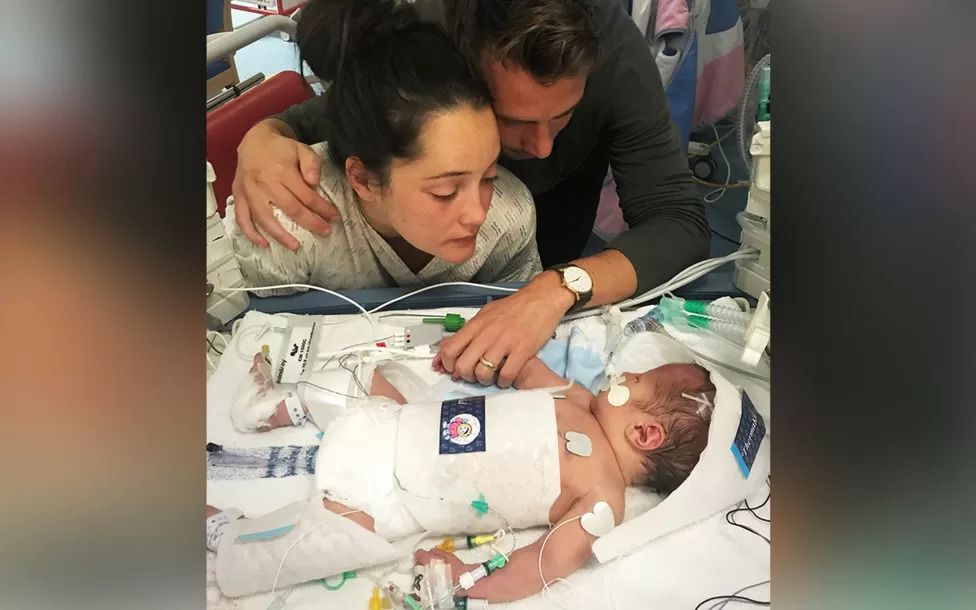 Sarah and Tom at Harry's bedside
Sixty one-year-old Derek had never campaigned for anything in his life. Alongside Nikki, the company director had raised four children - Harry was their third grandchild. His initial approach was to wait for East Kent Hospitals Trust to investigate the death, as it had promised.
One nagging issue that was to become central to Derek's view of the trust, was the hospital's continual refusal to inform the coroner of Harry's death. The family repeatedly requested it, but the trust said it was unnecessary as it knew the cause, namely the removal of the life support system.
The hospital also recorded Harry's death as "expected" - again because his life support system had been withdrawn. On both points, the family were left confused and increasingly angry.
In early March 2018, some four months after Harry's death, the family finally received the outcome of the trust's internal investigation - known as the Root Cause Analysis (RCA). With limited medical knowledge, they spent the next few days Googling all the terms they did not understand, all the job titles they had never heard of, to prepare for a meeting with the trust on 14 March.
The RCA indicated multiple errors had been made in Harry and Sarah's care and treatment, and his death was "potentially avoidable".
Prior to the meeting, Derek wrote to the Kent coroner's office outlining in general the circumstances of Harry's case, asking if that was the type they would expect to be notified of. The email response from the coroner's office was clear. It said: "Based on the facts you have presented, this death should have been reported to the coroner."
Despite this, at the meeting with the trust, the lead investigator into Harry's death told the family: "If we have a clear cause of death by and large we do not involve the coroner."
The family's insistence eventually paid off - five weeks after that meeting, the trust informed the coroner of Harry's death.
While his son and daughter-in-law started trying to recover from the trauma of losing Harry, Derek turned his attention to investigating East Kent, one of the largest hospital trusts in England.
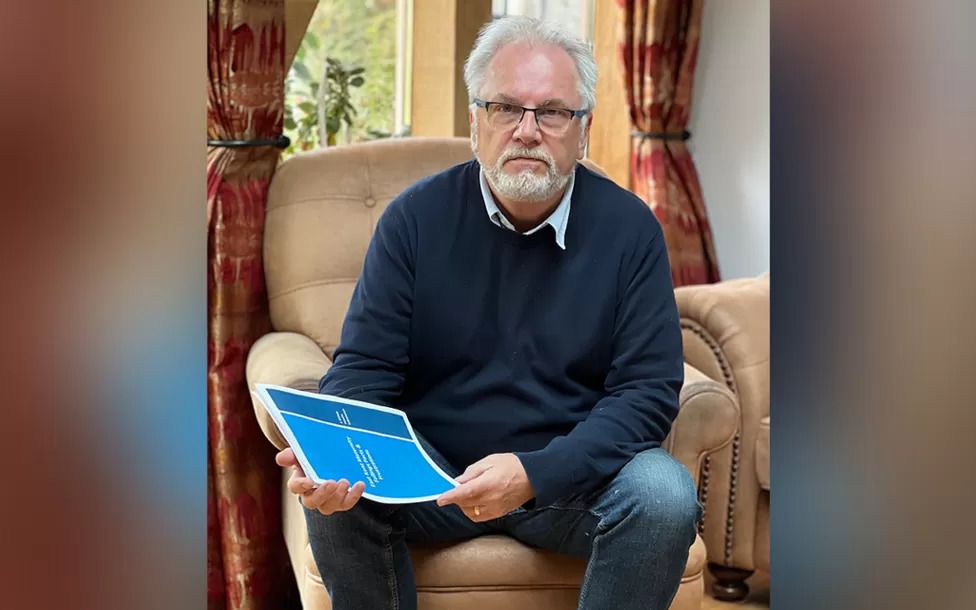 Being one step removed from the loss allowed Derek to have "the helicopter view", he says.
The "grandfather effect", as he describes it, was what made it possible to focus his fire on the NHS. Being one step removed from the loss allowed him to have "the helicopter view", he says. "You're not as close to the grief of losing your child. But by the same token, you're grieving your grandchild and also seeing the devastation which has happened to your children, which is just dreadful and ongoing."
One of the key documents Derek uncovered was a report from the Royal College of Obstetricians and Gynaecologists (RCOG), whose experts had been invited into the trust in November 2015 to assess maternity care. It was damning. Among the findings were that some consultants did not carry out ward rounds, review women, attend out-of-hours calls when requested or complete mandatory training.
Derek found that report had led to a Maternity Improvement Plan overseen by NHS England, but the trust's board papers - which he pored over for hours, weeks on end - showed the problems continued into 2016 and 2017.
In other words, managers and external regulators knew there were problems in the trust, particularly at the QEQM Hospital. He asks: "Who followed it up, at the trust, at NHS England?"
The one agency that did not know about the RCOG report was the Care Quality Commission (CQC) - which inspects health and social care providers. Derek had written to the CQC to inform it of Harry's death and the problems surrounding it.
The commission's initial response was to thank him, but to say it would be taking no further action as it appeared his grandson's death had been because of the poor skills of one doctor - the locum who carried out the C-section.
But Derek persisted and changed the CQC's view of the trust. This eventually led, in June 2021, to East Kent being fined more than £700,000 for failing to provide both Harry and Sarah with safe care and treatment.
In October 2019, three months before Harry's inquest was due to take place, Derek decided he had uncovered deep-seated problems at the trust and only publicity was likely to bring change. He saw my coverage of an inquest into the death of 14-year-old Amy Allan, which found significant failings by Great Ormond Street Hospital, and sent me an email.
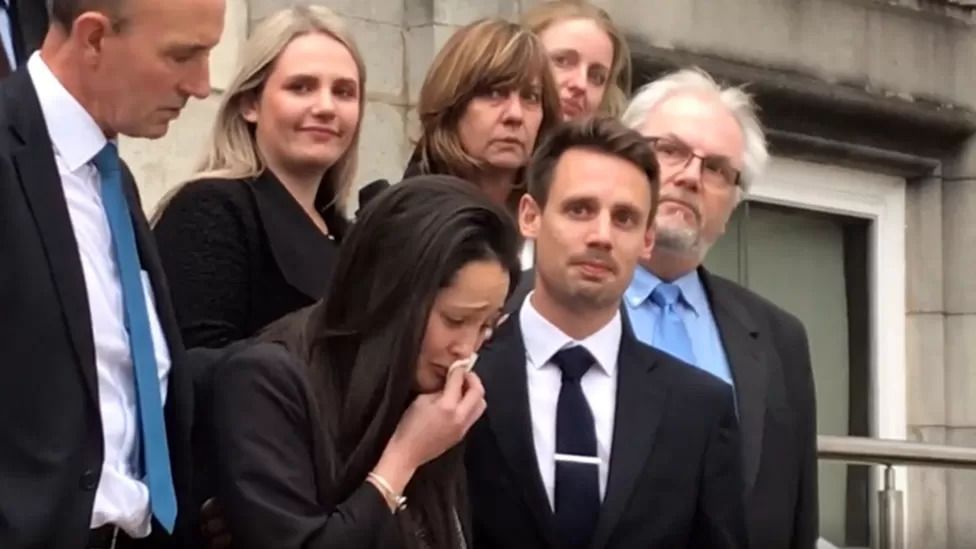 The Richford family in January 2020 - at the end of Harry's inquest which concluded his death had been"wholly avoidable"
I spent three months with a colleague looking into the East Kent trust. In January 2020 we reported there were significant problems with its maternity services, including the potentially-avoidable deaths of seven babies.
The coroner at Harry's inquest later that month concluded his death had been"wholly avoidable". The family stood outside the court in front of the cameras, tears gently rolling down cheeks, arms and hands tightly gripped around each other. They had achieved their primary aim - justice for Harry.
Within three weeks of the inquest concluding - and with more serious concerns emerging - NHS England appointed Dr Bill Kirkup to carry out an independent investigation into maternity care at East Kent.
The publicity led to other families getting in touch with us - and seeking advice from Derek - telling their own stories of poor outcomes. Because he has become viewed as the chief instigator of the inquiry, people randomly contact Derek and - without warning - launch into detailed and often horrific details of what happened in their own case.
Derek says his coping mechanism has been blogging on the web - writing in general terms about the conversations he has had with families, and offering possible useful advice.
"Writing it down, getting it out of my head and onto a page, I found really useful," he says.
"It has, at times, been quite lonely. At times you have to walk a tightrope between what is right for other families and what's right for me. More importantly however, is what is right for Tom and Sarah."
Despite those tensions, Derek says he does not have any regrets about the past few years - but says he cannot answer for Harry's parents, who might feel differently.
"When I started investigating what was going on with Harry, it was very much like peeling back an onion. 'Hang on a minute, that can't be right, that doesn't add up.' Ever since I was a small kid, justice has been so important to me.
"What I found was that, up to that point, no-one had ever joined the dots. And that's so important. I think this had to happen, someone had to do it. There will be families before us that wish they did it. We will be saving a level of families after us."
But it was not just other families who had not joined the dots - lawyers raising repeated individual clinical negligence cases against the trust, charities offering bereavement support, as well as NHS regulators, all failed to see what was happening.
For a skilled, determined, campaigner like Derek - who has spent so much time pushing forward, lobbying and cajoling - it can sometimes be difficult for him to see how far he has come and how much he has achieved.
The trust has, after all, offered a fulsome apology for its actions in relation to Harry, admitting in June 2021 it had "failed" his parents. While it acknowledged it had more to do, the trust also said at the time that it had more doctors and better training. And it has of course had to expose itself to a team of experts crawling over its maternity services.
In his garden in rural Kent, I ask Derek if he has had time to reflect on his achievements. He looks away and, for the first time, struggles to answer. His voice breaks, he sniffles slightly. "I would like to think that we as a family have done Harry proud," he says eventually. "And that I've done Tom and Sarah proud."

