

NI Election 2022: Prime minister to visit NI as DUP blocks assembly
It comes as the DUP blocked the election of a Speaker to a new assembly on Friday, meaning it cannot function.
The DUP said its actions sent a "clear message" about its opposition to the NI Protocol.
Sir Jeffrey Donaldson said the PM must "outline what he intends to do".
Mr Johnson's visit coincides with increased speculation that the government is poised to introduce legislation to strip away parts of the Northern Ireland Protocol.
The Democratic Unionist Party's move to block the election of a Speaker follows the assembly election on 5 May.
The Northern Ireland Protocol, a part of the UK-EU Brexit deal which keeps Northern Ireland aligned with the EU single market for goods, places a trade border in the Irish Sea between Great Britain and Northern Ireland.
The protocol - now under fresh scrutiny following the election - was designed to ensure free trade could continue across the Irish land border, but it has been opposed by unionist politicians.
Last week's vote cemented a majority for assembly members who accept the protocol, including the new largest party, the republican party Sinn Féin.
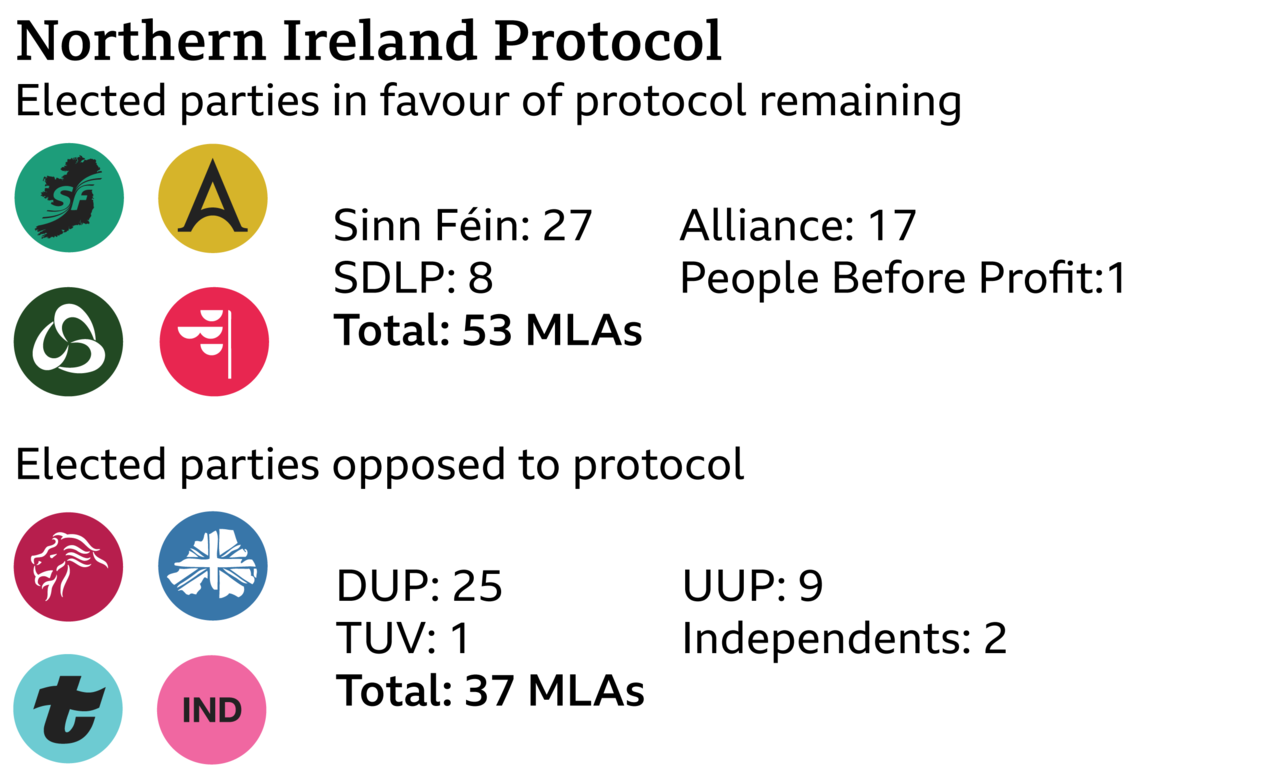 Most politicians elected to the Northern Ireland Assembly want the protocol to remain
Its vice-president, Michelle O'Neill, who is entitled to be Northern Ireland's next first minister, said the DUP had failed on day one of the new assembly.
"There is no reason why we should be in a rolling crisis for even one second," Ms O'Neill told the chamber.
Speaking to press in the Great Hall following the sitting, Ms O'Neill claimed that the DUP had "punished the public" for its own selfish interest.
"That isn't tolerable, it isn't acceptable , it isn't good enough", she added.
The UK government has said it wants to override parts of the treaty it signed in 2020, but Sir Jeffrey said it would "not be words that determine how we [the DUP] proceed, it will be actions".
'Rolling crisis'
The DUP, now the second-largest party by seats, said it would not nominate ministers to Stormont's governing executive until its concerns about the protocol were resolved.
Its decision to also not elect a Speaker - a move which requires cross community support - means that there can be no debates in the assembly, no committees can be held, and the actions of ministers, currently acting in a caretaker capacity, cannot be scrutinised.
The Northern Ireland Executive cannot meet without a first and deputy first minister as the roles are joint and one cannot exist without the other.
The executive collapsed in February when the DUP First Minister Paul Givan resigned in protest over the protocol, meaning the deputy first minister had to leave their post as well.
Other ministers who were in office at that time can continue in a caretaker fashion but their powers are limited.
Mr Givan told MLAs on Friday that his party was respecting its mandate to "remove the Irish Sea border".
"Our message is now clear - it is time for action, words will no longer suffice," he said.
Mr Givan added that his party had been patient and reasonable in its demands for progress in the UK-EU talks on the protocol.
Earlier, Sir Jeffrey said his party needed to "send a very clear message to the European Union and to our government that we are serious about getting this protocol sorted out".
"Because of the harm it is doing, undermining political stability, damaging agreements, harming our economy, contributing to the cost of living crisis, this matter needs to be dealt with," he added.
Sir Jeffrey has argued the protocol has eroded the foundations "devolution has been built upon" and undermined Northern Ireland's position in the UK.
DUP move things up a gear

Without a Speaker we have a "silent assembly".
It was one of the few moves left open to the DUP to try and apply pressure.
In other words, the party is saying to London and Brussels you can have the protocol or Stormont - but you can't have both.
This is a big gamble for the DUP in the hope there will be movement on the protocol to allow the party to return to Stormont.
What if there is no change? How long will the party stay away from the assembly and the executive? How will the public react?
What of the fact that a majority of MLAs support the protocol and does this look like the DUP are holding people to ransom?
This is the DUP moving things up a gear.
NI Secretary Brandon Lewis said he was disappointed by the DUP's move, tweeting that Northern Ireland deserved a stable and accountable devolved government.
Ms O'Neill said that when she meets Mr Johnson on Monday, she will tell him "that he needs to stop pandering to the DUP, that they need to get on and work with the [European] Commission and find ways to smooth the implementation of the protocol and stop holding us to ransom for their game playing".
Taoiseach (Irish prime minister) Micheál Martin said the EU had been flexible in its approach to the negotiations with the UK government, but this had not been reciprocated.
"There are issues that unionism have raised with us in respect of the protocol, but those issues should not prevent the establishment of the assembly," he added.
What have the other NI political parties said?
Alliance Party leader Naomi Long said parties who believe in devolution "do not gamble with it".
"Many of us in this chamber represent people who did not consent to Brexit in the first place and yet we turned up for work," she said.
Mrs Long later said it was a "shameful day" for the DUP.
"The DUP came to Stormont, signed the register, took their salaries but refused to take their seats and do the work to earn it," she said.
Ulster Unionist Party (UUP) leader Doug Beattie said without a functioning assembly there would be "silence" as people deal with the cost of living crisis and die on hospital waiting lists.
"People will be desperately calling for an ambulance and from this place there will be silence," he said.
Matthew O'Toole, of the Social Democratic and Labour Party (SDLP), accused the DUP of having "thwarted and demeaned" democracy.
However, Jim Allister, the Traditional Unionist Voice (TUV) leader, said the protocol was causing "pain" and it was not the right time to appoint a Speaker.
Meanwhile, Sinn Féin's John O'Dowd will become the new infrastructure minister. He will replace Nichola Mallon of the SDLP after she failed to gain re-election to the assembly last week.