London Daily

Focus on the big picture.
Saturday, Jan 17, 2026

New Covid variant: How worried should we be?

New Covid variant: How worried should we be?

We're back in familiar territory - growing concern about a new variant of coronavirus.

The latest is the most heavily mutated version discovered so far - and it has such a long list of mutations that it was described by one scientist as "horrific", while another told me it was the worst variant they'd seen.

It is early days and the confirmed cases are still mostly concentrated in one province in South Africa, but there are hints it may have spread further.

Immediately there are questions around how quickly the new variant spreads, its ability to bypass some of the protection given by vaccines and what should be done about it.

There is a lot of speculation, but there are very few clear answers.

So, what do we know?


The variant has been named Omicron by the World Health Organization, following the pattern of Greek code-names like the Alpha and Delta variants.

It is also incredibly heavily mutated. Prof Tulio de Oliveira, the director of the Centre for Epidemic Response and Innovation in South Africa, said there was an "unusual constellation of mutations" and that it was "very different" to other variants that have circulated.

"This variant did surprise us, it has a big jump on evolution [and] many more mutations that we expected," he said.

In a media briefing Prof de Oliveira said there were 50 mutations overall and more than 30 on the spike protein, which is the target of most vaccines and the key the virus uses to unlock the doorway into our body's cells.

Zooming in even further to the receptor binding domain (that's the part of the virus that makes first contact with our body's cells), it has 10 mutations compared to just two for the Delta variant that swept the world.

This level of mutation has most likely come from a single patient who was unable to beat the virus.

A lot of mutation doesn't automatically mean: bad. It is important to know what those mutations are actually doing.
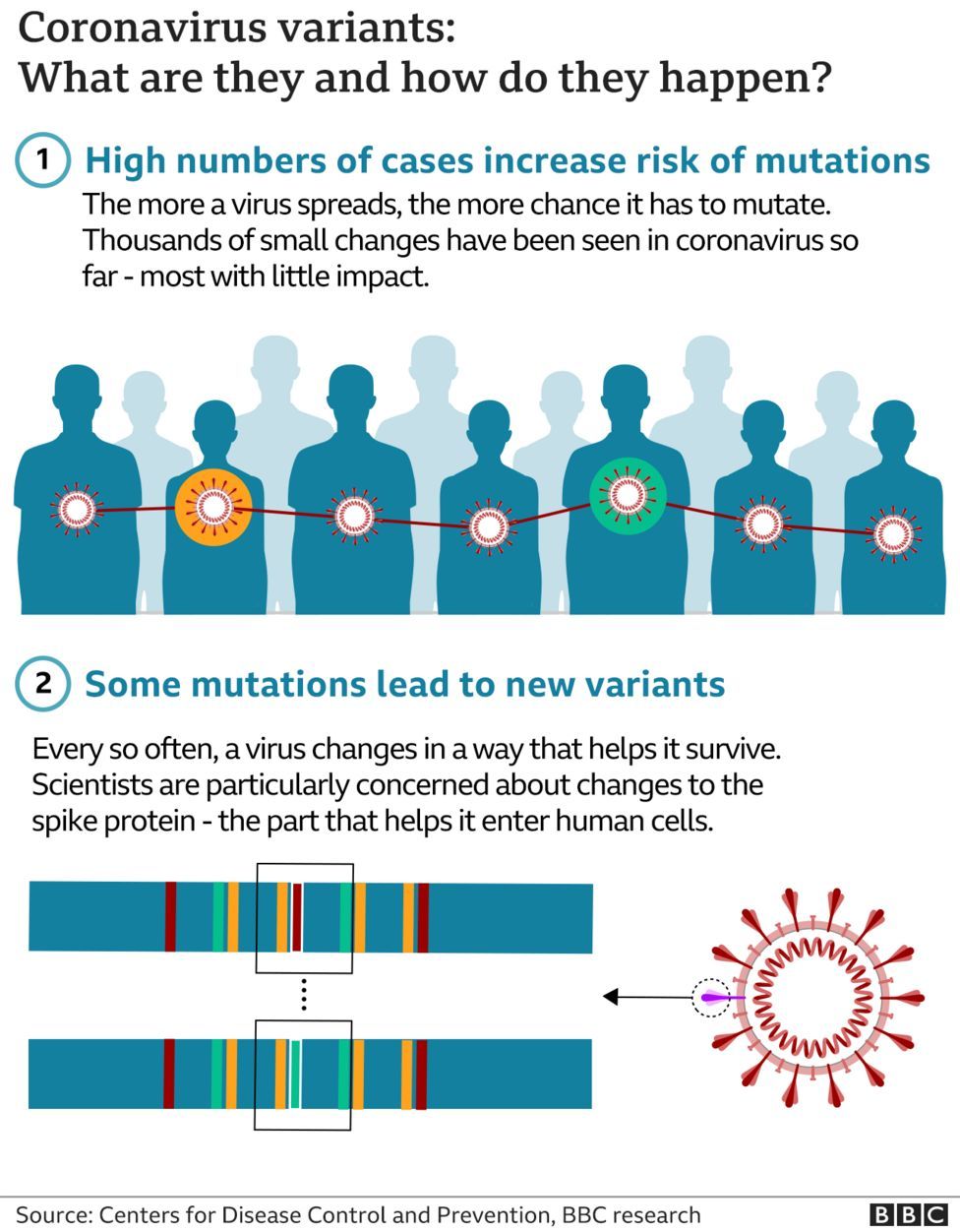

But the concern is this virus is now radically different to the original that emerged in Wuhan, China. That means vaccines, which were designed using the original strain, may not be as effective.

Some of the mutations have been seen before in other variants, which gives some insight into their likely role in this variant.

For example N501Y seems to make it easier for a coronavirus to spread. There are some in there that make it harder for antibodies to recognise the virus and might make vaccines less effective, but there are others that are completely new.

Prof Richard Lessells, from the University of KwaZulu-Natal in South Africa, said: "They give us concern this virus might have enhanced transmissibility, enhanced ability to spread from person to person, but might also be able to get around parts of the immune system."

There have been many examples of variants that have seemed scary on paper, but came to nothing. The Beta variant was at the top of people's concerns at the beginning of the year because it was the best at escaping the immune system. But in the end it was the faster-spreading Delta that took over the world.

Prof Ravi Gupta, from the University of Cambridge, said: "Beta was all immune escape and nothing else, Delta had infectivity and modest immune escape, this potentially has both to high degrees."

Scientific studies in the laboratory will give a clearer picture, but answers will come more quickly from monitoring the virus in the real world.

It is still early to draw clear conclusions, but there are already signs that are causing worry.

There have been 77 fully confirmed cases in Gauteng province in South Africa, four cases in Botswana and one in Hong Kong (which is directly linked to travel from South Africa). Israel and Belgium have also reported cases.

However, there are clues the variant has spread even more widely.

This variant seems to give quirky results (known as an S-gene dropout) in the standard tests and that can be used to track the variant without doing a full genetic analysis.

That suggests 90% of cases in Gauteng may already be this variant and it "may already be present in most provinces" in South Africa.

But this does not tell us whether it spreads faster than Delta, is any more severe or to what extent it can evade the immune protection that comes from vaccination.

It also does not tell us how well the variant will spread in countries with much higher vaccination rates than the 24% of South Africa that is fully vaccinated, although large numbers of people in the country have had Covid.

So for now we are left with a variant that raises significant concerns despite huge holes in our knowledge, and is one that needs to be watched closely and asks deep questions about what to do and when. The lesson of the pandemic is you can't always wait until you have all the answers.


Why do new variants of Covid-19 keep appearing?


Newsletter

Related Articles

0:00
0:00
Close
Prince Harry Returns to UK High Court as Final Privacy Trial Against Daily Mail Publisher Begins
Britain Confronts a Billion-Pound Wind Energy Paradox Amid Grid Constraints
The graduate 'jobpocalypse': Entry-level jobs are not shrinking. They are disappearing.
Cybercrime, Inc.: When Crime Becomes an Economy. How the World Accidentally Built a Twenty-Trillion-Dollar Criminal Economy
The Return of the Hands: Why the AI Age Is Rewriting the Meaning of “Real Work”
UK PM Kier Scammer Ridicules Tories With "Kamasutra"
Strategic Restraint, Credible Force, and the Discipline of Power
United Kingdom and Norway Endorse NATO’s ‘Arctic Sentry’ Mission Including Greenland
Woman Claiming to Be Freddie Mercury’s Secret Daughter Dies at Forty-Eight After Rare Cancer Battle
UK Launches First-Ever ‘Town of Culture’ Competition to Celebrate Local Stories and Boost Communities
Planned Sale of Shell and Exxon’s UK Gas Assets to Viaro Energy Collapses Amid Regulatory and Market Hurdles
UK Intensifies Arctic Security Engagement as Trump’s Greenland Rhetoric Fuels Allied Concern
Meghan Markle Could Return to the UK for the First Time in Nearly Four Years If Security Is Secured
Meghan Markle Likely to Return to UK Only if Harry Secures Official Security Cover
UAE Restricts Funding for Emiratis to Study in UK Amid Fears Over Muslim Brotherhood Influence
EU Seeks ‘Farage Clause’ in Brexit Reset Talks to Safeguard Long-Term Agreement Stability
Starmer’s Push to Rally Support for Action Against Elon Musk’s X Faces Setback as Canada Shuns Ban
UK Free School Meals Expansion Faces Political and Budgetary Delays
EU Seeks ‘Farage Clause’ in Brexit Reset Talks With Britain
Germany Hit by Major Airport Strikes Disrupting European Travel
Prince Harry Seeks King Charles’ Support to Open Invictus Games on UK Return
Washington Holds Back as Britain and France Signal Willingness to Deploy Troops in Postwar Ukraine
Elon Musk Accuses UK Government of Suppressing Free Speech as X Faces Potential Ban Over AI-Generated Content
Russia Deploys Hypersonic Missile in Strike on Ukraine
OpenAI and SoftBank Commit One Billion Dollars to Energy and Data Centre Supplier
UK Prime Minister Starmer Reaffirms Support for Danish Sovereignty Over Greenland Amid U.S. Pressure
UK Support Bolsters U.S. Seizure of Russian-Flagged Tanker Marinera in Atlantic Strike on Sanctions Evasion
The Claim That Maduro’s Capture and Trial Violate International Law Is Either Legally Illiterate—or Deliberately Deceptive
UK Data Watchdog Probes Elon Musk’s X Over AI-Generated Grok Images Amid Surge in Non-Consensual Outputs
Prince Harry to Return to UK for Court Hearing Without Plans to Meet King Charles III
UK Confirms Support for US Seizure of Russian-Flagged Oil Tanker in North Atlantic
Béla Tarr, Visionary Hungarian Filmmaker, Dies at Seventy After Long Illness
UK and France Pledge Military Hubs Across Ukraine in Post-Ceasefire Security Plan
Prince Harry Poised to Regain UK Security Cover, Clearing Way for Family Visits
UK Junk Food Advertising Ban Faces Major Loophole Allowing Brand-Only Promotions
Maduro’s Arrest Without The Hague Tests International Law—and Trump’s Willingness to Break It
German Intelligence Secretly Intercepted Obama’s Air Force One Communications
The U.S. State Department’s account in Persian: “President Trump is a man of action. If you didn’t know it until now, now you do—do not play games with President Trump.”
Fake Mainstream Media Double Standard: Elon Musk Versus Mamdani
HSBC Leads 2026 Mortgage Rate Cuts as UK Lending Costs Ease
US Joint Chiefs Chairman Outlines How Operation Absolute Resolve Was Carried Out in Venezuela
Starmer Welcomes End of Maduro Era While Stressing International Law and UK Non-Involvement
Korean Beauty Turns Viral Skincare Into a Global Export Engine
UK Confirms Non-Involvement in U.S. Military Action Against Venezuela
UK Terror Watchdog Calls for Australian-Style Social Media Ban to Protect Teenagers
Iranian Protests Intensify as Another Revolutionary Guard Member Is Killed and Khamenei Blames the West
Delta Force Identified as Unit Behind U.S. Operation That Captured Venezuela’s President
Europe’s Luxury Sanctions Punish Russian Consumers While a Sanctions-Circumvention Industry Thrives
Berkshire’s Buffett-to-Abel Transition Tests Whether a One-Man Trust Model Can Survive as a System
Fraud in European Central Bank: Lagarde’s Hidden Pay Premium Exposes a Transparency Crisis at the European Central Bank
×