

NATO’s new secretary-general, same as the old one?
With war raging in Europe, the race to find NATO’s next chief is on.
Jens Stoltenberg was a steady hand as Western capitals rushed to help Ukraine push back invading Russian troops. But as his term expires in September, speculation is growing over who might succeed him.
Could it be a woman? Someone from Eastern Europe?
Moscow’s war greatly complicates the decision, which requires consensus among the leaders of NATO’s 30 member countries.
The next secretary-general must play a tough balancing act in encouraging capitals to continue supplying weapons to Ukraine and building up NATO’s own defenses — all while formally staying out of the conflict. Few pass muster for this highly sensitive role.
The “overall feeling,” said one senior NATO diplomat, is that it is “time for fresh air.”
But the allies may end up playing it safe after all, and sticking with Stoltenberg.
The Stoltenberg card
A senior European diplomat summed up the buzz around names in three tiers, ranked by intensity of chatter.
An extension of Stoltenberg’s term is the most-mentioned option.
A second tier includes Dutch Prime Minister Mark Rutte, Estonian Prime Minister Kaja Kallas and British Defense Secretary Ben Wallace.
A third group of less frequently mentioned names, the diplomat said, consists of Lithuanian Prime Minister Ingrida Šimonytė, Slovakia’s President Zuzana Čaputová and European Commission President Ursula von der Leyen of Germany.
 Jens Stoltenberg was a steady hand as Western capitals rushed to help
Ukraine push back invading Russian troops. But as his term expires in
September, speculation is growing over who might succeed him
Jens Stoltenberg was a steady hand as Western capitals rushed to help
Ukraine push back invading Russian troops. But as his term expires in
September, speculation is growing over who might succeed him
Since all of NATO’s secretaries-general have thus far been male, there is pressure within the ranks to appoint a woman.
“Time for a female Sec Gen,” said the senior NATO diplomat. “If men try to hold their positions forever, fair representation of women will never have a chance.”
And some allies have pushed for more regional diversity. Stoltenberg, who has held the job since 2014, is a former Norwegian prime minister. His most recent predecessors were Danish, Dutch and British.
The current secretary-general’s term was quickly extended last March after Russia’s invasion of Ukraine. Many officials now believe that another extension for Stoltenberg, even if short, is a serious possibility.
The longtime leader is seen as a safe pair of hands. Despite some delegations preferring to see a fresh face soon, Stoltenberg is still perceived as a rare senior official who can keep his cool — and stick to the script — in even the gravest of crises.
“Stoltenberg wants to stay,” said the senior NATO diplomat.
But giving Stoltenberg a short extension could make a future replacement decision collide with the EU’s own top jobs competition in 2024, not to mention the upcoming U.S. presidential election — an outcome some allies would prefer to avoid.
A NATO spokesperson declined to elaborate on Stoltenberg’s future aspirations. Asked in December about the issue, the current secretary-general told the BBC: “My focus now is on my responsibilities.”
“I don’t speculate,” he added, “about what will happen after my tenure.”
The eastern front
Some see candidates from Eastern Europe as particularly suitable.
Already before Russia’s invasion of Ukraine, there was momentum for the alliance to select a secretary-general from the east. Some officials in the region argue that the war has since strengthened the case for someone from a country like Estonia or Lithuania.
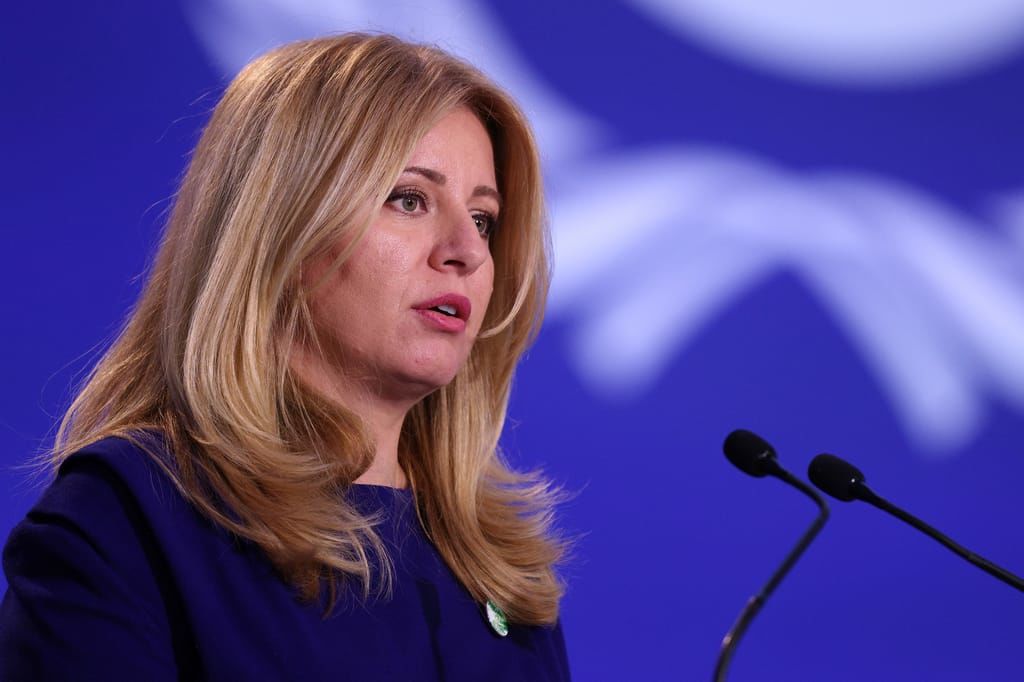 Slovakia’s Zuzana Čaputová ticks both boxes as a female eastern
candidate, though her name is mentioned less often in alliance circles
Slovakia’s Zuzana Čaputová ticks both boxes as a female eastern
candidate, though her name is mentioned less often in alliance circles
“For years, the countries of the eastern flank have been warning about Russia’s threat,” said an official from the Baltics.
The region’s countries, the Baltic official said, were front-runners in boosting military spending and pushing the alliance to improve its defenses.
“It would be very logical and sobering,” the official continued, “to have someone who is experienced in dealing with Russia and who understands Russia’s logic and mentality, to lead the North Atlantic Alliance.”
Slovakia’s Čaputová ticks both boxes as a female eastern candidate, though her name is mentioned less often in alliance circles.
A spokesperson for Čaputová said she was focused on her current job, but said the possibility of a Slovak being floated for the NATO post was “a strong reflection of our foreign and security decisions.”
Another figure possibly in the running is Klaus Iohannis, Romania’s president. But he could face obstacles from neighboring Hungary, and opposition from those who would prefer a female candidate.
Some western capitals, however, would not support such candidates at the moment, seeing the alliance’s east — and the Baltic states in particular — as too hawkish when war is raging next door.
Estonia’s Kallas herself has played down expectations, telling local media in November that “the likelihood of an offer like this being made” is “extremely low.”
The Western option
Western NATO countries are for some allies a reliable fallback source for possible leadership.
Wallace, Britain’s defense secretary, is well respected and has previously said that NATO would be a “nice job.” However, numerous European capitals — in particular Paris — are expected to object to a London name and insist on an EU candidate.
One possible compromise being floated in Brussels is yet another secretary-general from the Netherlands. Dutch politicians have traditionally been a popular choice for the role, previously holding the post for three terms covering 21 years in the past six decades.
The Dutch are seen as serious on defense but not as hawkish as the Baltics — and the names of current Prime Minister Rutte, Deputy Prime Minister and Finance Minister Sigrid Kaag and Defense Minister Kajsa Ollongren are all circulating as possible candidates.
Asked about the speculation, Rutte said he wanted to “leave politics altogether and do something completely different.” The two Dutch ministers did not express interest in the job.
Commission President von der Leyen, a former German defense minister, is a female candidate who could gain support from western capitals nervous about the prospect of a leader from the eastern flank, but it’s unclear whether she is interested in the role. “We never comment on such speculations,” said a Commission spokesperson.
Although her reputation in security circles is mixed, von der Leyen is seen as a strong possible candidate regardless — if the timing aligns and she does not get a second term as European Commission president.
Other female politicians floated include Canada’s widely respected Deputy Prime Minister Chrystia Freeland and Foreign Minister Mélanie Joly. Nevertheless, officials say, as the alliance focuses on boosting its defenses, Ottawa’s low defense spending and non-European status mean that a Canadian is unlikely to get the job.
Amid all the speculation, some within the alliance dismiss the breathless names game.
“This is more a basket of names that came to anybody’s mind,” said a second senior European diplomat, adding: “My guess: Stoltenberg.”