

Nato reinforces eastern borders as Ukraine tensions mount
The US has placed 8,500 troops on heightened alert to deploy to Europe as Nato reinforced its eastern borders with warships and fighter jets, amid growing fears of a possible “lightning” attack by Russia to seize the Ukrainian capital, Kyiv.
Pentagon spokesman John Kirby said the troops, all of them currently stationed in the US, would be on standby to take part in Nato’s Response Force (NRF) if it is activated, but would also be available “if other situations develop”.
The alert order issued by the defence secretary, Lloyd Austin, reduces the number of days it would take to deploy but it is not itself an order to deploy.
The USS Harry S Truman aircraft carrier, along with its strike group and air wing, joined patrolling activities across the Mediterranean Sea on Monday, the first time since the cold war that a full US carrier group has come under Nato command.
Kirby said: “In the event of Nato’s activation of the NRF or a deteriorating security environment, the United States would be in a position to rapidly deploy additional brigade combat teams, logistics, medical, aviation, intelligence, surveillance and reconnaissance, transportation and additional capabilities into Europe.”
Any deployment in Europe, he said, “is really about reassuring the eastern flank of Nato” of the US readiness to come to the defence of alliance members. The force would not be deployed in Ukraine, which is not a Nato member. There are currently about 150 US military advisers in the country, and Kirby said there were no plans at present to withdraw them.
Jen Psaki, the White House spokesperson, said the US had “a sacred obligation to support the security of our eastern flank countries”.
“We are talking to them about what their needs are and what security concerns they have. So I wouldn’t say it’s a response to an abrupt moment. It’s a part of an ongoing contingency planning process and discussion,” Psaki said.
Earlier on Monday, Jens Stoltenberg, Nato’s secretary general, said the “deteriorating security situation” had driven the military alliance to bolster its “collective defence”.
Denmark is sending a frigate to the Baltic Sea and four F-16 fighter jets to Lithuania. Spain has offered to send a frigate to the Black Sea and Eurofighter planes to Bulgaria. The Netherlands will also send two F-35 warplanes to Bulgaria. Emmanuel Macron has expressed his government’s readiness to send French troops to Romania under Nato command.
“Nato will continue to take all necessary measures to protect and defend all allies, including by reinforcing the eastern part of the alliance. We will always respond to any deterioration of our security environment, including through strengthening our collective defence,” Stoltenberg said.
After meetings with the UK foreign secretary, Liz Truss, and her counterparts from Finland and Sweden, Stoltenberg said Nato was also considering “deployment of additional Nato battlegroups” to supplement the four that were deployed to Estonia, Latvia, Lithuania and Poland after Russia’s annexation of Crimea in 2014.
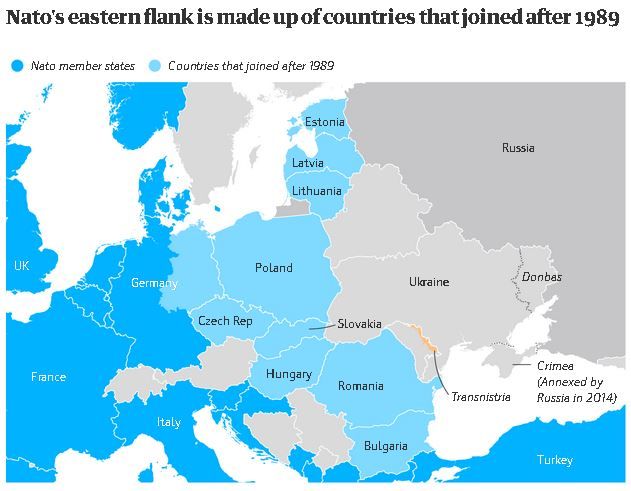
The Kremlin pointed to the new deployments as evidence of Nato aggressive posturing, blaming Nato for the rise in tensions. Its spokesperson Dmitry Peskov said: “We see statements by the North Atlantic Alliance about reinforcement, pulling forces and resources to the eastern flank. All this leads to the fact that tensions are growing. This is not happening because of what we, Russia, are doing. This is all happening because of what Nato and the US are doing and due to the information they are spreading.”
In recent months Russia has massed more than 106,000 troops along Ukraine’s border and it is planning extensive military exercises in neighbouring Belarus and in the Mediterranean.
The Belarusian leader, Alexander Lukashenko, said on Monday he would deploy a “whole contingent of the army” to the border with Ukraine, alleging: “Ukrainians have begun to gather troops [there]. I don’t understand why.”
Russia continued preparations for sweeping naval exercises on Monday as the Baltic fleet announced that two corvettes had set sail to join in the military drills. The Kremlin has also dispatched six amphibious landing ships to the Mediterranean as part of the exercises, which will include 140 ships and more than 10,000 Russian troops.
Joe Biden held a video conference on Monday afternoon with the leaders of Germany, France, the UK, Italy, Poland, the EU and Nato, in a continuing effort to maintain transatlantic unity in the face of the growing threat to Ukraine.
“I had a very, very, very good meeting,” Biden said afterwards, claiming there was “total unanimity with all the European leaders”. The White House, Downing Street and the Élysée Palace gave similar accounts of the discussion, saying the leaders were agreed on the primacy of diplomacy and the intensity of punitive measures if Russia invades.
Boris Johnson “outlined the steps the UK has taken to increase Ukraine’s defensive capacity” Downing Street said, adding that the prime minister “emphasised the need to support Ukraine’s defences against the full spectrum of malign Russian activity”.
The virtual summit came days after the US president conceded there were significant differences between the allies on how to respond.
“There are a number of issues that are worrying some Nato countries, one of which is definitely the way that Germany is dealing with with the current situation,” a European diplomat said before the virtual meeting.
Germany is reportedly blocking Estonia’s export of German-made military equipment to Ukraine in line with Berlin’s policy of not supplying arms to countries in conflict. The UK sent a flight carrying arms supplies to Kyiv but avoided German airspace. A European diplomat said that Germany had made it known that overflight rights would not necessarily be granted if requested.
Some French officials have told reporters in recent days that the US and UK were being alarmist. A senior presidential adviser played down talk of rifts on Monday but also appeared more optimistic than Washington or London about a peaceful resolution. “There are indications that the Russians are prepared to de-escalate but no certainties,” the French official said.
He pointed to a political advisers meeting in Paris this week of the Normandy format group, comprising Russia, France, Germany and Ukraine, at which the Russian delegation will be led by Dmitry Kozak, Kremlin deputy chief of staff and a close aid to Vladimir Putin.
Johnson, warning of a “painful, violent and bloody business” should Ukraine be invaded, said he had seen clear intelligence of 60 Russian battlegroups on the border, pointing to a potential “plan for a lightning war that could take out Kyiv”.
The White House and Downing Street said they had started withdrawing diplomats’ families from Ukraine, and EU foreign ministers gathered in Brussels to discuss the crisis with the US secretary of state, Antony Blinken.
The Ukrainian government has criticised the withdrawals as “premature”. Ukrainian security experts said that Russia has not yet made the preparations necessary for a large-scale invasion, such as the deployment of combat units and establishment of medical facilities.
Oleksiy Danilov, the secretary of the national security and defence council, said he did not expect an imminent invasion and did not share the “panic” which he connected to “geopolitical and domestic” processes in the west.
“The buildup of Russian troops isn’t as rapid as some claim,” Danilov told the BBC’s Ukrainian service.