

Liz Truss resigns: Race kicks off to find her successor within a week
Hopefuls need the backing of 100 MPs by Monday, with her successor likely to be announced by Friday at the latest.
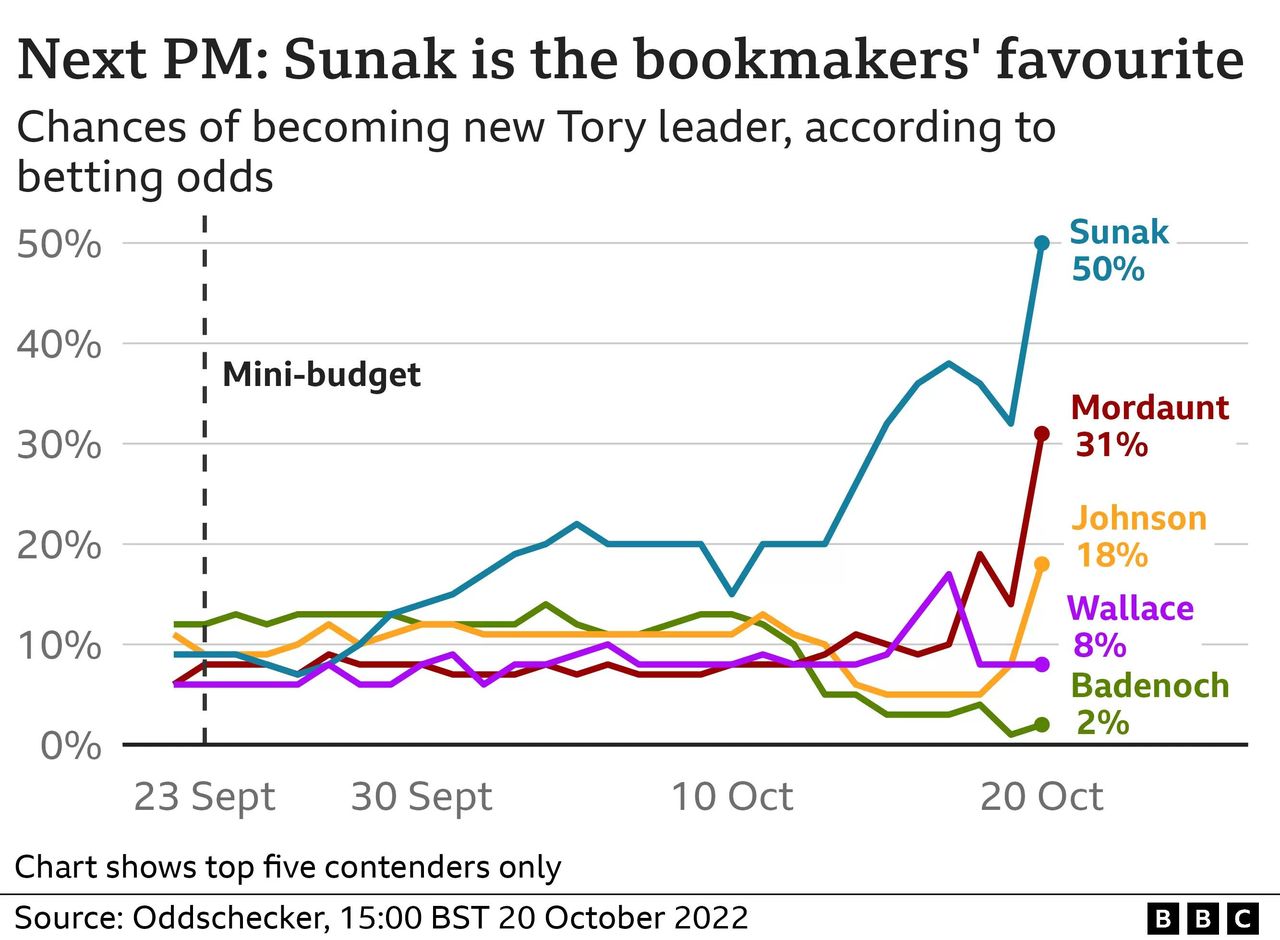
New Chancellor Jeremy Hunt has ruled himself out but Rishi Sunak and Penny Mordaunt are seen as contenders.
Sources close to Boris Johnson neither confirm nor deny he will stand again.
A handful of the former prime minister's biggest political supporters are pressing him to make a comeback.
Business Secretary Jacob Rees-Mogg has been encouraging MP colleagues to nominate Mr Johnson, Conservative sources have told BBC News.
The Daily Telegraph quoted an ally of Mr Johnson as saying he could offer an "olive branch" to Mr Sunak, his former chancellor whose resignation contributed to his downfall.
But others are unconvinced. Tory MP John Baron said it would be impossible to serve in a new Johnson government and suggested he would become independent instead.
Mr Johnson, who is on holiday in the Caribbean, was forced to resign as Conservative leader in July following a string of scandals.
BBC political correspondent Ione Wells says some senior Conservatives have said they would consider standing down and triggering a by-election if Mr Johnson was re-elected.
However, she says Cabinet Office Minister Brendan Clarke Smith insists that the former prime minister was a proven winner who could restore his party's fortunes.
Mr Smith said: "We're looking at someone with a mandate with the general electorate, the membership, he's a winner. He delivered an historic 80-seat majority. We need somebody who can unite the party, get us back in the polls and who can be a winner and Boris Johnson ticks all of those boxes."
Other names being touted as contenders, although not confirmed, include Defence Secretary Ben Wallace, International Trade Secretary Kemi Badenoch, Foreign Secretary James Cleverly, Justice Secretary Brandon Lewis and Suella Braverman, who resigned as home secretary on Wednesday.
Michael Gove and Tom Tugendhat, who stood in the last contest held over the summer, have said they will sit this one out.
At 13:35 BST on Thursday, after days of turmoil, chaos and rebellion, Liz Truss delivered a brief resignation statement under grey skies outside No 10, a lone figure with just her husband, Hugh O'Leary, standing to one side.
She told the mass of waiting camera crews and reporters she could not deliver the mandate on which she had been elected, and would resign.
In so doing, she will become the shortest-serving British prime minister in history.
Opposition parties immediately insisted it was time for a general election to decide who should be the next prime minister.
Labour leader Sir Keir Starmer said his party was on an election footing, with a manifesto at the ready.
Liberal Democrat leader Sir Ed Davey, Scotland's First Minister Nicola Sturgeon and Wales's First Minister Mark Drakeford all demanded the electorate decide.
The next general election is not due to take place until at least 2024 and, at this stage, it looks unlikely that date will be brought forward.
Ms Truss, 47, has said she will stay on until her successor is chosen. They will inherit a fractious party 12 years into office, with turmoil at home and abroad.
Ms Truss's resignation comes after several weeks of political and economic turbulence - and one day after she told MPs she was "a fighter, not a quitter".
Her now-abandoned September mini-budget started the turmoil, sending financial markets into a tailspin. In response, she sacked her chancellor, Kwasi Kwarteng, and appointed Jeremy Hunt to the post hours later to try to calm the markets.
On Wednesday, her home secretary, Suella Braverman, resigned and a chaotic night with accusations of bullying during a vote in the House of Commons followed, sealing her fate.
Through Thursday morning, the number of MPs publicly calling for the prime minister to go doubled and Sir Graham Brady, chairman of the influential 1922 Committee - a group of backbench MPs - was summoned to No 10 to give her an update.
Within the hour Ms Truss was joined by her deputy, Therese Coffey, and party chairman Jake Berry as pressure on her to quit became insurmountable.
Graham Stuart, a government minister, said he had no idea the PM's resignation was coming, despite being in her cabinet.
He later told BBC One's Question Time he sat in silence with colleagues in the House of Commons tea room, watching her statement on TV.
"I feel disappointed, shocked, I backed Liz Truss," he said, and apologised to the country for the "instability" caused.
On BBC Newsnight, long-time Conservative MP Sir Christopher Chope defended Ms Truss, calling those who ousted her "hyenas who are out for blood and revenge".
He said: "The way in which she has been treated is a disgrace. I am ashamed of my party for having behaved in that way."
It now falls to Sir Graham Brady of the 1922 Committee to organise the accelerated contest to find Ms Truss's successor who, he says, could be chosen by next Friday.
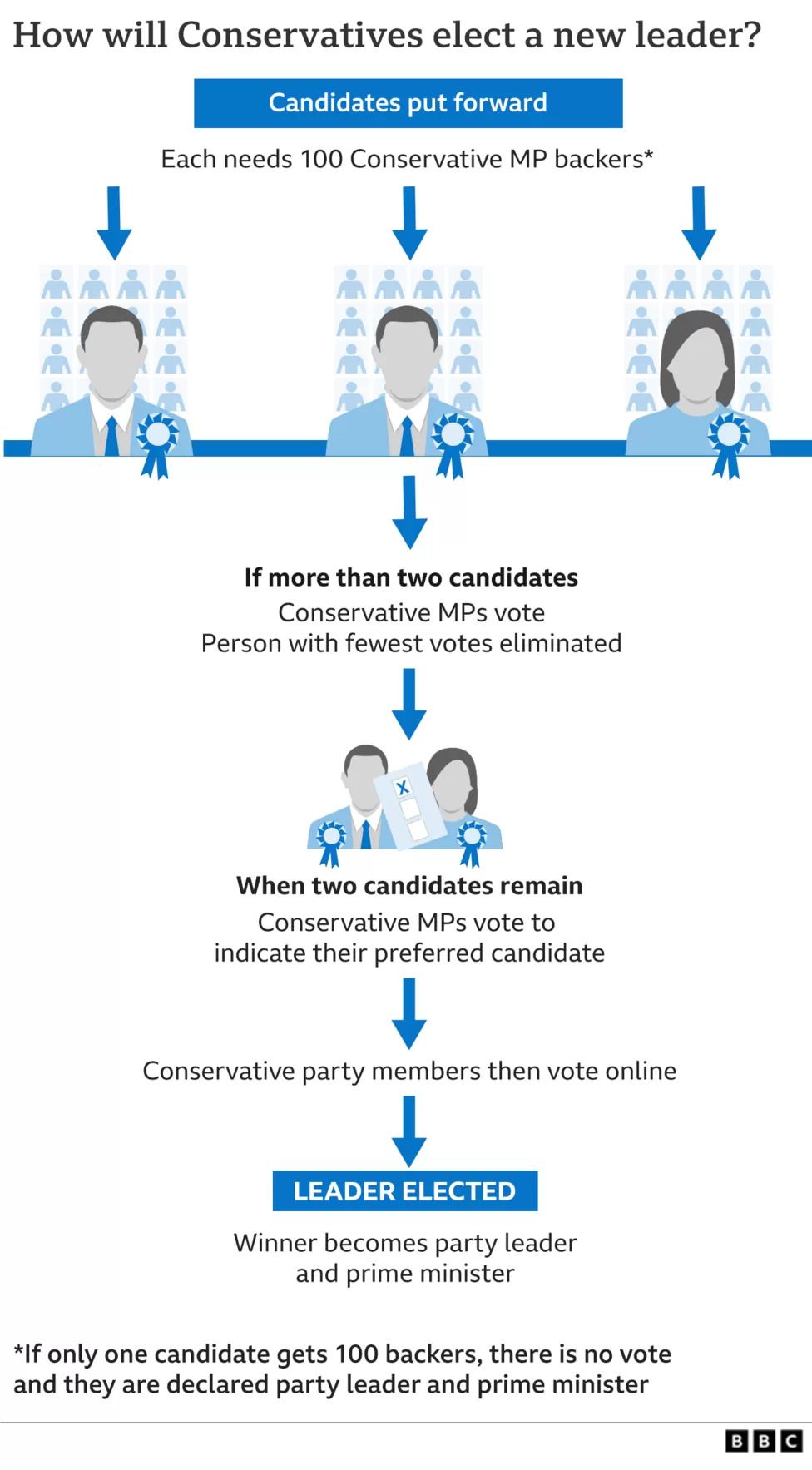
Under party rules, leadership hopefuls will need to secure the support of 100 MPs to enter the contest.
There are 357 Conservative MPs so that means a maximum of three candidates can stand.
Candidate nominations will close at 14:00 BST on Monday and the first ballot of MPs will be held that day between 15:30 and 17:30.
A first ballot will be held among MPs and the person with the lowest number of votes will be eliminated, if there are three candidates.
If a second ballot is needed, MPs will be able to signal who they prefer through an indicative vote.
And if both candidates opt to stay in the race, the final decision will go to party members via an online vote.
WATCH: Liz Truss's 45 days in office