

‘Like a clown’: what other countries thought of Boris Johnson at Cop26
It was one of the defining images from Cop26.
Seated next to Boris Johnson on Monday and wearing a mask was 95-year-old David Attenborough. The prime minister, however, was maskless. At one point, Johnson seemed to have nodded off.
On stage and in front of 120 world leaders, the contrast between the two men was striking. The naturalist was sombre and serious. There was a “desperate hope” we might still avoid disaster, Attenborough said in Glasgow, in the most memorable phrase of the week. Joe Biden was among those to give him a standing ovation.
Johnson sought to strike a similarly elevated tone. There were serious moments in his speech: he mentioned a responsibility to future generations, for example, and to “children not yet born”.
But overall the prime minister appeared to rely on the jokes and verbal antics that have served him well in the past. With the world watching on the most urgent issue of the age, he sought to mix it up – part statesman, part standup.
Labour said his speech seemed thrown together at the last moment. To many others, his quips seemed strangely unsuited to the grave occasion and to his non-British audience.
He began by likening the climate crisis to James Bond wrestling with a ticking bomb. “It’s one minute to midnight on that Doomsday Clock and we need to act now,” he declared. (Days before, at the G20 summit in Rome, he had used football for his analogies – describing humanity as “5-1 down at half time”.)
Johnson’s Cop26 address was met with stony silence. The prime minister left pauses for laughs. They never came.
Outside the hall, what did other countries make of a British leader who had once written sceptically about the climate emergency? Was his new evangelism for real, many wondered, or merely an act by someone adept at persuading people he holds certain beliefs?
Abroad, few were convinced. In Spain, El País noted Johnson appeared to have undergone something of a Damascene conversion to environmentalism since the days when “as a provocative political columnist for the Daily Telegraph, he flirted with a rather loutish kind of climate change denialism”.
His attempts to stress the importance of the meeting were undercut by a familiar idiosyncrasy, it said. “He wanted to appear ‘cautiously optimistic’, and yet he couldn’t avoid slipping into his usual over-the-top rhetoric,” the paper reported.
Others felt his puns got lost in translation. Bas Eickhout, a long-serving Dutch Green MEP, observed: “He is regarded a bit like a clown. It’s clear that this is his style and that is certainly now what people are used to. Some of the jokes are quite domestic orientated for a domestic audience.”
Asked about Johnson’s leadership, one EU official laughed, but offered a diplomatic take. “It’s not completely my taste to be honest,” the person said, sidestepping to praise the UK diplomatic machine. “One thing that we profit from is that the UK still has one of the best foreign services in the world. It’s pretty difficult to break that up and they [Downing Street] haven’t got round to it yet.”
The French media was also unimpressed, at a time when Paris and London are involving in a bitter spat over fishing. Le Point said Johnson had indulged in his “usual humorous banter”. “Wide-eyed, we observe Johnson’s smirk; his face recalls that of a dad cracking one of his favourite jokes,” it said.
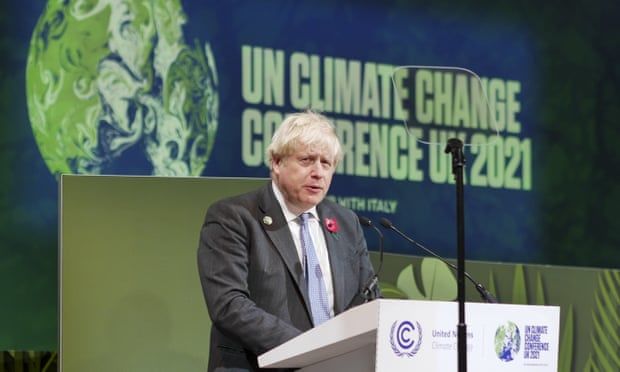 Doubts remain over Johnson’s sincerity on climate issues.
Libération saw “chaotic organisation” on show at the summit; Le Monde “apparent nonchalance” from the British side. “He seems a lot more interested in re-litigating Brexit with Brussels than with convincing global leaders to raise their CO2 reduction targets,” the paper wrote.
Germany’s Der Spiegel recalled the prime minister’s climate speech in September to the UN general assembly when – bizarrely – he referenced Kermit the frog. “When it comes to using zany metaphors to underline his message, Johnson has form,” Spiegel said.
For his part, Johnson insists his conviction that global heating poses an existential threat is real. Asked by the Guardian why he had become a believer, Johnson said he received a briefing from government scientists soon after becoming prime minister. It featured terrifying data and graphs, he recalled. Johnson’s wife, Carrie, probably also played a role in changing his mind, or so everyone around him thinks.
Yet doubts over Johnson’s sincerity remain. He flew to Rome and then on to Glasgow in a luxurious chartered plane painted with “United Kingdom” and a union flag. The jet is used by Johnson and some royals for shorter trips. But why not travel back to London from Cop26 by train, a comfortable journey of four and a half hours? This was not possible, No 10 said, because of “time restraints”.
On Thursday, the reason for Johnson’s haste became clear. The Mirror reported Johnson had flown back to London to attend a reunion of Daily Telegraph journalists at the men-only Garrick Club. He was pictured emerging from a dinner with Charles Moore, his old boss, whom Johnson recently made a Tory peer.
Lord Moore has said there is no proof the planet faces a “climate emergency” and accuses activists of “project fear”.
Anneliese Dodds, the Labour party chair, said Johnson was guilty of “staggering hypocrisy”. The charge sheet also includes reducing taxes on domestic passenger flights in last week’s budget and equivocating on whether a controversial new coalmine should be built in Cumbria, at the same time as calling on China, the US, Australia and others to phase out coal production.
It has left many environmentalists with a fear that Johnson has so far failed to heed his own apocalyptic rhetoric, even if he now grasps the problem.
“We hope world leaders listen to Johnson’s warnings. But maybe he needs to listen to them himself,” Greenpeace’s Rebecca Newsom said.