

Lifting Covid rules in England ‘will overwhelm testing capacity’
The £22bn NHS test-and-trace system risks being overwhelmed by surging Covid infections after the planned wholesale lifting of restrictions in England this month, a leading academic has warned.
Jon Deeks, a professor of biostatistics at the University of Birmingham, said at least 660,000 gold-standard PCR tests are likely to be needed each day to discover 100,000 daily infections this summer – the number forewarned by the health secretary, Sajid Javid, after the government announced plans to drop restrictions from 19 July.
This level of testing is almost three times the current rate in the UK, more than double the highest volume achieved at any point during the pandemic, and at the peak of the system’s theoretical laboratory capacity calculated this spring by the National Audit Office (NAO).
One director of public health warned that rationing may be required in the areas where contact tracing is carried out, focusing on poorer locations on the basis that residents are more likely to live in overcrowded conditions and have face-to-face jobs.
The latest data released by NHS test and trace on Thursday showed signs of the system already straining. Positive tests in England were up 71% in the last week of June – the highest number since early February – and turnaround times have increased, with the proportion of in-person test results returned in 24 hours down to 77% from 84% the previous week.
On Thursday, the UK had another 32,551 reported coronavirus cases and 35 deaths within 28 days of a positive test. It is the highest death toll since early April and the highest number of new infections since 20 January.
Ministers are now heaping further pressure on the test-and-trace system, which has a £22bn budget, by mandating that anyone who has close contact with an infected person from 16 August should take a PCR test “as soon as possible” instead of self-isolating.
“If we get to 100,000 cases a day, the capacity of our testing system is going to be breached, particularly when we build in the recommendation for testing contacts,” Deeks told the Guardian. “Plus some of the labs are being shut down, such as the turnkey lab here at the University of Birmingham.” The Department of Health and Social Care (DHSC) said it has been consolidating its laboratory network.
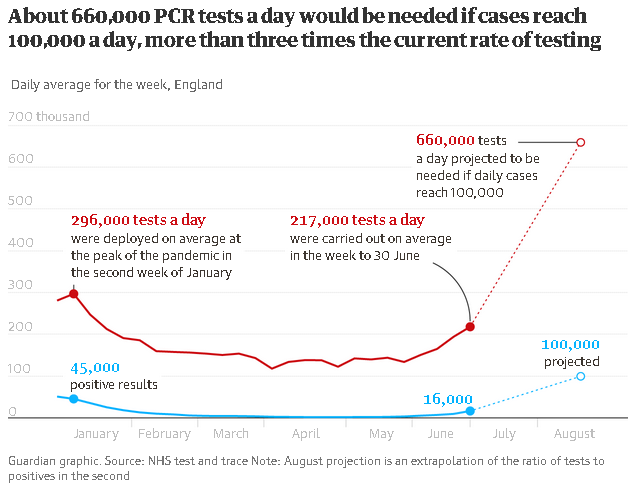
PCR testing capacity has been reduced by more than 100,000 tests per day since the end of March, according to the NAO, but it has increased 45% in the last four weeks.
On Thursday, Dr Jenny Harries, the chief executive of the UK Health and Security Agency, who is now in charge of NHS test and trace, told MPs that current laboratory capacity was “peaking”. She said the sharp rise in cases is also “overstretching” local contact tracing capacity.
She said private labs would now be used as “part of the planned step-up” in capacity to tackle the growing demand. A DHSC-owned “mega-lab” built at Leamington Spa has started operating, but will only reach capacity “in the coming months”.
Directors of public health have also warned the accelerating spread of the Delta coronavirus variant in recent weeks means their capacity to reach infected people and gather information about their contacts is close to its limit.
“I am struggling to think how [the system] can cope with 100,000 cases a day,” said Greg Fell, the director of public health for Sheffield city council, which contacts people who have tested positive to instruct them to isolate, gather contacts and offer support. “We have seen a massive increase in cases over recent days and that’s only going to go one way. We are getting close to capacity now.”
One director said local teams were “despondent” and added: “I don’t see how test and trace will cope with 100,000 cases a day, if I’m honest.”
Lorna Smith, Newcastle’s deputy director of public health, said: “The system could not cope with that number using a test and trace approach and a lack of other restrictions or guidance in place. That level of transmission has serious implications for our health system … [with] a significant proportion of unvaccinated adults that we still need to reach.” Some 53% of adults in Newcastle have still not had two doses.
Harries told MPs on Thursday that some councils have already hit contract tracing capacity and are handing cases over to the centralised system. But she said she anticipated new cases peaking in the middle of August when 75% of the population should be double jabbed.
Greg Clark, the Conservative chairman of the Commons science and technology committee, said: “Now we have surging infections ... a lot rests on test and trace in the future, and the record over the last year has not been one of reliable springing into life to wrestle this virus to the ground.”
Deeks based his estimate of the required capacity on the testing needs at the peak of the pandemic in the second week of January, when 300,000 PCR tests were deployed each day to find 45,000 cases. More recently the number of tests required to find a case has increased, meaning his estimate may be conservative.
Labour said it appeared the government had not learned from mistakes last autumn when people were sent hundreds of miles for tests “because of a failure to anticipate increased demand for tests”.
“This coupled with the winding down of the contract tracing service earlier this year leaves us dangerously exposed at a time when the government seems hell bent on maximising the risk,” said Justin Madders, a shadow health minister.
A DHSC spokesperson said: “We continuously review our laboratory requirements as the pandemic progresses. NHS test and trace continues to be a central part of our roadmap to return life to normal, and our new UK Health Security Agency will consolidate the enormous expertise that now exists across our health system to help us face down future threats and viruses.”