

Laughing gas: Experts warn nitrous oxide ban will not stop use
The government has defended its plans to tackle anti-social behaviour, including making the possession of nitrous oxide a criminal offence.
The Drug Science scientific charity says a blanket ban "is completely disproportionate" and "would likely deliver more harm than good".
The £160m plan will also address homelessness, begging and graffiti.
Unveiling his plans to clamp down on anti-social behaviour on Monday, Prime Minister Rishi Sunak said there was a need for a "zero-tolerance" approach and stressed the importance of "immediate justice".
Speaking at a boxing club in Chelmsford, Essex, Mr Sunak said he wanted to deal with a small minority of people who were being disruptive.
The decision to make nitrous oxide a Class C drug goes against advice from the Advisory Council on the Misuse of Drugs (ACMD), which recently said nitrous oxide should not be banned under the Misuse of Drugs Act 1971.
Its review also found "no substantive evidence of links between nitrous oxide and anti-social behaviour" aside from littering.
On Monday afternoon, Home Secretary Suella Braverman told MPs the government was expected to "take a broader view" on the ACMD's findings, adding there was still "emerging evidence that [nitrous oxide] does cause serious harm to health and wellbeing".
She said the government would "put an end to hordes of youths loitering in and littering parks with empty canisters".
But shadow home secretary Yvette Cooper claimed the government's crackdown was "too weak, too little and too late".
"There are 10,000 fewer neighbourhood police and PCSOs on our streets today than there were seven years ago," she said.
She said Labour supported a ban on nitrous oxide, but stressed it needed to be part of an integrated anti-social behaviour strategy.
The gas, sold in metal canisters, is known as NOS and is one of the most-used drugs by UK 16 to 24-year-olds.
Heavy use can lead to a vitamin deficiency that damages nerves in the spinal cord.
Proposals in the government's crackdown on anti-social behaviour also include:
* Powers allowing police and councils to prohibit organised begging by criminal gangs, as well as begging which causes nuisance and puts public safety at risk
* Increased fines for graffiti and littering, rising to up to £500, and up to £1,000 for fly-tipping
* Making offenders swiftly clear up vandalism
* A strategy of "hotspot" policing including more patrols
* More funding for youth centres
* Landlords and housing associations getting more powers to evict tenants who create persistent noise
* Reopening empty shops by giving councils powers to quickly sell off rental rights for empty buildings to willing tenants
Some 16 areas will get funding for either the "hotspot" policing or a new "immediate justice" scheme, where those who carry out anti-social activity will undertake repair and clean-up works within 48 hours of being handed orders. Four areas will trial both schemes.
The areas include Northumbria, Cleveland, Derbyshire, Durham, Nottinghamshire, Merseyside, Sussex, Dorset, Northamptonshire, West Yorkshire, West Midlands, South Yorkshire, Essex, Lancashire, South Wales and Staffordshire.
Victims of anti-social behaviour will get a say in people's punishments "to ensure justice is visible and fits the crime", the Department for Levelling Up, Housing and Communities said.
The government defended its move to clamp down on laughing gas, with Policing Minister Chris Philp saying there were concerns that nitrous oxide was being consumed on "a very large scale".
Questioned about the decision to go against ACMD advice, he told BBC Radio 4's Today Programme: "We have taken a broader view - considering firstly the social harms caused by nitrous oxide, the contribution it makes to anti-social behaviour, a sense sometimes of menace in local communities, the littering that goes with it and also the very early evidence of some medical harm."
In its policy paper, the government said it intends to make nitrous oxide a Class C drug with potential prison sentences and unlimited fines for unlawful supply and possession, when parliamentary time allows.
David Badcock, chief executive of Drug Science, said he was "disheartened" at the proposed ban and the government was "going completely against its own advisory panel".
He went on to ask: "What's the point in the ACMD when the very best scientists and experts have looked at the evidence and advised what to do and they completely ignore it?"
Steve Rolles, senior policy analyst at the Transform Drug Policy Foundation, said criminalising nitrous oxide would "hand control of the product to criminal gangs".
Prof Adam Winstock, an addiction medicine specialist and founder of the Global Drug Survey, told the BBC that getting a criminal record "is going to be a far greater harm than the risks for the vast majority of people using nitrous oxide".
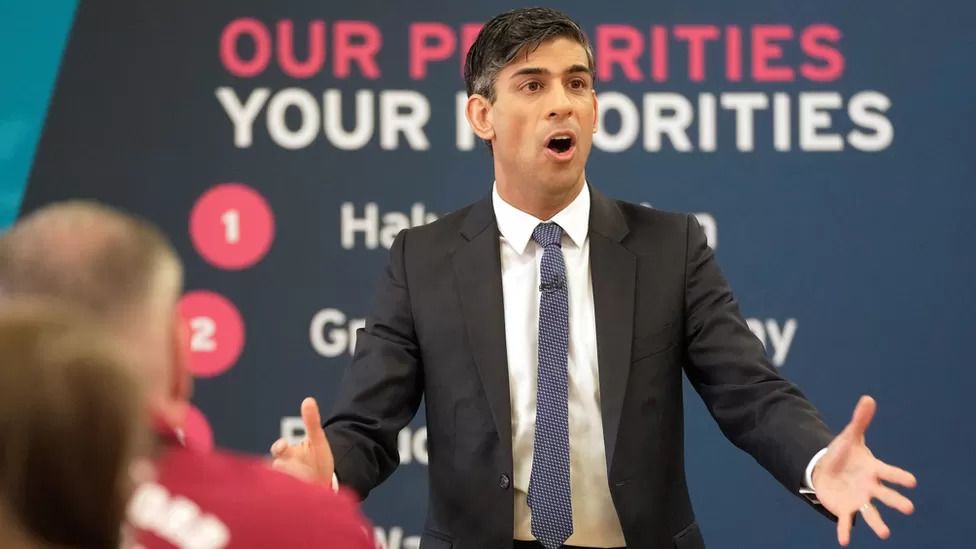 Rishi Sunak during a Q&A session in Chelmsford on Monday
It is already illegal to produce or supply the gas for its psychoactive effects under the Psychoactive Substances Act 2016, but this does not cover possession unless it is with the intent to supply.
According to the ACDM, the number of deaths and demand for treatment for problematic use of nitrous oxide remains low compared with other drugs.
However, there have been reports of an increase in neurological harms, including nerve and spinal cord damage, related to heavy and persistent use.
Nitrous oxide is also regularly used as an anaesthetic in medicine and dentistry, and as a gas for making whipped cream in cooking.
The Liberal Democrats said: "Making something like this illegal doesn't work and hands profit and control to serious criminals."