

King Charles banknotes printed - but not ready yet
The BBC was given exclusive access to the highly-secure site where notes are being produced for the Bank of England.
The King's portrait will be the only change to existing designs of £5, £10, £20 and £50 notes, and new notes will replace damaged or worn older ones.
However, machines such as self-service tills need to recognise the new image.
That process requires a relatively long build-up, and is why the notes will only be issued in mid-2024 - many months after 50p pieces featuring the King's image were put in use, according to the Bank of England's chief cashier.
Sarah John, whose role means her signature is on the banknotes, said: "There is a lot to do to ensure that machines used up and down the country can accept the banknotes.
"They all need to be adapted to recognise the new design, with software updates, and that takes months and months.
"Otherwise, we will be putting a banknote out there that people simply would not be able to use."
The reverse side of current polymer Bank of England banknotes, which in ascending order feature Sir Winston Churchill, Jane Austen, JMW Turner and Alan Turing, will be unchanged.
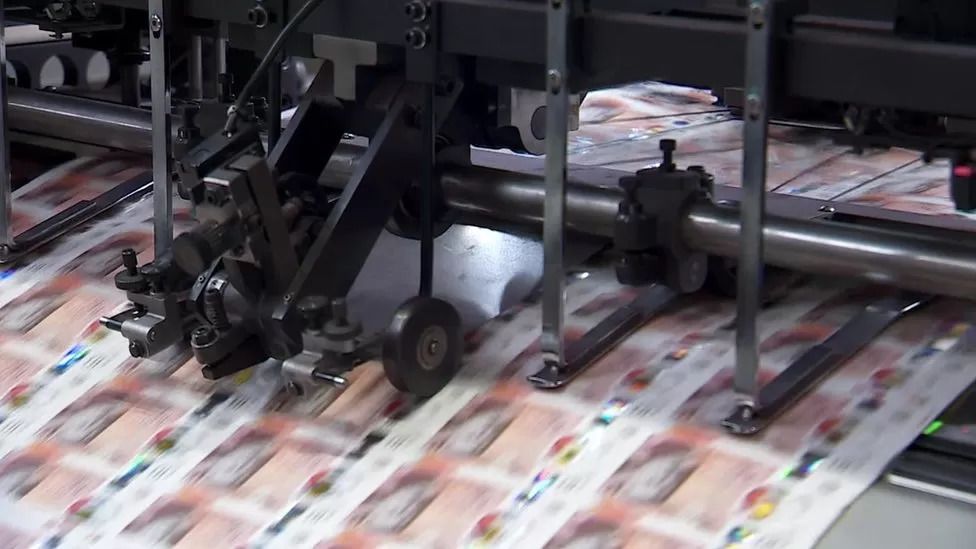 The printing process is complex with multiple stages
The Queen Elizabeth notes that are already in circulation - some 4.7 billion of them, worth £82bn - can still be used in the shops, even after the new notes enter circulation. The King Charles notes will only replace them when they are no longer fit for use, or when there is any increased demand.
The Royal household has given guidance encouraging such a move, rather than a wholesale switch, in order to minimise the environmental and financial impact of the change.
Even so, on the day of the BBC's visit to the production site - a complex surrounded by barbed wire with tight security and the external look of a prison - about six million new notes were being printed in 24 hours.
These are packaged up in a "sausage" of 5,000 notes, each one of which would pay off many a mortgage, but will instead be used for daily transactions throughout the UK economy. However, the buying power of specific banknotes has been diluted by rising prices.
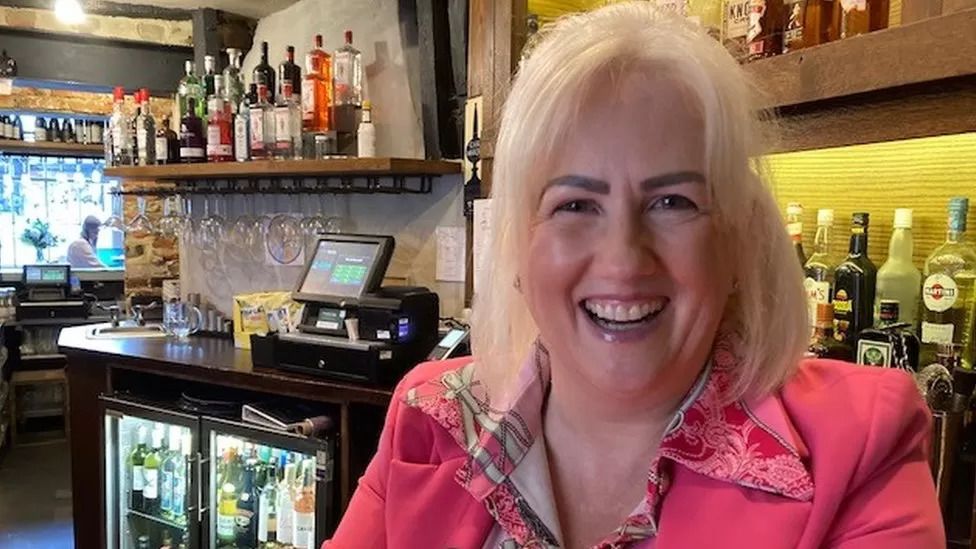 Carol Mason says customers' attitude to cash changed during the pandemic
There are more banknotes in circulation than ever before, but are not used so commonly by consumers. Cash use has become far less frequent when compared to debit cards, owing primarily to the use of contactless payments.
Where better to test the appetite for embracing the new Charles banknotes than at The King's Head, in Chipping Ongar. The pub has a rich history of its own, named as such because King James II is said to have stayed at a coaching inn on the site during his reign.
Deputy manager Carol Mason said very few customers paid for their drinks with cash now, and they were often from the older generations.
"I started here in 2015 and we noticed the biggest change during Covid when people didn't want to be touching cash," she said.
"They just started using their phones more, their watches more, their credit cards. They just found them easier to use, and they have stuck with it. People have got used to that way of life."
Sarah John, from the Bank of England, said: "There are still a lot of people who rely on cash for their day-to-day spending. It might not be obvious to everyone, but it is still really important that they have cash available when they really need it."
Her comments come as a survey by Link, which oversees the UK's cash machine network, suggested that 45% of those asked had been somewhere that had not accepted, or had discouraged the use of cash over the last eight weeks. One in five of them described this as fairly, or very, inconvenient.
There had been a growing issue with problems paying for parking where only cards were accepted, the organisation suggested.
Campaigners say that when businesses and service operators start to refuse cash payments, its decline will be hastened, and the danger of millions of people who rely on it being left isolated becomes more acute.
And yet, even if cash is no longer King, the image of a King will be on our banknotes for some time to come.