

Jeremy Hunt says significant tax cuts in Budget unlikely
The chancellor has been under pressure recently from some in his party to cut taxes to stimulate the UK economy.
But Mr Hunt said that a pledge to halve the rate of inflation "is the best tax cut right now".
He admitted the UK was going through "a difficult patch" but insisted the country "can get through it and we can get to the other side".
On Friday, Mr Hunt set out a plan to help lift the UK's economic growth.
After a turbulent autumn, when financial markets pushed up the country's cost of borrowing, Mr Hunt said he was determined to show that the UK was responsible.
That meant "showing the world, showing the markets that we are a responsible nation, that we can pay our way, that we can balance our books", he said.
He added that "it is unlikely that we would have the room for any significant tax cuts" at the Budget in March.
Government borrowing - which is the difference between spending and tax income - rose to a record £27.4bn in December. It was the highest amount for that month since 1993.
Borrowing was driven by the cost of helping households and businesses with rising energy bills. Higher inflation also pushed up interest payments on debt owed by the government.
The rate of price rises - or inflation - has begun to slow, but at 10.5% remains close to a 40-year high.
Prime Minister Rishi Sunak has pledged to halve inflation by the end of the year.
But some economists have said prices will begin to fall back naturally, without government policies, due to commodity prices and shipping costs decreasing towards the end of last year. Energy prices are also expected to ease in the second half of 2023.
Mr Hunt said: "The biggest tax cut that we can give the British people is to halve inflation, that means the value of their weekly shop won't continue to go up, the value of their pay packet won't continue to be eroded and that's what we are focused on."
Four 'Es'
The chancellor also unveiled a plan to grow the UK economy, though it drew a mixed reaction with some business groups criticising a lack of detail.
He said the strategy would focus on four pillars, or "four Es": enterprise, education, employment and everywhere.
He said that while it was not a series of measures or announcements, it would provide "the framework against which individual policies will be assessed and taken forward".
But the Institute of Directors (IoD) suggested Mr Hunt add a fifth E for "empty" after not issuing concrete plans.
IoD chief economist Kitty Ussher said businesses needed "government action to counteract the negative mood", such as continuing the capital investment super-deduction and bringing in tax credits for employers who invest in skill shortage areas.
Mr Hunt said the government planned to achieve growth in multiple sectors across the UK, including digital technology, green industries, life sciences, advanced manufacturing and creative industries.
The TUC said the lack of the mention of public sector pay in the speech was the "elephant in the room".
"Public servants will be deeply worried about the chancellor's warnings of further restraint. We know that is usually code for cuts," said the union's general secretary Paul Nowak.
Craig Beaumont, of the Federation of Small Businesses, said the contents of Mr Hunt's speech had "all the right elements", but warned the "proof will be in the pudding in the years ahead".
'A lack of clarity for business'
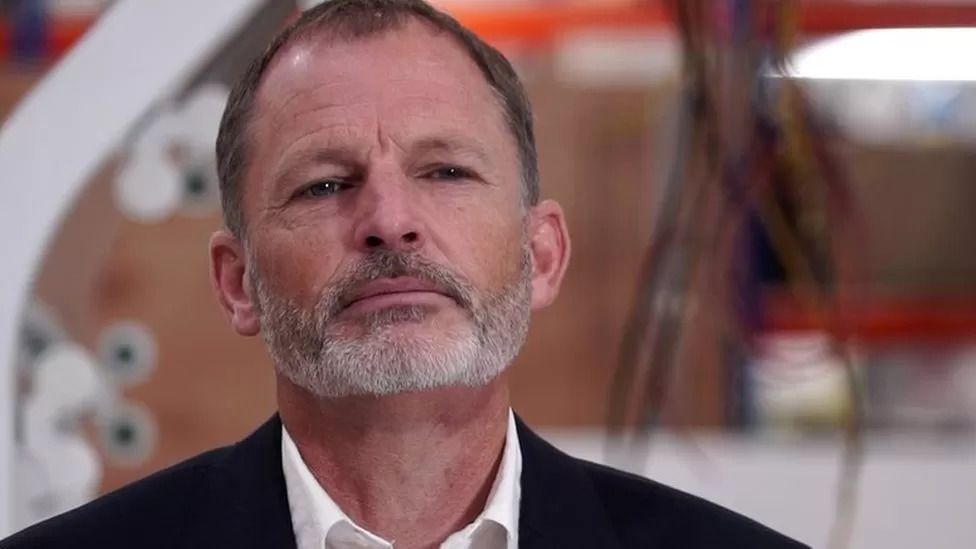
Brian Palmer, founder of robotics firm Tharsus in Blyth, Northumberland, said the "themes" that the government was talking about were important, but said firms "need to see the detail".
"There is a lack of a clear long-term strategy. Without that long-term plan, businesses can't get behind it, can't have the confidence that the government's going to follow through with the policies."
Brian, whose company makes high-tech equipment for companies such as Ocado, warned some firms were already holding back on investment because of a lack of confidence.
"The government needs to provide industry with a clear idea of what the playing field is going to look like going forward," he added.
Many have interpreted Mr Hunt's speech as an attempt to respond to criticism that the government has no long-term plan for growth.
Carmakers articulated that idea this week. On Thursday, figures from the Society of Motor Manufacturers and Traders (SMMT) showed the number of new cars made in the UK has sunk to its lowest level for 66 years, with the SMMT warning that the UK was lagging behind other countries, particularly on offering state aid to manufacturers.
Make UK, which represents the manufacturing industry, said there had been "some hugely damaging big picture issues caused by the absence of an industrial strategy which are impacting on some of our strategic sectors".
Mr Hunt said he wanted to tackle poor productivity and said the UK's exit from the European Union would encourage risk-taking and changing regulation.
'Cold comfort'
Looking at the wider picture, Mr Hunt said that "declinism about Britain" was wrong and praised what he called "British genius and British hard work".
"Some of the gloom is based on statistics that do not reflect the whole picture," he said.
But Liberal Democrat MP Sarah Olney said: "Jeremy Hunt's speech is cold comfort for families and pensioners facing unbearable price rises."
Labour's shadow chancellor Rachel Reeves said that "13 years of Tory economic failure have left living standards and growth on the floor, crashed our economy, and driven up mortgages and bills".
"The Tories have no plan for now, and no plan for the future," she added.
Watch: Jeremy Hunt says significant tax cuts are "unlikely"