

Jeremy Corbyn: The left-wing veteran outcast by his party
But he is now facing the end of his long political marriage with the Labour Party.
His successor, Sir Keir Starmer, has told him he will not be a Labour candidate at the next election.
Now Labour's governing body has voted to approve a proposal to officially ban Mr Corbyn from standing for Labour.
The decision had been hanging over Mr Corbyn since he was suspended as a Labour MP in a row over antisemitism.
His political future now hangs in the balance as he considers whether to stand against Labour as an independent candidate in his Islington North constituency.
Whatever he decides, Mr Corbyn has already left an indelible mark on British politics.
A fixture on the left-wing political scene for more than four decades, Mr Corbyn was schooled in radicalism by his parents, who met as activists in London during the Spanish Civil War.
He grew up in Shropshire and became politically active early on in his life, joining Labour and the Campaign for Nuclear Disarmament (CND) while at school in the 1960s.
A stint as a trade union official and a councillor in London followed in the 1970s, before he was elected MP for the Labour stronghold of Islington in 1983.
Through the 1980s and subsequent decades, he devoted himself to various socialist causes, railing against the policies of the Thatcher, Major and Blair governments from the backbenches.
A committed pacifist, Mr Corbyn was a thorn in the side of former Labour Prime Minister Tony Blair, repeatedly rebelling against his government, most notably over the Iraq War.
At that point, few would have predicted Mr Corbyn's rise to Labour's top job.
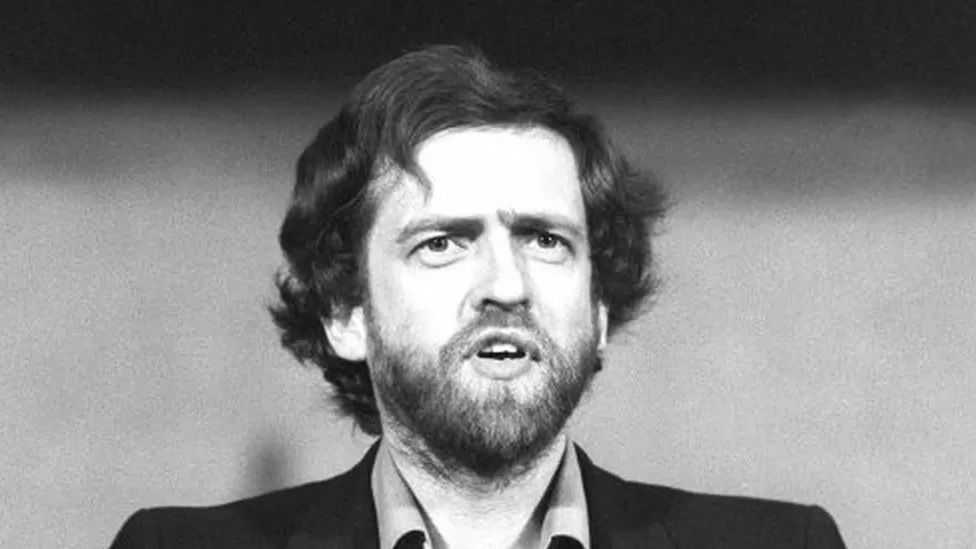 Mr Corbyn has been a stalwart of the British left for more than 40 years
Mr Corbyn's election in September 2015 as Labour leader, at the age of 66, counted as one of the biggest upsets in British political history.
It heralded a remarkable revival in fortunes for a brand of left-wing politics that Mr Blair made a point of departing from under the New Labour banner.
His unvarnished and unabashed commitment to socialism - that made him an irrelevant throwback in the eyes of his critics - struck a powerful chord with many Labour activists.
According to research conducted by the British Election Study after each election, Labour's vote share rose by more than 20% among 18 to 25-year-olds between 2015 and 2017 but actually fell among voters aged 66 and over.
The high watermark of Corbynism came at the 2017 year's general election, which saw Labour exceed all expectations by winning 40% of votes nationally.
Even though it was a loss, Mr Corbyn deprived the prime minister at the time - Theresa May - of her majority.
A crowd of tens of thousands at that year's Glastonbury Festival chanted "Oh Jeremy Corbyn", as the Labour leader took to the stage.
The enthusiasm he generated among his supporters was not enough to win Labour the next election in 2019, though.
With Parliament in deadlock over Brexit, former Prime Minister Boris Johnson won a landslide victory, sweeping aside Labour strongholds across northern England, the Midlands and Wales in areas which backed leaving the EU in the 2016 referendum.
Mr Corbyn stood down as leader, saying Brexit had "polarised and divided debate in this country".
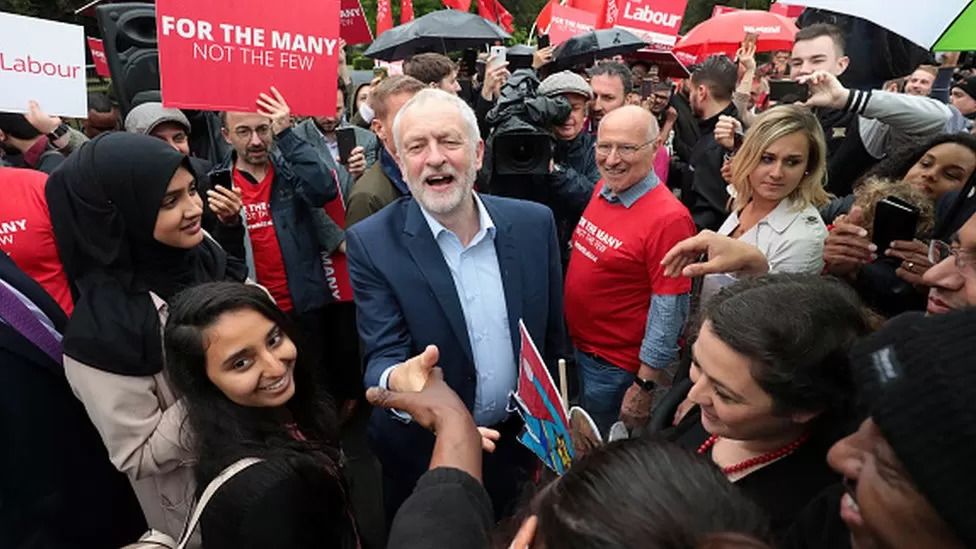 Mr Corbyn said he was dedicated to overturning the "rigged" system that favoured elites over ordinary working people
Under his leadership, Labour had been plagued by allegations of anti-Jewish racism by some of its supporters. Recriminations over how complaints about these allegations were handled by the party continued once Mr Corbyn had quit as leader.
In October 2020, a report by the Equality and Human Rights Commission's found Labour to have been responsible for "unlawful" acts of harassment and discrimination during Mr Corbyn's four-and a-half years as party leader.
Its investigation identified serious failings in leadership and an inadequate process of handling antisemitism complaints.
Mr Corbyn said the scale of antisemitism within Labour had been "dramatically overstated" by his opponents and that he had always been "determined to eliminate all forms of racism".
He was suspended from the party and was readmitted a month later.
But Mr Corbyn was not readmitted to Labour's parliamentary party and continues to sit in the House of Commons as an independent MP.
Labour, under Sir Keir's leadership, pledged to rid party of antisemitism and the Equality and Human Rights Commission said last month it was satisfied that enough changes had now been made.
As Labour turns the page on project Corbyn, its chief architect has returned to a position of familiarity on the margins of politics.
A rank outsider, Mr Corbyn will need to beat the odds yet again to add new chapters to his colourful political career.