

Javid advised to take ‘stringent’ Covid measures within a week, leak reveals
Britain’s top public health officials have advised ministers that “stringent national measures” need to be imposed by 18 December to avoid Covid hospitalisations surpassing last winter’s peak, according to documents leaked to the Guardian.
Sajid Javid, the health secretary, received a presentation from the UK Health and Security Agency (UKHSA) on Tuesday warning that even if the new Omicron variant leads to less serious disease than Delta, it risks overwhelming the NHS with 5,000 people admitted to hospital a day.
In an interview with the Guardian, the epidemiologist Prof Neil Ferguson said the total could be double that number.
No 10 insisted there were no imminent plans to bring in more measures after plan B measures were announced for England this week but cabinet minister Michael Gove, who chaired a Cobra meeting on Friday, said the government had been presented with some “very challenging information” about the speed of the spread.
The Guardian has seen leaked advice from UKHSA for Javid marked “official, sensitive” saying: “The key point is that under a range of plausible scenarios, stringent action is needed on or before 18 December 2021 if doubling times stay at 2.5 days. Even if doubling times rise to around 5 days, stringent action is likely still needed in December.”
It adds: “The rapid spread of Omicron means that action to limit pressures on the health system might have to come earlier than intuition suggests.” Its calculations suggest that even if Omicron causes a less severe hospitalisation rate of 1% or 0.5% compared with Delta’s 1.5%, then “stringent national measures’” would be needed by 18 December at the latest.
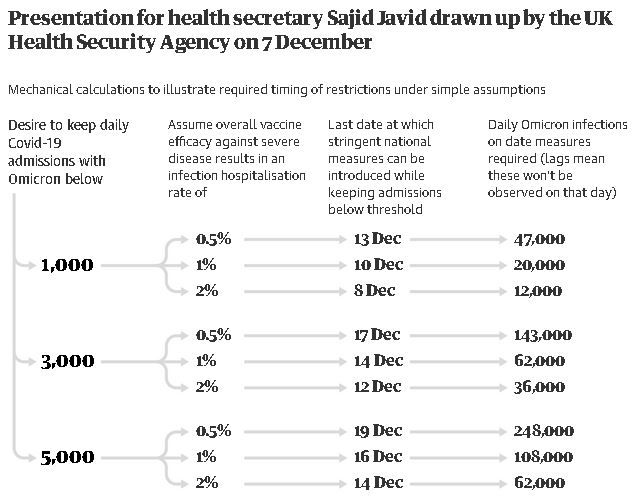 Note from UKHSA presentation: This is not a
projection. This purely illustrates timings based on our estimates of
Omicron prevalence now and doubling times seen in the UK so far.
Assumptions: 2.5-day doubling time, infection hospitalisation rate
varying by values no age mix adjustment, ‘stringent’ means R<1, no
susceptible depletion
Note from UKHSA presentation: This is not a
projection. This purely illustrates timings based on our estimates of
Omicron prevalence now and doubling times seen in the UK so far.
Assumptions: 2.5-day doubling time, infection hospitalisation rate
varying by values no age mix adjustment, ‘stringent’ means R<1, no
susceptible depletion
On the current trajectory of 2.5 days doubling time, and without any further restrictions, the document warns that Omicron cases could be at 248,000 cases a day by 19 December. It also stresses that the figures are not a projection but an estimate of Omicron prevalence and doubling times seen in the UK so far.
The document does not detail what the necessary curbs would be but defines “stringent national measures” as those that bring the R (reproduction) number below 1.
Boris Johnson triggered plan B this week including more wide-ranging mask mandates, asking people to work from home and Covid passports for big venues but a senior Whitehall source said few inside UKHSA believe this will have much effect on slowing the spread of the variant.
Further measures, now being referred to as plan C, could include stricter isolation requirements for contacts of Covid cases, masks in pubs, shutting hospitality entirely, more restrictions on visitors to care homes and hospitals or even the return of curbs on social contact.
As the ministers convened a Cobra meeting to discuss Omicron, the level of concern about the variant is rising among its scientific and public health advisers. There were more than 58,000 new confirmed UK daily cases of Covid on Friday – the highest level since January – with 120 deaths within 28 days of a positive test.
Cobra, which involved the four nations of the UK, was chaired by Gove, the levelling up secretary, as Johnson spent time with his family after the birth of his second child with his wife, Carrie Johnson.
He warned that evidence suggests Omicron is “more likely” than past Covid-19 variants to “potentially” lead to hospital admissions among the fully vaccinated.
Sturgeon warned of a “potential tsunami” of Omicron infections as the new variant brings “the fastest exponential growth we have seen in this pandemic so far”. At an unscheduled televised Covid update on Friday, the first minister said that “frankness” with the public was necessary, as the Scottish government published an evidence paper suggesting Omicron is “rising exponentially”.
It came as the Welsh government hinted at new restrictions on visiting people in care homes and hospitals to counter the impact of Omicron. The first minister, Mark Drakeford, also suggested it would be wise for businesses and public sector leaders to plan for the possibility of further clampdowns and even a new lockdown.
He said: “We will be issuing new guidance for visiting in care homes and hospitals. We want to do all we can to support visiting where it is safe to do so but, if we see a new wave of cases, some strengthened measures to protect patients and residents may be needed.”
A government spokesperson said: “There are no plans for further restrictions. Plan B is the proportionate approach given what we know at this stage about the Omicron variant.
“The government will continue to look closely at all the emerging data and we’ll keep our measures under review as we learn more about this variant.”