

Inside Just Stop Oil: ‘If I just waved a placard, nothing would change’
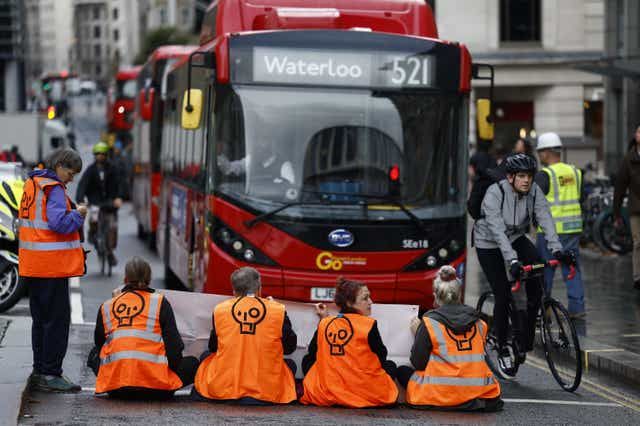
It’s 8am last Wednesday and 10 people in orange hi-vis vests stroll out onto one of the busiest roads in the City. They aren’t doing emergency roadworks but their actions will still cause miles of traffic jams. The bright orange banners they unfurl bear a crude black skull logo. As they chant “no coal, no oil, no gas”, police mill about, explaining to angry drivers that they are unable to do anything, as the group aren’t causing “serious disruption”.
Last week’s slow marches through London are just the latest wave of action from the protest group Just Stop Oil. Since forming in February, they have climbed onto overhead gantries on the M25, causing tailbacks and accidents, thrown tomato soup at Van Gogh’s Sunflowers and covered a memorial to Sir Captain Tom Moore in faeces.
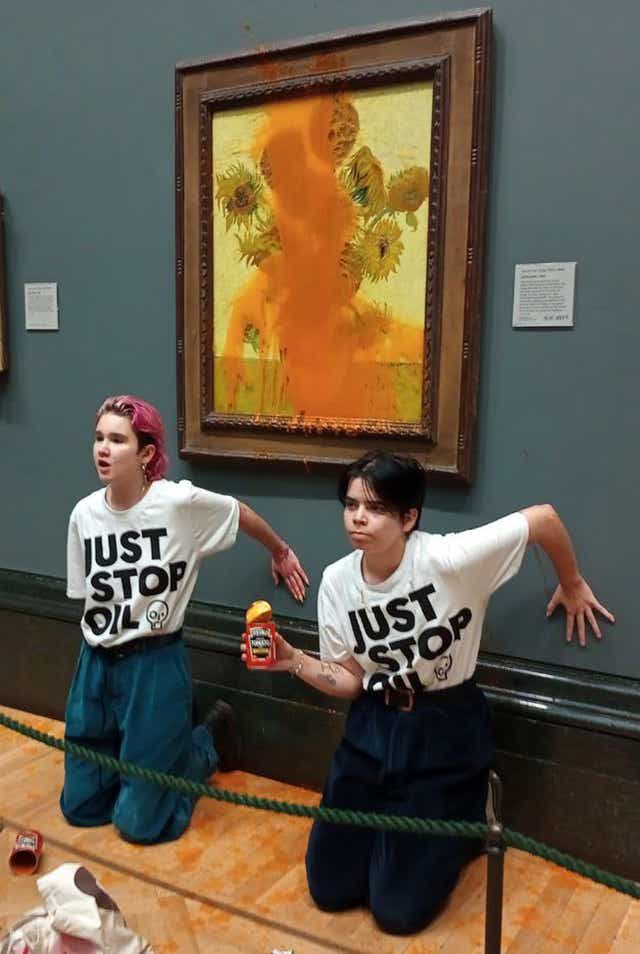
Two protesters who have thrown tinned soup at Vincent Van Gogh’s famous 1888 work Sunflowers at the National Gallery in London, Friday Oct. 14, 2022.
Emma Brown, 31, joined JSO in March, after seeing a leaflet in the library where she works which read “We Are F**ked — What Are We Going To Do About It?” Since then she has been arrested “quite a few times”, and has glued herself to 10 Downing Street, blockaded oil tankers in Essex and sprayed orange paint on car showrooms in Berkeley Square.
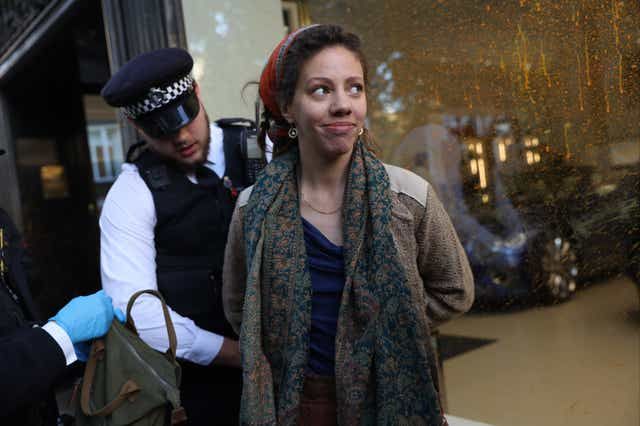 Police arresting Emma Brownon alongside
other demonstrators from Just Stop Oil, following a protest at the Jack
Barclay Bentley store in Berkeley Square, on October 26, 2022.
Police arresting Emma Brownon alongside
other demonstrators from Just Stop Oil, following a protest at the Jack
Barclay Bentley store in Berkeley Square, on October 26, 2022.
“I’d been to a few Extinction Rebellion demonstrations but I just stood around and didn’t really feel part of it,” she says. “But when I got that leaflet I was invited to someone’s flat and there were loads of young people there and I made some great friends. It’s those personal connections which have helped me to step into a world which can be quite scary.”
According to JSO, their supporters have been arrested more than 2,000 times since April, and 26 of their group are in prison. Last week, Jan Goodey, 57, a lecturer at Kingston University, was given a six-month sentence for causing multiple closures on the M25.
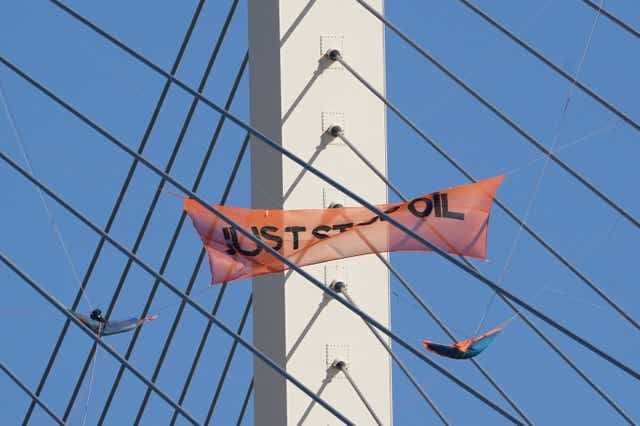
Just Stop Oil protested on the Queen Elizabeth II Bridge
Brown began by flyering for JSO, and then attended a training day after ticking a box to say she was willing to take direct action and get arrested. “We do role plays where other members of the group shout horrible things at you so you can practise what that feels like,” she says. “We also have de-escalators who are trained in calming situations down when people get angry. It’s horrible when people shout at you, but it’s even worse when they plead with you to stop.” As part of their training, protesters are taught how to make their whole body floppy so they are harder to lift up by police and how to protect themselves from physical attack.
Most members of JSO are under 30 or over 60, and they organise much of their direct action over Zoom and WhatsApp. Nearly all the group’s funding comes from the Climate Emergency Fund — a US network of philanthropists including Aileen Getty, whose grandfather was petroleum tycoon J Paul Getty. The group provides no-fee lawyers for those arrested and a 12-hour hotline for emotional support. Before an action, JSO reportedly sends out coping techniques including recommended poems, Shambhala warrior mind-training, and Tonglen, a Tibetan meditation practice.
Harley Brewer, 29, a former English tutor from Peckham, has been working for JSO since it started. “I joined because I’m terrified by the climate science that says that by 2030, large parts of London are going to be under water,” he says. “I had this combination of fear and determination and I knew I had to act.”
Brewer says he faces a prison sentence after being arrested three times. “I’ve got a big family and some of them don’t believe in climate change and think I’m a maniac,” he says. “But some of them are really supportive.” JSO says it has no formal leadership, but it was set up by Roger Hallam who also founded direct action group Insulate Britain. This former organic farmer, who has a PhD in civil disobedience, co-founded Extinction Rebellion in 2018. He was “unreservedly denounced” by XR in 2019 for describing the Holocaust as “just another f**kery in human history”.
Hallam has said: “If you don’t upset people enough, then nothing happens. If you upset people too much, like traditionally with violence, then you’re dead as well. But then there’s a sweet spot. No one knows where that sweet spot is, but as a general rule of thumb it’s a lot higher up than you think.”
Notable names have been unwilling to endorse JSO’s civil disobedience. Jeremy Corbyn joined a JSO march this year but even people sympathetic to the cause, such as David Attenborough, Rowan Williams, Sadiq Khan and King Charles, have criticised JSO and Insulate Britain for alienating the general public with their tactics. Just Stop Oil is also creating divisions in the climate movement. A recent study from the environmental platform Milkywire found that 67 per cent of conservationists are against disrupting travel for ordinary people as part of climate change protests, and 83 per cent think artwork should not be damaged in protest stunts.
"The young people carrying out Just Stop Oil’s actions seem like they’re doing it out of anxiety and fear — I feel really sorry for them"
“There was always a more extreme side of Extinction Rebellion and Just Stop Oil has emerged out of that,” says Zion Lights, 38, a science writer who used to be a spokesperson for XR. “They were the ones who organised the action at Canning Town in 2019 [where protesters scaled a Tube train and were beaten by commuters]. XR did a poll before that happened and a lot of members didn’t agree with it. After that incident a lot of XR’s funding dried up, and then the pandemic meant that we couldn’t get people together and it all kind of tailed off.”
She adds: “XR was always positive and peaceful, but the young people carrying out Just Stop Oil’s actions seem like they’re doing it out of anxiety and fear. I feel really sorry for them. I’ve got two daughters and I wouldn’t want them to be taking action for Just Stop Oil.” One criticism of JSO (and many eco-activism groups) is that members are nearly all white and middle-class. Zion says: “I’m a woman of colour, I’m a single mum, I understand why those groups can’t risk arrest. If we want to be productive we need to appeal to everyone.”
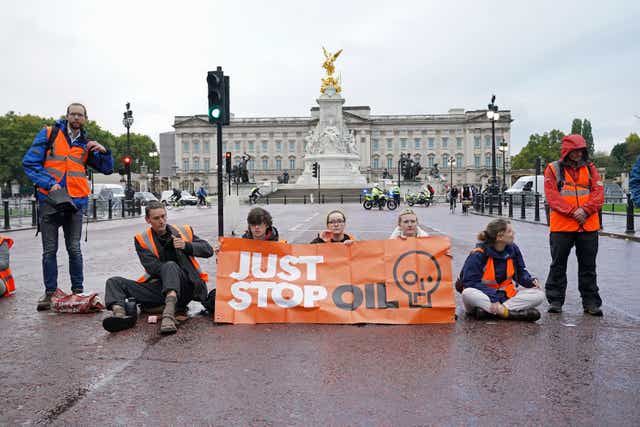
Dr Rupert Read, author of Why Climate Breakdown Matters, agrees. “The most important thing now is to find a way forward that doesn’t polarise people,” he says. “The climate crisis is not going to be solved by shock tactics and there is no lone solution. We need a mass buy-in — a large mobilisation of people, all taking meaningful action in how they live and work and eat.” Emma Brown says: “Of course I’d rather not be standing in the road pissing people off, but if I’m just waving a placard then nothing is going to change.” She adds: “Since I started protesting with JSO the conversation has changed massively. I really do think we’re going to win.”
Extinction Rebellion say they are completely separate from JSO. But spokesperson Nuala Mai Gathercole added that “we’re pleased that Just Stop Oil play the role they do in taking higher risk actions and getting these issues discussed in the media.”
However, there are fears that JSO’s vow to “escalate” could stray into violence. Last week, spokesperson Alex De Koning, 24, refused to rule out slashing artwork like the Suffragettes did.
“Roger [Hallam] was always very strategic in saying that the only reason he didn’t condone or encourage violent protest was because violent movements are less successful,” says Zion. “A lot of us were really shocked by that. I think he could end up leading these young people into more and more extreme action.”
After recent disruptions, Just Stop Oil published a statement: “This is an act of resistance against a criminal government and their genocidal death project. Our supporters will be returning — today, tomorrow and the next day — and every day until our demand is met: no new oil and gas in the UK.”