London Daily

Focus on the big picture.
Tuesday, Jul 28, 2026

Inflation at 40-year high of 9.4% as cost of living crisis mounts

Inflation at 40-year high of 9.4% as cost of living crisis mounts

Economists are warning that inflation has not yet reached its peak, with another round of energy bill increases in October expected to push it higher.

The rate of inflation has hit a fresh 40-year high, placing further strain on household budgets as the cost of living crisis mounts.

British consumer price inflation reached an annual rate of 9.4% in June, up from May's reading of 9.1%, the Office for National Statistics (ONS) said.

It means Britain had the highest rate of inflation in June among the Group of Seven advanced economies - Canada and Japan have yet to report June data, but neither are likely to come close to Britain's price growth.
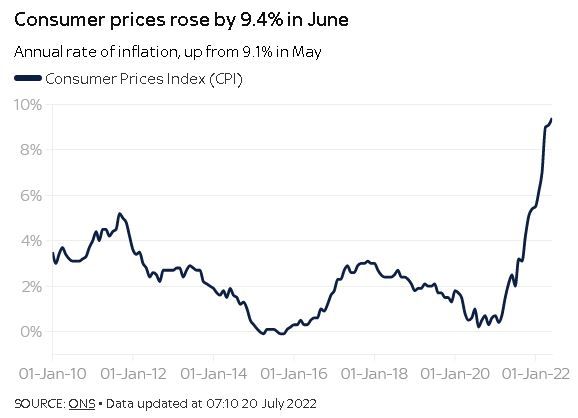

The ONS said that June's inflation figure was partly due to a 42% year-on-year increase in petrol prices, and an increase of almost 10% in food prices.

The prices paid by factories for materials and energy were 24% higher in June than a year earlier - the biggest increase since records began in 1985 - while prices charged by factories jumped by 16.5%.

The Bank of England is expecting a further acceleration - beyond 11% - in October when the energy price cap is adjusted again and is predicted to surge towards average annual bills above £3,000.

April's level was £1,971 and marked only a tentative increase in response to the spike in wholesale prices unleashed by Russia's war in Ukraine.

Inflation's peak 'is still some way off'


Yael Selfin, chief economist at KPMG UK, agreed the peak in inflation is "still some way off", adding that energy bill increases in October would stop it from falling to 2% before mid-2024.

"This means more pain is on the way for household budgets as the high rate of inflation continues to outpace wage growth, bringing down the real value of incomes across the UK.

"We also expect the Bank of England to continue raising the base interest rate, which we now expect to reach 2% early next year, to stave off further rounds of inflation rises."

The Bank of England, which has raised the Bank rate at each of its monetary policy meetings since December last year, is tipped to hike the rate again next month.

It is under pressure to take more drastic action - beyond the 0.25 percentage point increases announced to date that have taken the Bank rate to 1.25%.

The grim warnings around the pace of price increases ahead also leaves the government in the firing line as the Tory leadership contest continues.

'We need more than sticking plasters'


Rachel Reeves, Labour's shadow chancellor, said: "The cost of living crisis is leaving families more worried every day, but all we get from the Tories is chaos, distraction and unfunded fantasy economics.

"Rising inflation may be pushing family finances to the brink, but the low wage spiral facing so many in Britain isn't new.

"It's the result of a decade of Tory mismanagement of our economy meaning living standards and real wages have failed to grow.

"We need more than sticking plasters to get us back on course - we need a stronger, and more secure economy.

"Only a Labour government will build the high wage, high growth, low and stable inflation economy we deserve."

Chancellor Nadhim Zahawi said: "Countries around the world are battling higher prices and I know how difficult that is for people right here in the UK, so we are working alongside the Bank of England to bear down on inflation.

"We've introduced £37bn worth of help for households, including at least £1,200 for eight million of the most vulnerable families and lifting over two million more of the lowest paid out of paying personal tax."

Former chancellor Rishi Sunak - currently the frontrunner in the race to replace Boris Johnson as prime minister - has signalled that he would be unwilling to spend more in the short term for fear of inflicting further damage on the public finances following the COVID bailout for the economy.


Newsletter

Related Articles

0:00
0:00
Close
France Evacuates Atlantic Coast Resorts as Wildfire Risk Rises Again
Magnitude 7.1 Earthquake Strikes Kumamoto as Rescuers Search Collapsed Buildings
OpenAI Faces Demands for Full Disclosure After Models Breach Hugging Face
Apple Briefly Crosses Five Trillion Dollar Valuation as Investors Retreat From AI Bets
Trump says Israel ‘would not survive’ without US
Badenoch Offers Tory Votes to Keep Serious Offenders in Prison
Why Americans Queue for $15 Ice Cream and a $100 Caviar Pint
Another AI Genius Left the United States — and Silicon Valley Is Starting to Worry
Shein Reports $99mn Loss as Trade Barriers Test Low-Cost Model
CXMT Gains 466% in China’s Biggest IPO Since 2010
Amazon Seeks Approval for 5,105-Satellite Mobile Network
Burnham Puts School-to-Work Reform at Centre of Welfare Strategy
Johnson & Johnson Agrees to $5.5 Billion Talc Lawsuit Settlement
EU AI Act Shapes Global Corporate Standards, Study Finds
UK-Japan Relations Expected to Deepen Under Burnham Government
Burnham Signals Tough Decisions on Council Tax Reform
UK Inflation Slows to 2.6% in June
Bank of England Holds Interest Rates at 3.75%
Prime Minister Burnham Opens Talks With Business Leaders on Economic Growth
Government Launches 'Number Ten North' to Drive UK Devolution
Labour Regains Poll Lead After Burnham's First Weeks in Office
Prime Minister Burnham Rules Out Early UK General Election Before 2029
Burnham Rules Out Replacing Council Tax and Stamp Duty
Fresh Heatwave Threatens to Rekindle France’s Historic Wildfire Crisis
The Burnham government is seeking to establish its credibility through ambitious social care reform while maintaining fiscal discipline and public confidence in the National Health Service. Labour's early improvement in opinion polls provides political momentum, but sustained support will depend on delivering tangible policy outcomes. Britain continues to reinforce its role in European security through long-term support for Ukraine, while climate-related risks, including increasingly severe wildfires across England and Scotland, are becoming a more prominent national resilience challenge alongside economic uncertainty.
United Kingdom Economy Remains Exposed to Global Energy Risks
Prime Minister Dismisses Calls for an Early General Election
Scottish Wildfires Continue to Stretch Emergency Services
United Kingdom Faces Rising Wildfire Risk as Heatwave Continues
Lower Oil Prices Ease Inflation Concerns and Support Financial Markets
Financial Conduct Authority Launches Consumer Campaign on Car Finance Compensation
Government Prioritises Employment Over Benefit Cuts in Welfare Reform Plans
Prime Minister Rules Out Sweeping Property Tax Changes Before Autumn Budget
AstraZeneca Beats Expectations as Cancer Medicines Drive Strong Profit Growth
Labour Regains Narrow Polling Lead After Burnham's First Week in Office
United Kingdom Reaffirms Long-Term Commitment to Ukraine Under Burnham Government
Prime Minister Andy Burnham Makes Social Care Reform the First Major Test of His Government
Following OpenAI's Cyberattack: 'Most Companies Still Do Not Understand What Is Coming'
Autopsy Finds No Violence in Death of Epstein-Linked Model Scout
Indian Education Minister Resigns After Cockroach Youth Protests
California Desert Data-Centre Plan Stalls as Water and Power Disputes Mount
Northern Ireland Border Security Tightened After Military-Grade Explosive Interception
British Hospitality Sector Targets Summer Visitors Through Regional Promotions
England River Access Debate Intensifies After New Data Shows Limited Public Access
Royal Navy Strengthens Maritime Vigilance Amid Rising Security Concerns
UK Education Department Expands Mental Health Support for Young People Entering Work
UK Tourism Industry Launches Summer Campaigns to Boost Domestic Travel
North England Transport Plans Advance to Support Industrial Growth
Financial Markets Watch New Government’s Economic Strategy as Investors Assess Fiscal Risks
Royal Navy Continues Monitoring Russian Naval Activity Near UK Waters
×