

Germany aims to ‘set the record straight’ on China after Macron’s Taiwan comments
German Foreign Minister Annalena Baerbock is heading to China to represent Berlin, but she'll likely have more explaining to do about Paris in the wake of French President Emmanuel Macron's explosive comments on Taiwan.
As Baerbock embarked on her two-day visit Wednesday evening, officials in Berlin were eager to stress that Germany and the EU care about Taiwan and stability in the region, arguing it's mainly China that must contribute to de-escalation by refraining from aggressive military maneuvers close to the island nation.
Baerbock's trip comes amid international backlash against Macron's comments in an interview with POLITICO, arguing Europe should avoid becoming America’s follower, including on the matter of Taiwan’s security. Although German government spokespeople refused to comment directly on the French president's remarks, a spokesperson for the foreign ministry specifically called out Beijing when expressing "great concern" over the situation in the Taiwan Strait.
"We expect all parties in the region to contribute to peace. That applies equally to the People's Republic of China," the spokesperson said, adding: "And it seems to us that actions such as military threatening gestures are counter to that goal and, in fact, increase the risk of unintended military clashes."
Nils Schmid, the foreign policy spokesperson for German Chancellor Olaf Scholz's Social Democratic Party (SPD), said he expects Baerbock to "set the record straight" during her trip to China, which will involve meetings with Beijing's Foreign Minister Qin Gang, Vice President Han Zheng and top diplomat Wang Yi.
"We clearly defined in the [government] coalition agreement that we need a changed China policy because China has changed. The chancellor made that clear during his visit. Above all, Scholz also issued clear warnings about Taiwan during his visit [last year]," Schmid wrote in a tweet. "I assume that Foreign Minister Baerbock will repeat exactly that and thus set the record straight and make a clarification after Macron's botched visit."
Berlin traditionally has been much more in sync with the U.S. on foreign and security policy than France has, which is why many politicians and officials in the German capital reacted with horror to Macron's comments. The French president said Europe should not take its "cue from the U.S. agenda and a Chinese overreaction," suggesting the EU stood between the two sides, rather than being aligned with its longtime democratic partners in Washington.
Macron gave the impression to some in the U.S. that Europeans see Beijing and Washington as "equidistant" from Brussels in terms of values and as allies, said SPD foreign policy lawmaker Metin Hakverdi, who is currently on a parliamentary visit to the U.S.
“That was foolish,” Hakverdi told POLITICO, adding that "Macron potentially damaged the peaceful status quo around Taiwan" by giving "the public impression that Europe has no particular interest in the conflict over Taiwan.
"The issue of Taiwan is not an internal matter for the People's Republic of China. Anything else would virtually invite Beijing to attack Taiwan," Hakverdi added. "I am confident that our foreign minister will make that clear during her trip to Asia — both to Beijing and to our Asian partners."
Katja Leikert from the main German opposition party, the center-right CDU, criticized Macron's comments as "extremely short-sighted," and added: "Should China decide to strike Taiwan militarily, either by invading it or by starting a maritime blockade, this would have significant political and economic repercussions for us. We cannot just wish that away.
"What we actually need to do right now is strengthen our defense against aggressive measures from Beijing," Leikert said.
For Berlin, Macron's comments also come at a particularly bad moment for transatlantic ties. The German government is keen to mend cracks in its relationship with Washington that have emerged over the controversial benefits for U.S. businesses under Joe Biden's Inflation Reduction Act. Europe hopes to reach an agreement so that its own companies may also be eligible for these subsidies.
Macron's comments "will not help in renegotiations on the Inflation Reduction Act, nor will they help Joe Biden in the election campaign against populist Republican candidates," said the SPD's Hakverdi.
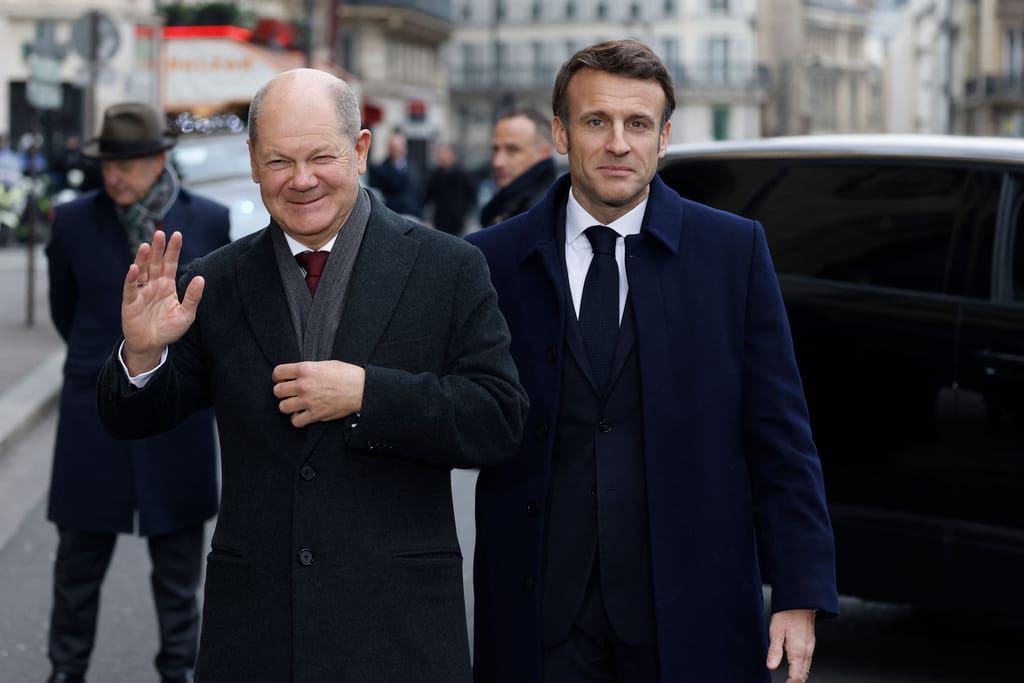 The German foreign ministry spokesperson was quick to stress that both
France and Germany were involved in shaping a joint EU-China policy
The German foreign ministry spokesperson was quick to stress that both
France and Germany were involved in shaping a joint EU-China policy
The German foreign ministry spokesperson was quick to stress that both France and Germany were involved in shaping a joint EU-China policy, which was also done in cooperation "with our transatlantic partner."
During her trip to China, Baerbock plans to raise the situation in the Taiwan Strait; Russia's war of aggression against Ukraine; the human rights situation in China; as well as the fight against climate crisis, the spokesperson said.
Baerbock's foreign ministry is also currently drafting Germany's first China strategy. A draft of this seen by POLITICO last year vowed to take a much harder line toward Beijing. Baerbock and her Green party are at the forefront of pushing such a tougher position, while Scholz has long preferred a softer approach.
Incidentally, however, the German government said Wednesday it is reassessing whether to potentially take a firmer stance and ban Chinese state company Cosco from going through with a highly controversial move to buy parts of a Hamburg port terminal.
Scholz had strongly pushed for the port deal ahead of his own trip to Beijing last year, but the future of the transaction is now in doubt after German security authorities classified the terminal as "critical infrastructure."