

Furious Microsoft boss says confidence in UK 'severely shaken'
The move was "bad for Britain" and marked Microsoft's "darkest day" in its four decades of working in the country, Brad Smith told the BBC.
The regulator hit back saying it had to do what's best for people, "not merging firms with commercial interests".
The UK's move means the multi-billion dollar deal cannot go ahead globally.
Although US and EU regulators have yet to decide on whether to approve the deal, the UK regulator the Competition and Markets Authority (CMA) said: "Activision is intertwined through different markets - it can't be separated for the UK. So this decision blocks the deal from happening globally."
If it had been approved, the $68.7bn (£55bn) deal would have been the gaming industry's biggest ever takeover, and would have seen Microsoft get hold of massively popular games titles such as Call of Duty, Candy Crush and World of Warcraft.
Both Microsoft and Activision have said they will appeal against the CMA's decision.
'Clear message'
In an interview with the BBC's Wake up to Money programme, Mr Smith said Microsoft was "very disappointed" with the CMA's decision, "but more than that, unfortunately, I think it's bad for Britain".
"It does more than shake our confidence in the future of the opportunity to grow a technology business in Britain than we've ever confronted before," he said.
"People are shocked, people are disappointed, and people's confidence in technology in the UK has been severely shaken.
"There's a clear message here - the European Union is a more attractive place to start a business than the United Kingdom."
A spokesman for Prime Minister Rishi Sunak said Mr Smith was wrong to say the CMA's decision was bad for Britain and that the EU was a better place to do business.
"Those sorts of claims are not borne out by the facts," the spokesman said, adding that the UK games sector had doubled in size over the last 10 years.
The government would continue to engage with Microsoft, he said, but pointed out that the CMA was independent.
For the deal to work, it has to be approved by regulators in the UK, the US and the EU.
The UK is the first to announce its decision, but the US Federal Trade Commission last year began a legal challenge to block the takeover.
In March, EU regulators delayed their decision after Microsoft proposed concessions to get the deal over the line.
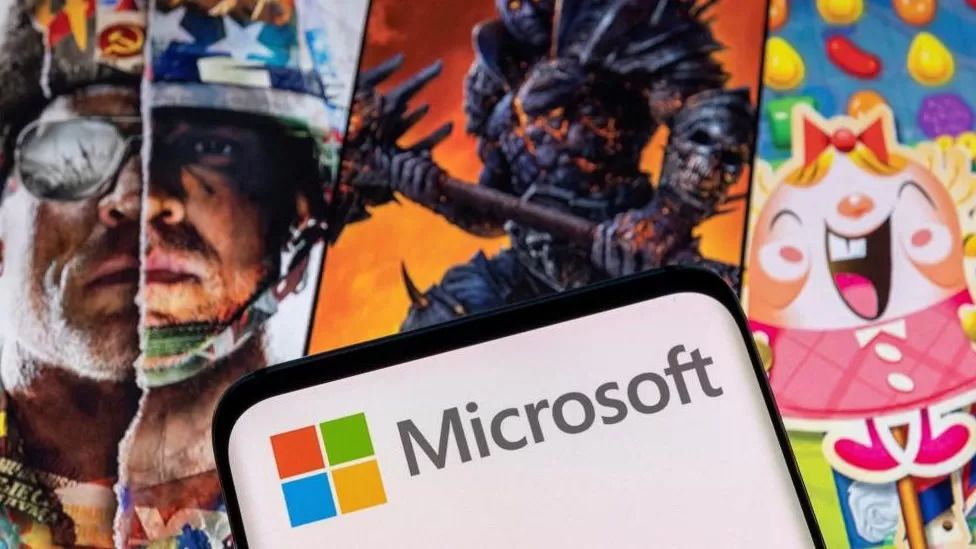 Activision Blizzard makes hit games like Call of Duty, World of Warcraft and Candy Crush
The UK government has made it one of its post-Brexit goals to bring in a "light-touch" set of rules for science and technology to encourage economic growth.
However, a number of recent takeovers of British firms by overseas ones has increased concerns that the UK market is declining in importance, and is failing to attract fast-growing tech firms.
Microsoft has already said the decision may have an impact on its UK investment.
Mr Smith said that if the UK wants to bring in investment, then "it needs to look hard at the role of the CMA and the regulatory structure".
UK 'absolutely open for business'
The CMA's chief executive, Sarah Cardell, told the Today programme that she did not agree with Mr Smith's comments.
"I think this decision shows actually how important it is to support competition in the UK and that the UK is absolutely open for business," she said.
"We want to create an environment where a whole host of different companies can compete effectively, can grow and innovate."
In its ruling on Wednesday the regulator said it was concerned the deal would hit innovation and give gamers less choice in the fast-growing cloud gaming market, where people buy subscriptions to access games online.
The merger is important for Microsoft because it sees cloud gaming as the future of the industry and wants to strengthen its position in the market.
The Activision deal would also give it some very popular games titles, allowing it to compete more effectively with rivals like Sony.
Sony's position is that if the deal went ahead, Microsoft would have an incentive to restrict access to Activision's titles to PlayStation, which would be bad for gamers.
The CMA said Microsoft already had a 60-70% share of the cloud gaming market, and combining with Activision would "really reinforce... [its] strong position".
"That would be problematic because it would really harm the ability of other competing cloud platforms to compete effectively and offer the kind of innovation and product choice that we want to see in this market," Ms Cardell said.
Gareth Sutcliffe, senior games analyst at Enders Analysis, said Microsoft had misjudged its approach.
"The signs were clear for months that this deal was in trouble with UK regulators and yet Microsoft executives didn't prioritise it or heed the evidence that it was," he told the BBC.
Mr Sutcliffe added that Mr Smith's comments about the UK were "somewhat redundant".
"They [Microsoft] had ample opportunity to do things differently over the past 16 months - they've not provided a convincing enough case."