London Daily

Focus on the big picture.
Wednesday, May 20, 2026

Fifth consecutive hike as interest rate raised to 1.25% by Bank of England

Fifth consecutive hike as interest rate raised to 1.25% by Bank of England

There is a marked shift in the Bank's outlook and plan to tackle inflation as it signals there is a chance of more aggressive action ahead to help cool the pace of price growth in the economy.

The Bank of England has raised interest rates for the fifth time in a row to 1.25% and set the scene to act more "forcefully" ahead because of a mounting inflation threat.

There had been speculation of a more aggressive tightening after the sharpest rate hike since 1994 of 0.75 percentage points was imposed by counterparts at the US central bank last night.

But the UK's Bank rate was raised by 0.25 percentage points, as financial markets and economists had expected, continuing the gradual increases that began in December last year as the rate of inflation gathered pace.

However, the Bank said on Thursday it was now forecasting that the headline rate of inflation would top 11% in the autumn - a rise of almost 1 percentage point on the figure it had expected just last month to see at the year's end.
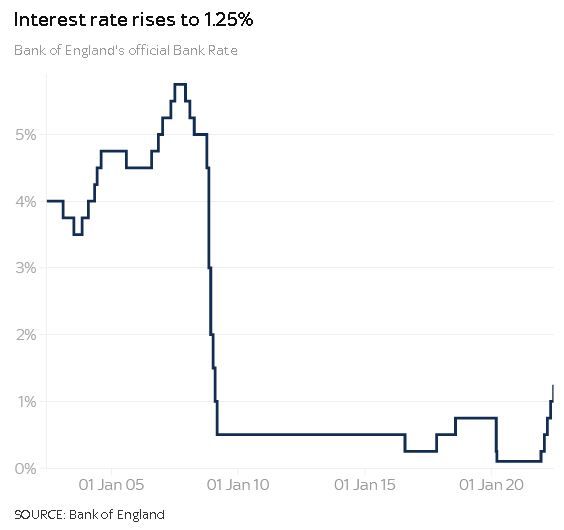

The rate-setting committee was split 6-3 on the rate hike vote, with the minority favouring a rise of 0.5 percentage points.

The BoE dropped its guidance from May when it said most committee members believed "some degree of further tightening in monetary policy may still be appropriate in the coming months".

Crucially, the minutes of the latest meeting read: "The committee will be particularly alert to indications of more persistent inflationary pressures, and will if necessary act forcefully in response."

That was seen as guidance that, as far as Bank rate is concerned, there was now a greater chance of a 0.5% percentage point increase ahead.

As the Bank was giving its update, growing fears of a global recession were continuing to take a hold of financial markets, with stock markets in Europe widely down by more than 2.5% as the recent rush for safe havens reared its head again.

The reopening of economies after the pandemic and, latterly, the effects of Russia's war in Ukraine have been responsible for the bulk of the soaring costs across the world.

The UK's main inflation measure has since hit a 40-year high, leaving economic growth intensely choked by a cost of living squeeze that is only tipped to intensify as energy, food and fuel bills rise sharply.

The anticipated rise of more than £800 in the energy price cap due in October was largely responsible for the adjustment to the Bank's inflation forecast.

Its latest rate action will mean there is further pain for millions of mortgage holders on tracker or standard variable deals.

There is some small relief for savers as savings rates lag inflation considerably.

Although many of the price increases in the economy are outside the Bank's control, it is keen to keep a lid on rises in wages for fear that levels matching the pace of price increases will only make the inflation problem worse.

Its plea for wage restraint has come under attack from unions, which argue that plunging living standards are no fault of their members.

The rail network is set to become the first national battleground in strike action expected to start next week.

Chancellor Rishi Sunak, who has delivered two rounds of financial help to help with rising living costs to date, welcomed the Bank's move but the reaction from business groups was more cautious.

Alpesh Paleja, lead economist at the CBI, a business lobby group, said: "With inflation high and price pressures remaining acute, the Bank of England has rightly raised interest rates again to anchor inflation.

"But with the outlook looking weaker, monetary policy is walking an increasingly fine line between taming inflation and supporting economic activity.

"We expect only meagre economic growth ahead, as a historic squeeze on household incomes bites hard on spending.

"Monetary policy can only do so much, and must now be coupled with government action to prevent a deeper and more prolonged downturn."

Newsletter

Related Articles

0:00
0:00
Close
'They're people from all walks of life across the UK'
EU Digital ID Claims Misstate What Brussels Can Legally Force on Member States
The Great Western Exit: Why Best Citizens Are Fleeing the Rich World [PODCAST]
The New Robber Barons of Intelligence: Are AI Bosses More Powerful Than Rockefeller?
The End of the Old Order [Podcast]
Britain’s Democracy Is Now a Costume
The AI Gold Rush Is Coming for America’s Last Open Spaces [Podcast]
The Pentagon’s AI Squeeze: Eight Tech Giants Get In, Anthropic Gets Shut Out [Podcast]
The War Map: Professor Jiang’s Dark Theory of Iran, Trump, China, Russia, Israel, and the Coming Global Shock [Podcast]
Labour Is No Longer a National Party [Podcast]
AI Isn’t Stealing Your Job. It’s Dismantling It Piece by Piece.
Lawyers vs Engineers: Why China Builds While America Litigates [Podcast]
Churchill’s Glass: The Drunk, the Doctor, and the Myth Britain Refuses to Sober Up From
Apple issues an unusual warning: this is how your iPhone can be hacked without you doing anything
Kennedy’s Quiet War on Antidepressants Sparks Alarm Across America’s Medical Establishment
The Met Gala Meets the Age of Billionaire Backlash
Russian Oligarch’s Superyacht Crosses Hormuz via Iran-Controlled Route
Gunfire Disrupts White House Correspondents’ Dinner as Trump Is Evacuated
A Leak, a King, and a Fracturing Alliance
Inside the Gates Foundation Turmoil: Layoffs, Scrutiny, and the Cost of Reputational Risk
UK Biobank Breach Exposes Health Data of 500,000, Listed for Sale on Chinese Platform
KPMG Cuts Around 10% of US Audit Partners After Failed Exit Push
French Police Probe Suspected Weather-Data Tampering After Unusual Polymarket Bets on Paris Temperatures
CATL Unveils Revolutionary EV Battery Tech: 1000 km Range and 7-Minute Charging Ahead of Beijing Auto Show
Crypto Scammers Capitalize on Maritime Chaos Near the Strait of Hormuz: A Rising Threat to Shipping Companies
Changi Airport: How Singapore Engineered the World’s Most Efficient Travel Experience
Power Dynamics: Apple’s Leadership Shakeup, Geopolitical Risks in the Strait of Hormuz, and Europe's Energy Strategy Amidst Global Challenges
Apple's Leadership Transition: Can New CEO John Ternus Navigate AI Challenges and Geopolitical Pressures?
Italy’s €100K Tax Gambit: Europe’s Soft Power Tax Haven
News Roundup
Microsoft lost 2.5 millions users (French government) to Linux
Privacy Problems in Microsoft Windows OS
News roundup
Péter András Magyar and the Strategic Reset of Hungary
Hungary After the Landslide — A Strategic Reset in Europe
Meghan Markle Plans Exclusive Women-Focused Retreat During Australia Visit
Starmer and Trump Hold Strategic Talks on Securing Strait of Hormuz Amid Rising Tensions
Unofficial Australia Visit by Prince Harry and Meghan Expected to Stir Tensions with Royal Circles
Pipeline Attack Cuts Significant Share of Saudi Arabia’s Oil Export Capacity
UK Stocks Rise on Ceasefire Momentum and Renewed Focus on Diplomacy
UK to Hold Further Strategic Talks on Strait of Hormuz Security
Starmer Voices Frustration as Global Tensions Drive Up UK Energy Costs
UK Students Voice Concern Over Proposal for Automatic Military Draft Registration
Rising Volatility Drives Uncertainty in UK Fuel and Petrol Prices
UK Moves to Deploy ‘Skyhammer’ Anti-Drone System to Strengthen Airspace Defense
New Analysis Explores UK Budget Mechanics in ‘Behind the Blue’ Feature
Man Arrested After Four Die in Channel Crossing Tragedy
UK Tightens Immigration Framework with New Sponsor Rules and Fee Increases
UK Foreign Secretary Highlights Impact of Intensified Strikes in Lebanon
UK Urges Inclusion of Lebanon in US-Iran Ceasefire Framework
×