London Daily

Focus on the big picture.
Sunday, Mar 01, 2026

Energy bills set to dip below energy price guarantee level from July, forecaster predicts

Energy bills set to dip below energy price guarantee level from July, forecaster predicts

A closely watched forecast suggests that while the taxpayer may be off the hook for energy support to households from the summer, bills will still be very high by historical standards.

A fall in wholesale energy costs means average annual bills could soon come in below the level of the government's energy support programme, according to a leading forecaster.

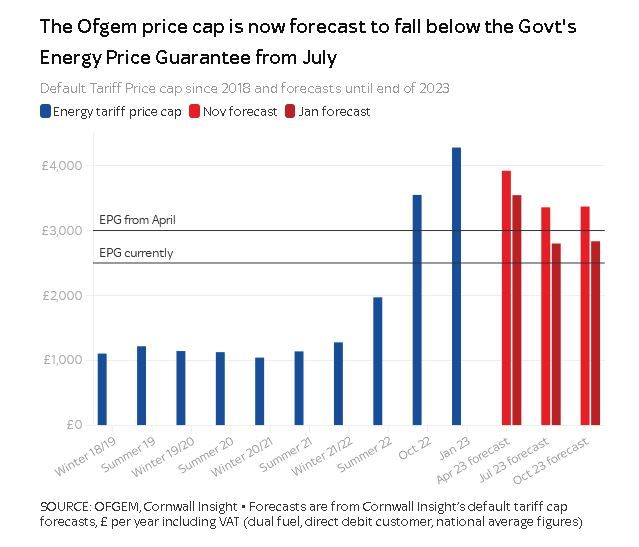
Average annual bills under the regulator Ofgem's price cap mechanism are expected to drop to around £2,800 a year from July, Cornwall Insight predicted.

This would mean the government's energy price guarantee (EPG), which limits how much a typical household pays for its wholesale energy, would no longer cost the taxpayer anything - potentially saving billions.


At the moment, if wholesale costs are above a certain level for electricity and gas, the government pays the excess.

This means an average bill of £2,500 for British households, a figure that will rise to £3,000 from April as the EPG's level of support is eased back.

Cornwall Insight predicted average annual bills of £3,545.31 between April and June - dropping sharply during the summer months from July to the £2,800 estimate.

The estimated bill is £300 above the current capped EPG rate of £2,500, but £200 below what the cap will be this summer after the EPG rises to £3,000 in April.

The EPG scheme, introduced by Liz Truss's short-lived government on 1 October, protects families from rises in energy costs by limiting the amount energy companies can charge per unit of energy used.

Behind the fall in prices is a drop in the price of wholesale gas, which dictates the overall cost of energy. Prices spiked throughout last year after Russia's invasion of Ukraine.

Consumers have been warned that bills will remain higher than in 2019, before the pandemic began.

Prices have already fallen from the high in August but it will take time for the effects of price decreases to work their way to customers. Full effects will not be seen until the third quarter of the year, from July to September, as energy suppliers buy energy ahead of time and falling day to day prices have a limited impact in the short-term.

Even if the current, comparatively low levels of wholesale prices are maintained, pressure on government to provide monetary support for bills will still remain as prices stay high. The estimated £2,800 a year cost is more than double the cost of 2021.

"While it is positive to see a drop in the price cap forecast, household bills are set to remain high," said Dr Craig Lowrey, principal consultant at Cornwall Insight said.

"With the Energy Price Guarantee rising in April, the second half of the year will still see a typical household facing bills that are well above historic levels and facing costs that many can ill afford."

Energy bill supports will need to be reviewed, he added. "It is clear that blanket measures of bill support are not providing adequate protection for the most vulnerable and more targeted measures including social tariffs may be something for the government to consider."

"While the details of future support are best left up to the judgement of politicians, the forecasts demonstrate we must look beyond the current policy if we are to see a fairer, more cost-efficient and enduring way of reducing household energy bills for those who need it the most."

Newsletter

Related Articles

0:00
0:00
Close
When the State Replaces the Parent: How Gender Policy Is Redefining Custody and Coercion
Bill Clinton Denies Knowing Woman in Hot Tub Photo During Closed-Door Epstein Deposition
Former U.S. President Bill Clinton Testifies on Ties to Jeffrey Epstein Before Congressional Oversight Committee
Dyson Reaches Settlement in Landmark UK Forced Labour Case
Barclays and Jefferies Shares Fall After UK Mortgage Lender Collapse Rekindles Credit Market Concerns
Play Exploring Donald Trump’s Rise to Power by ‘Lehman Trilogy’ Author to Premiere in the UK
Man Arrested After Churchill Statue Defaced in Central London
Keir Starmer Faces Political Setback as Labour Finishes Third in High-Profile By-Election
UK Assisted Dying Bill Set to Fall Short in Parliament as Regional Initiatives Gain Ground
UK Defence Ministry Clarifies Position After Reports of Imminent Helicopter Contract
Independent Left-Wing Plumber Secures Shock Victory as Greens Surge in UK By-Election
Reform UK Refers Alleged ‘Family Voting’ Incidents in By-Election to Police
United Kingdom Temporarily Withdraws Embassy Staff from Iran Amid Heightened Regional Tensions
UK Government Reaches Framework Agreement on Release of Mandelson Vetting Files
UK Police Contracts With Israeli Surveillance Firms Spark Debate Over Ethics and Oversight
United Airlines Passenger Hears Cockpit Conversations After Accessing In-Flight Audio Channel
Spain to Conduct Border Checks on Gibraltar Arrivals Under New Post-Brexit Framework
Engie Shares Jump After $14 Billion Agreement to Acquire UK Power Grid Assets
BNP Paribas Overtakes Goldman Sachs in UK Investment Banking League Tables
Geothermal Project to Power Ten Thousand Homes Marks UK Renewable Energy Milestone
UK Visa Grants Drop Nineteen Percent in 2025 as Migration Controls Tighten
Barclays and Jefferies Among Banks Exposed to Collapse of UK Mortgage Lender MFS
UK Asylum Applications Edge Down in 2025 Despite Rise in Small Boat Crossings
Jefferies Reports Significant Exposure After Collapse of UK Lender MFS
FTSE 100 Reaches Fresh Record Highs as Major Share Buybacks and Earnings Lift London Stocks
So, what's happened is, I think, government policy, not just under Labour, but under the Conservatives as well, has driven a lot of small landlords out of business.
Larry Summers, the former U.S. Treasury Secretary, is resigning from Harvard University as fallout continues over his ties to Jeffrey Epstein.
U.S. stocks ended higher on Wednesday, with the Dow gaining about six-tenths of a percent, the S&P 500 adding eight-tenths of a percent, and the tech-heavy Nasdaq climbing roughly one-and-a-quarter percent.
From fears of AI-fuelled unemployment to Big Tech's record investment, this is AI Weekly.
Apple just dropped iOS 26.4.
US Lawmakers Seek Briefing from UK Over Reported Encryption Order Directed at Apple
UK Business Secretary Calls on EU to Remove Trade Barriers Hindering Growth
Legal Pathways for Removing Prince Andrew from Britain’s Line of Succession Examined
PM Netanyahu welcome India PM Narendra Modi to Israel
Shadow Diplomacy: How Harry and Meghan’s Jordan Trip Undermines the Monarchy
Sir Jim Ratcliffe, co-owner of Manchester United, comments on immigration in the UK.
Bill Gates, the UN and the WEF are attempting to construct "a giant digital gulag for all of humanity" via digital ID, CBDCs and vaccine passport infrastructure.
Britain’s Channel Crisis: Paying Billions While the Boats Keep Coming
Downing Street’s Veteran Deception Scandal
UK HealthCare Expands ‘Food as Health’ Initiative Statewide to Tackle Chronic Illness in Kentucky
Leonardo Chief Says UK Set to Decide on New Medium Helicopter Programme
UK Slows Chagos Islands Agreement After Concerns Raised in Washington
European and UK Stock Markets Reach Fresh Highs as Banks and Miners Lead Rally
UK Government Insists Chagos Islands Negotiations Continue After Minister’s ‘Pause’ Remark
No Confirmed Deal for Engie to Acquire UK Power Networks Amid Market Speculation
UK Reaffirms Updated Entry Requirements for Travellers as of February 25, 2026
General Atlantic to sell equity stake in ByteDance, valuing the company at $550 billion
German Chancellor Friedrich Merz Secures Pledge from China for Greater Imports of Quality Goods
Lord Mandelson Condemns Arrest as Driven by ‘Baseless Suggestion’ He Would Flee Abroad
Former UK Ambassador Released on Bail Following Arrest in Epstein-Linked Investigation
×