London Daily

Focus on the big picture.
Wednesday, Jun 24, 2026

Energy bills: Customers can't carry cost of Ukraine war, boss says

Energy bills: Customers can't carry cost of Ukraine war, boss says

UK households cannot carry the cost of the Ukraine war which is set to push energy bills even higher, the boss of Octopus Energy has said.

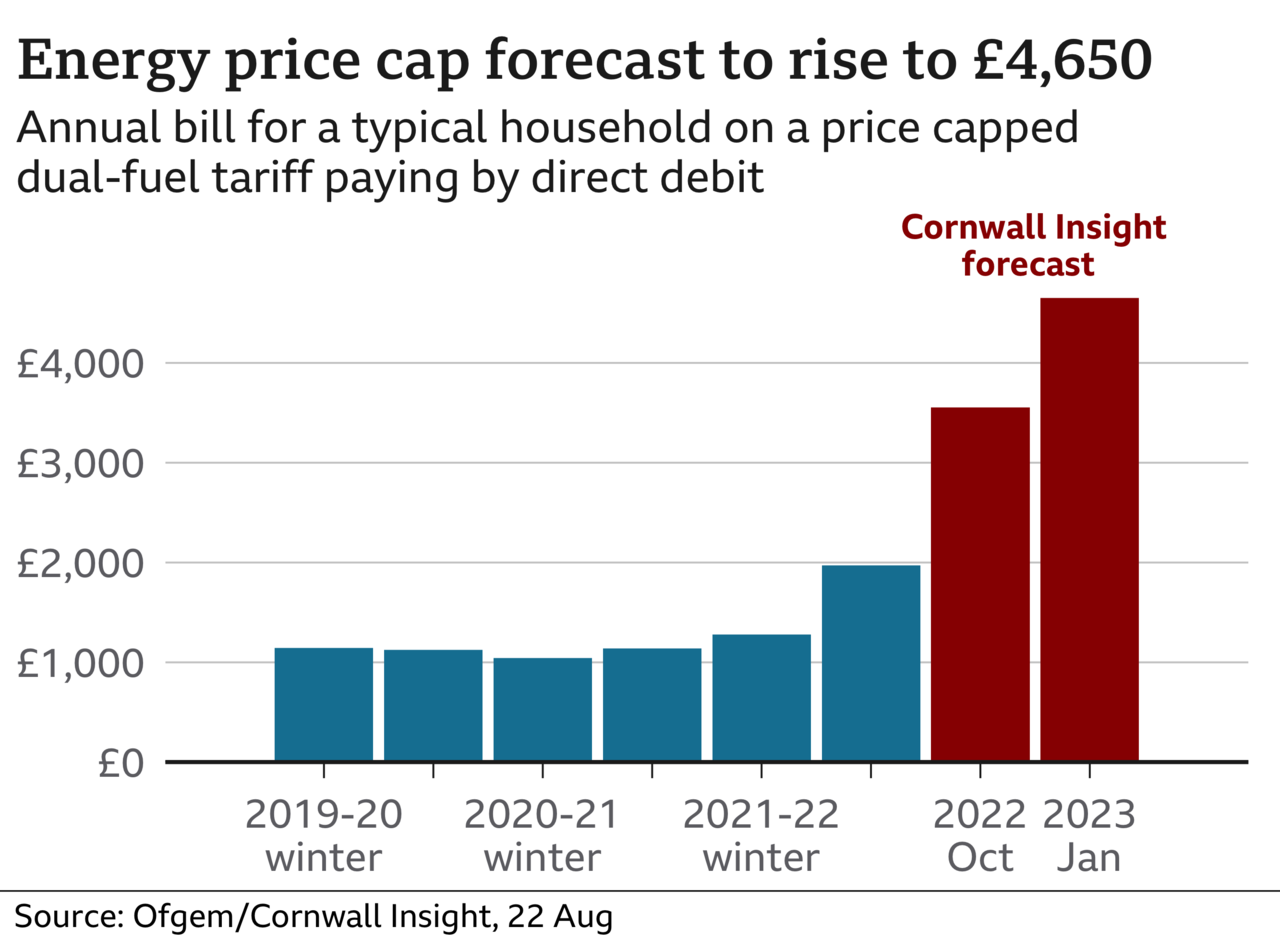
Greg Jackson was speaking as UK households brace for average energy bills to reach a predicted £3,554 a year in October and £4,650 in January.

He called for the government to double its financial support or freeze the amount suppliers can charge for energy.

No 10 previously said there would be no new policy before a new PM is in place.

The new Conservative Party leader will be announced on 5 September and will face immediate pressure to tackle the nation's energy bills.

The current favourite, Liz Truss, has promised tax cuts and recently hinted at direct financial help for hard-pressed households.

Her rival, Rishi Sunak, has said he would introduce more targeted support for households, and has promised to reduce VAT on domestic energy bills from 5% to zero.

The upcoming jump in energy prices has prompted investment bank Citi to raise his forecast of UK inflation to 18% in early 2023.

Inflation - the rate at which prices rise - is currently at 10.1% and the Bank of England's target is 2%.

On Friday, the energy price cap - the maximum amount suppliers can charge customers in England, Scotland and Wales for each unit of energy - will be announced.

Energy prices have risen sharply because demand for gas increased when Covid restrictions eased while the war in Ukraine has disrupted supplies from Russia.

Mr Jackson, founder and chief executive of Octopus Energy Group, said: "You can't expect the energy customers, or indeed the retailers to carry the cost of a war."

Asked what the solution could be, he told BBC Radio 4's Today programme the government "could double the existing support package".

In October, all UK households will get a £400 discount on their fuel bills and some eight million low-income households will get an additional £650.

Plans to enable households to get discounts on electricity bills if they cut use at peak times are set to be announced by the National Grid in the next two weeks.

Mr Jackson also suggested a "tariff deficit fund" which would involve the government freezing the energy price cap roughly where it is.

The government would borrow money from banks to pay the difference between the wholesale cost and the price to the consumer while energy prices were high.

This money would be paid back when energy prices came down, he said.

Dale Vince, chief executive of renewable energy generator and supplier Ecotricity, told the BBC: "The government does need to intervene we shouldn't expect customers to pay the cost of this failure and the Ukraine war."

He said the problem pre-dated the invasion of Ukraine and there was a "systemic failure in the energy market".

But he said the deficit scheme Mr Jackson had outlined would force taxpayers to foot the bill over the next decade.

"The government simply needs to step in and pick up this cost like it did in the pandemic," he said.

"We need £40bn to get through this winter. That's 10% of what was spent during the pandemic and that's the only thing that will really sort this problem out."


This summer has seen forecasts, suggestions and a lot of political debate. What it has not seen is certainty.

On Friday, households will finally be told exactly by how much domestic energy bills will rise in October. Remember, individual bills will vary, depending on how much gas and electricity you use. But the percentage increase in the domestic energy price cap for England, Wales and Scotland will be official and expressed in clear terms.

Energy will be more expensive, but at least people will have some basis to plan for the financial hit.

That said, the uncertainty won't be over. What extra support, if any, that is provided by government won't be clear until a new prime minister is in place. Energy prices for the second half of the winter are also unclear.

Energy bosses say fundamental change in the sector doesn't come quickly, but help for householders facing soaring bills as the nights draw in cannot come quickly enough.

Meanwhile Bill Bullen, founder and chief executive of energy supplier Utilita,said that energy prices must be frozen at their current level.

"That's not going to be enough even still for those customers who are on low incomes and vulnerable, maybe have some medical dependencies so some extra help is going to be required," he said.

He added: "The reality is when you get up to £3,500 a huge number of homes won't be able to afford this."

Mr Vince said there needed to be an overhaul of how electricity prices were decided.

"The price of gas sets the price of electricity in our country and we should break that link - other European countries are looking to do exactly that," he said.

"We let global commodity markets set the price that we pay for gas from our own North Sea and we are paying up to 10 times more for that right now."

He added: "Half of the gas that Britain uses come from our North Sea if we price cap that we take away half the problem."


Newsletter

Related Articles

0:00
0:00
Close
UK Biotechnology Sector Receives Increased Public Funding to Support Regional Growth
Police Chiefs Update National Protest Management Guidelines Amid Rising Demonstration Activity
UK Aviation Regulator Expands Support for Regional Airports to Strengthen Domestic Routes
CMA Launches Investigation Into Retail Pricing Across UK Grocery Sector
UK Energy Operator Warns of Winter Supply Pressures Despite Stable Overall Grid Outlook
UK Research Council Expands Funding for Regional Biotechnology and Life Sciences Clusters
UK Compensation Scheme for Post Office Horizon Scandal Reaches 80 Percent Completion
Police Chiefs Issue Updated National Guidance on Managing Large Public Demonstrations
UK Expands Regional Airport Funding Scheme to Boost Domestic Connectivity
UK Competition Watchdog Launches Inquiry Into Grocery Pricing Practices
National Grid Warns of Tight Energy Management Needs During Upcoming Winter Peak Demand
UK Education Department Introduces National Standards for AI Use in Secondary Schools
UK High Court Clears North Sea Carbon Capture Project After Final Legal Challenge Fails
Northern Ireland Leaders Hold Emergency Talks on Trade Disruption Under Windsor Framework
Welsh Government Moves to Expand Social Housing in Response to Severe Affordability Pressures
UK Economy Sees Unexpected Rise in Business Investment in Second Quarter, ONS Data Shows
Scottish Government Unveils Multi-Billion Pound Investment Plan for Renewable Energy and Grid Expansion
UK and EU Agree Enhanced Defence Cooperation Pact Covering Intelligence and North Sea Security
Prime Minister Orders Independent Review of NHS Performance After Record Waiting Lists
Bank of England Holds Interest Rates at 5 Percent as Services Inflation Remains Persistent
UK Heatwave Disrupts Transport, Healthcare and Public Services as Red Weather Alerts Expand Nationwide
Barclays Warns of Growing Cyber Risk Divide Between Large UK Firms and Micro Businesses
European Defence Plans Including Ukraine Integration Prompt UK Strategic Reassessment
UK Equity Markets React as US–Iran Peace Roadmap Eases Oil Price Pressures
United Kingdom Expands Global Clean Energy Partnerships With Brazil, Morocco and Tanzania
Lord David Frost Urges Incoming UK Leadership to Abandon EU Regulatory Reset Strategy
Housing Groups Support Amendment to Strengthen Fire and Gas Safety Access Powers in Social Housing
South London NHS Estates Staff Ballot on Industrial Action Over Pay Structures in Hospital Maintenance Services
United Kingdom Government Invests £60 Million in AI Research Labs at Oxford and University College London
Barclays Cyber Security Report Highlights Rising Threat Exposure Among UK Small Businesses in AI-Driven Attacks
UK Met Office Heatwave Triggers Transport Warnings as Rail Operators Urge Cancellations Amid Infrastructure Strain
South London NHS Estates Workers Ballot for Strike Action Over Pay Disputes Across Major London Hospitals
Barclays Warns of Severe Cyber Security Gap Between Large Corporations and Small Businesses in the United Kingdom
United Kingdom Government Allocates £60 Million for Artificial Intelligence Research Laboratories at Oxford and UCL
National Health Service Approves Teplizumab Treatment to Delay Onset of Type One Diabetes in First European Rollout
Met Office Issues Rare Red Extreme Heat Warning Across London, South East and West Midlands as Transport and Health Systems Face Disruption
Prime Minister Keir Starmer Resigns After Labour Party Revolt Following Economic Stagnation and Local Election Losses
United Kingdom Economy Contracts for Second Consecutive Month as Private Sector Weakens and Job Loss Fears Rise
Taxpayer Support Grows for Higher Digital Levies on Multinational Tech Companies
Bank of England Signals Caution Over Inflation Despite Easing Energy Prices
Lloyds Banking Group Expands Artificial Intelligence Hiring Amid Sector-Wide Automation Shift
Film Producer Corporate Collapse Leaves Creditors Facing Unrecoverable Losses
UK Ten-Year Brexit Anniversary Highlights Ongoing Political and Economic Uncertainty
Nottingham Maternity Scandal Inquiry Reveals Systemic Failings in NHS Care
Met Office Heatwave Prompts Public Health Warnings Across United Kingdom
Concerns Rise Over Fiscal Stability as Political Uncertainty Weighs on UK Borrowing Costs
UK Taxpayers Back Higher Digital Taxes on Global Technology Firms, Survey Shows
Bank of England Holds Interest Rates Steady Amid Persistent Services Inflation
Reform UK and Opposition Leaders Call for General Election Following Starmer’s Departure
Ten Years After Brexit Referendum, UK Faces Ongoing Political Fragmentation and Economic Debate
×