London Daily

Focus on the big picture.
Thursday, Jun 11, 2026

Covid: Will Scotland hit its January booster jabs target?

Covid: Will Scotland hit its January booster jabs target?

Accelerating the booster vaccination programme has become the UK's main line of defence against the Omicron variant.

There are fears the strain could be more infectious, cause more serious illness and be better at evading vaccines than previous variants.

Every adult in Scotland will now be offered a booster, following the latest guidance from the JCVI - the UK government's vaccine advisors.

More than 1.7 million boosters have been delivered so far and the Scottish government says all eligible over-18s will be offered one by the end of January.
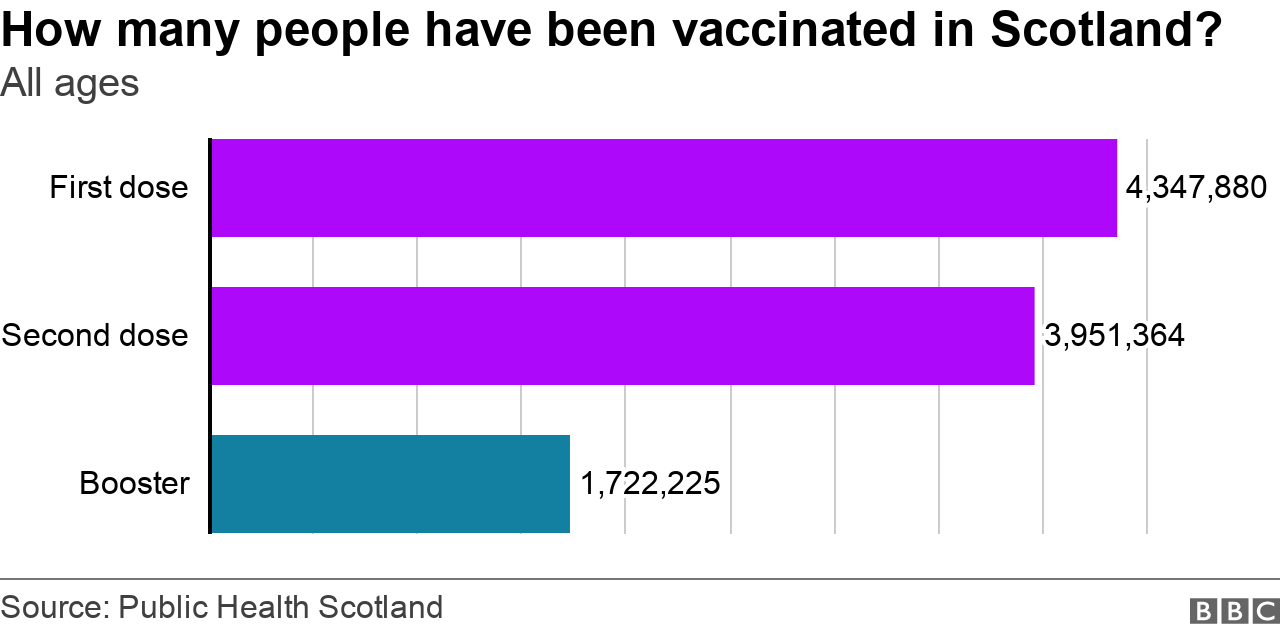

How easy will it be to meet the January target? At first glance, it's an easy question to answer.

As of 30 November, about 3.92 million adults in Scotland have had a second dose of a Covid vaccine and will need a booster shot.

Take away the number of boosters already delivered to over-18s (close to 1.7 million) and you're left with about 2.2 million people who will need the jab.

Given current vaccination rates, Scotland would need about 70 days to complete the booster programme, taking us into the second week of February.

However, that number of eligible adults is growing every day as more people receive second doses.

To add a bit more complexity, not everyone in that group is eligible right now. Even if it were possible to line up 2.2 million people and jab them in a single day, you wouldn't want to do it.

There needs to be a period of time between the second and third doses - there's no point in boosting immunity if it hasn't already started to wane.

That period was six months, but has now been reduced to three months following new guidance from the JCVI, the UK government's vaccine advisors.

So how do we figure this out?

The first part of the equation is to estimate how many boosters a day are likely to be delivered over the coming months.

Delivering booster shots became the focus of Scotland's vaccination programme in September and the number of first and second doses being given each day has reduced significantly since the summer.


We can see from Public Health Scotland figures that over the past two weeks an average of 32,158 boosters have been given to over-18s each day.

Clearly this figure could change over time.

It could go up if the Scottish government directs more resources towards vaccination - or it might go down during the Christmas holiday period.

However, it does give us a reasonable figure to project vaccination rates over the next few months.

The next part of the equation - working out how many over-18s will be eligible for a booster over the coming months - is easier.

That three-month delay between doses means we know exactly how many over-18s will become eligible between now and the end of February.

By plotting the number of eligible people against the estimated number of vaccinations we can see where the lines cross, which is the point where the booster gap will be closed.

Given current vaccination levels, this will be around 5 February.
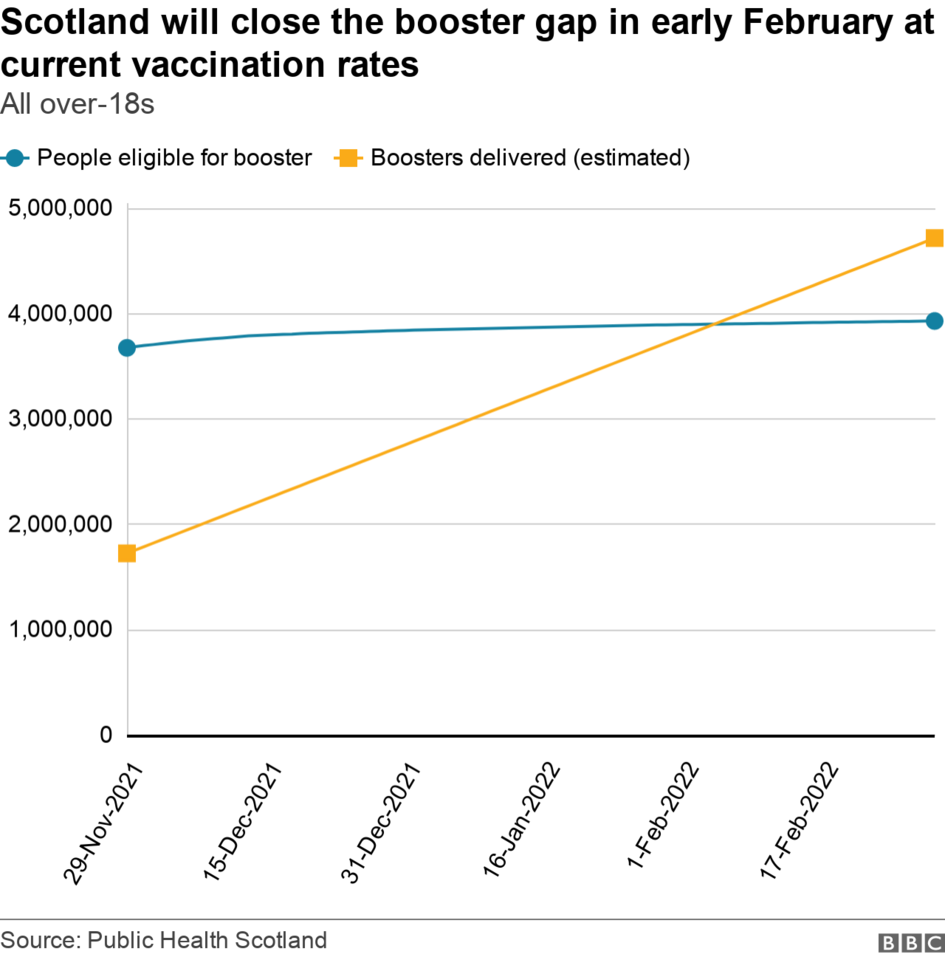

If we wanted to get those two lines to cross by the end of January, we'd need to be delivering about 34,000 jabs a day - 5.7% higher than current levels.

There's also a continuing demand for first and second doses to keep up with, especially in the youngest age groups.

The Scottish government says it's "aiming to offer the booster vaccine to everyone aged 18 or older who is eligible by the end of January". Boris Johnson has set the same target for England.

A Scottish government spokesperson also told the BBC that its approach to vaccine deployment would be confirmed "very soon".

Offering the vaccine is, of course, different to actually getting a jab into an arm. It's also worth noting that the job won't be complete at the end of January.

More people will continue to become eligible for a booster, but the number will start to dwindle as second dose coverage moves closer to 100%, and by then it should be easier to keep up with demand.

Newsletter

Related Articles

0:00
0:00
Close
Office for National Statistics Adopts Supermarket Checkout Data for Inflation Measurement
Applied Atomics Launches With $500 Million Space Infrastructure Order Book
BYD Plans Nationwide Rollout of Ultra-Fast EV Charging Network
UK House Prices Unexpectedly Fall in May
CBI Warns UK Growth Is Becoming Increasingly Dependent on Public Spending
Makerfield By-Election Fuels Speculation Over Labour’s Future Leadership
Britain Declines to Join EU SAFE Defence Fund
UK Unveils 2040 Emissions Target Despite Strong Political Opposition
Government Orders Full Review of Palantir’s NHS Data Contract
UK Borrowing Costs Climb as Markets Price in Further Bank of England Rate Rises
Resident Doctors Confirm Five-Day NHS Strike Across England
Violent Anti-Immigrant Riots in Belfast Spark Political and Diplomatic Tensions
United Kingdom Sees Recovery in Horizon Europe Research Funding Share to 9.3 Percent
UK Inflation Holds at 2.8 Percent as Office for Budget Responsibility Flags Persistent Price Pressures
United Kingdom Launches National Anti-Fraud Framework to Combat Rising Pension Scam Losses
United Kingdom Expands Sanctions on Israeli Groups While Funding Palestinian Authority Salaries and Gaza Mine Clearance
United Kingdom Issues Three-Month Ultimatum to Major Technology Firms Over Child Online Safety Controls
United Kingdom Government Moves Toward Blanket Social Media Ban for Children Under Sixteen
Widespread Anti-Immigration Rioting Erupts Across Belfast After Knife Attack Linked to Asylum Seeker
Farmers Warn of Crop Losses Following Months of Unseasonal Rainfall
Civil Aviation Authority Launches Review of Regional Airport Operations
Met Office Issues Heat-Health Alert Across Parts of England
National Grid Introduces New Measures to Protect Winter Energy Supply
Northern England Rail Upgrades Receive Additional Government Funding
Wales Advances Green Hydrogen Strategy to Decarbonize Heavy Industry
UK Expands Recruitment Incentives to Address Shortage of STEM Teachers
High Court Opens Door to Climate Liability Claims Against Major Industrial Emitters
Police Service of Northern Ireland Investigates Major Personnel Data Breach
Defense Ministry Overhauls Procurement System to Accelerate AUKUS Submarine Program
Net Migration Remains Above Government Expectations, New Data Shows
UK and Scottish Governments Agree Framework for Expanded North Sea Wind Development
UK Treasury Launches New Tax Incentives to Boost AI and Semiconductor Investment
Bank of England Signals Continued Caution on Interest Rate Cuts
UK Unveils £10 Billion NHS Digital Modernization Plan Centered on AI Integration
Nebius Opens Major Robotics and Physical AI Laboratory in London
Bank of England Data Shows Strong Rise in New Mortgage Approvals
Network Rail Completes Landmark Upgrade of Severn Tunnel Rail Infrastructure
East West Rail Passenger Services Between Oxford and Milton Keynes Set for December Launch
GlaxoSmithKline Reportedly Pursues £7 Billion Acquisition of US Cancer Drug Developer Nuvalent
Bank of England Signals Interest Rates Likely to Remain Unchanged Despite Energy Market Risks
NHS Trusts Launch Job-Cutting Programmes as Financial Pressures Intensify Across England
More Than 130 Labour MPs Urge Ban on Trade With Israeli Settlements
Keir Starmer Orders Technology Firms to Introduce Smartphone Nudity Controls for Under-18s
UK Unveils £400 Million National AI Supercomputer Fund and New Economics Institute
Japanese Technology Firm Fujitsu Launches Advanced Artificial Intelligence Tool for Corporate Disclosures
South Africa Officially Launches Nationwide Campaign for Highly Contested Local Government Elections
United Kingdom Commits Additional Funding for Unexploded Ordnance Clearance in Laos
Singapore Announces Stringent New Greenhouse Gas Regulations for Commercial Cooling Systems
Cambodia and Thailand Hold High-Level Border Security Talks at United Nations Headquarters
Myanmar Military Government and China Sign Major Agreement to Upgrade Media and Cultural Cooperation
×