

Could Boris Johnson lose his seat in the next election?
Could Boris Johnson lose his seat at the next general election? It’s a question that would have been risible for any other prime minister, but defeat in his Uxbridge and South Ruislip constituency is not unthinkable.
The local elections in London earlier this month saw a substantial swing towards Labour. A YouGov poll this weekend suggests Johnson would lose his seat if an election were held tomorrow. Electoral Calculus, which analyses national polling data, is also tentatively favouring a Labour win in the west London constituency.
“He’s hanging on at the top, which pleases me no end because he’s such an unpopular guy now,” said David Williams, chairman of Hillingdon Labour. “Locally, he’s not a political asset – he didn’t appear in the local elections. So I want to see him go and I want him to stay at the same time – it’s a very strange feeling.”
It would require a hefty swing to overcome Johnson’s 15% majority. But Williams said constituency boundary changes will add Northolt to the seat, a town he calls “a strong Labour area”. Meanwhile, young commuters are streaming from inner London to outer boroughs, and Hillingdon is no exception, especially with a new Elizabeth line station in Johnson’s constituency.
Perhaps the biggest local issue is the future of Heathrow’s third runway. Tory controlled Hillingdon council is also struggling with a £38m deficit, despite a £25m government bailout in March. One of the solutions is to build more housing, which attracts more council taxpayers and section 106 payments from developers, earmarked for new amenities.
But the electoral cost of development is felt in places like Yiewsley, a battleground in the south of the constituency. Labour took both council seats from the Tories in May, fuelled by opposition to the council’s plans to replace the library with a six-storey block of flats and new library, with some of it on car parking for Yiewsley Park. The swimming pool was demolished 14 years ago and the land is still vacant despite promises of a new leisure centre. With threats by the campaign groups of judicial reviews and protests, the issue looks likely to drag on into next year and beyond, making it a hot local issue for Johnson.
Debbi King, of the Yiewsley.org campaign group, said: “It will have a big impact – it has just been forced through so far.” Johnson’s responses have been neutral until now, but coming out against the plans would mean a confrontation with Tory councillors who already blame Downing Street for their financial difficulties.
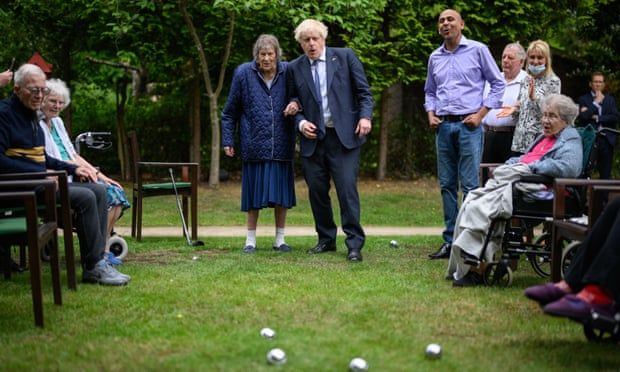 Boris Johnson plays boules with care-home residents in the Uxbridge and South Ruislip constituency he has held since 2015.
The issue comes up on Yiewsley’s high street. Outside a branch of Wenzel’s the Bakers, Paula Grimes, a charity worker, feels betrayed by the council’s approach to the swimming pool and Yiewsley Park, although she voted for Johnson last time and will do again. “There’s a lot of things bigger than lockdown parties,” she said, mentioning Ukraine and rising food prices. “I don’t think people could cope with a big change.”
Her partner, Daniel McGuinness, disagrees vehemently. He resents Johnson’s decision to lockdown during the pandemic. “I have absolutely no time for the man whatsoever,” he said. “He comes across as a buffoon. I struggled during lockdown.”
Johnson will be happier about divisions between Labour’s headquarters and Hillingdon’s left-leaning activists. Williams said the party was hampered in the local elections because they were not allowed to select candidates until shortly before the deadline for nominations. “The national party is holding back on us selecting a [parliamentary] candidate,” he said. There is no shortage of strong contenders though. “Everyone wants to be the knight that slays the dragon.”
Senior Labour figures say that Uxbridge and South Ruislip would have to be among the 125 seats Labour wins if it is to secure a majority at the next election. In fact, according to Electoral Calculus, it would fall to Labour even if the party was 25 seats short of an overall majority.
However, prime ministers have a much larger personal vote than most MPs. Margaret Thatcher held Finchley comfortably despite it not being a theoretically safe seat, according to Electoral Calculus’s founder, Martin Baxter. Johnson’s seat “looks competitive”, he said. “What probably won’t happen is that Johnson would lose his seat but the Conservatives stay in power. The PM can’t lose his own seat without the Conservatives losing their parliamentary majority.”
One senior Tory familiar with the area said a huge upset “is possible” and Johnson could lose, suggesting that liberal Tories who backed David Cameron and Theresa May were deeply unimpressed with the PM. However, he said non-traditional Tory voters still liked Johnson.
“It’s fair to say that anybody at any stage these days can be in trouble,” he said. “Anything is possible. But the local council is Conservative and popular. There are good campaigners there, and Johnson got more than 50% of the vote last time. I think the economy will be the thing – and how people are feeling personally. It’s also possible that he doesn’t stand again, if he goes.”
But there are other options for Johnson. He could do the “chicken run” and stand in a different seat, although doing so might be seen as conceding defeat – a bad look for a prime minister. Assuming, of course, that by the time the next election rolls around, he is still in No 10.

