London Daily

Focus on the big picture.
Saturday, Feb 28, 2026

Cost of living: Inflation takes toll as UK economy contracts in March

Cost of living: Inflation takes toll as UK economy contracts in March

Families and businesses are straining under a weight of global price increases largely caused by demand outstripping supply as the COVID crisis eases and, latterly, the effects of Russia's war in Ukraine. Chancellor Rishi Sunak admits Britons are facing "anxious times".

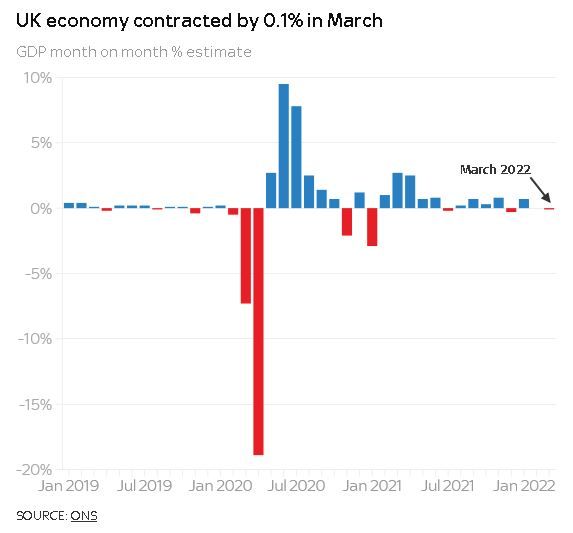
The UK economy contracted by 0.1% in March, as surging inflation took a toll on demand to offset the boost that had been expected from the end of COVID restrictions.

The monthly figure compares to no growth in February and 0.7% growth in January, while the quarterly figure (between January and March) showed a growth of 0.8%, which was down from 1.3% in the previous three months.

Chancellor Rishi Sunak said: "The UK economy recovered quickly from the worst of the pandemic and our growth in the first few months of the year was strong - faster than the US, Germany and Italy, but I know these are still anxious times.

"Our recovery is being disrupted by Putin's barbaric invasion of Ukraine and other global challenges, but we are continuing to help people where we can.
Advertisement

"Growth is the best way to help families in the longer-term so as well as easing immediate pressure on households and businesses, we are investing in capital, people, and ideas to boost living standards in the future."

The Office for National Statistics (ONS) data was released as alarm bells ring over the country's economic prospects, with the Bank of England warning last week that a recession loomed large due to the cost of living crisis.

Families and businesses are straining under a weight of global price increases largely caused by demand outstripping supply as the COVID crisis eases and, latterly, the effects of Russia's war in Ukraine.

No let-up in inflation


Separate figures released by the ONS next week are tipped by economists to show inflation nearing a 40-year high in April, at around 8.5%.

The leap, from the March level of 7%, will be mostly a consequence of higher energy costs being passed on down the supply chain, raising the cost of doing business and ultimately the cost of everyday goods and services.

There is also one direct price shock to be reflected for the first time: the unprecedented £693 hike in the energy price cap for households that took hold on 1 April.

Alice Haine, personal finance analyst at DIY investment platform Bestinvest, said: "There is a high risk of an ongoing contraction in the coming months as the squeeze on real incomes ramps up amid the cost-of-living crisis, with inflation heading for double figures, all of which raises the spectre of stagflation (a combination of negative or stagnant economic growth and high inflation)."

Daniel Casali, chief investment strategist at Tilney Smith & Williamson, said: "Importantly for the UK economy, both labour demand and business investment intentions remain firm.

"This should at least reduce the risk of a sharp downturn in overall growth. The Bank of England expects GDP to be flat in the second quarter, though there is the potential for a modest contraction."

'There is nobody around'


For many small business owners, however, the situation is already desperate.

Barry Whitehouse, owner at Banbury-based art shop, The Artery, said: "We have just had one of our worst weeks since the previous recession. Total takings for the week didn't even cover the wages of the staff.

"Loss of footfall and empty streets makes creating a sale or greeting a customer impossible. There is nobody around.

"Online sales have fallen sharply as everyone has one eye on their energy bills to see what money is left, and there is suddenly a drop in enquiries for shop items and our classes.

"I am really worried.

"My savings have gone, and I have nothing left to keep the business afloat without sales and footfall. I will not survive many more weeks like this."

'A theatre of cruelty'


Sandra Wilson, director of Ipswich-based recruitment and HR firm Cottrell Moore, said: "The UK economy is starting to feel like a theatre of cruelty.

"Whether you're a pessimist or an optimist, the reality is the same: we are all paying out more and most of us aren't earning more.

"The economic sea is getting extremely choppy, and many people will go overboard if the government doesn't take action immediately."

'Economy headed for the slaughterhouse'


Dave Kelly, co-founder of Bristol-based butcher Ruby & White, said: "Right now, it feels like the UK economy is headed for the slaughterhouse.

"Inflation, soaring energy bills, tax, and interest rate rises are crippling households around the country. Worst of all, it feels like the government is watching on and doing nothing.

"For us, sales are still holding up for now, but we are seeing slightly more people order cheaper cuts. We're probably being helped by the fact that more people are choosing to stay in than go out."


Newsletter

Related Articles

0:00
0:00
Close
When the State Replaces the Parent: How Gender Policy Is Redefining Custody and Coercion
Bill Clinton Denies Knowing Woman in Hot Tub Photo During Closed-Door Epstein Deposition
Former U.S. President Bill Clinton Testifies on Ties to Jeffrey Epstein Before Congressional Oversight Committee
Dyson Reaches Settlement in Landmark UK Forced Labour Case
Barclays and Jefferies Shares Fall After UK Mortgage Lender Collapse Rekindles Credit Market Concerns
Play Exploring Donald Trump’s Rise to Power by ‘Lehman Trilogy’ Author to Premiere in the UK
Man Arrested After Churchill Statue Defaced in Central London
Keir Starmer Faces Political Setback as Labour Finishes Third in High-Profile By-Election
UK Assisted Dying Bill Set to Fall Short in Parliament as Regional Initiatives Gain Ground
UK Defence Ministry Clarifies Position After Reports of Imminent Helicopter Contract
Independent Left-Wing Plumber Secures Shock Victory as Greens Surge in UK By-Election
Reform UK Refers Alleged ‘Family Voting’ Incidents in By-Election to Police
United Kingdom Temporarily Withdraws Embassy Staff from Iran Amid Heightened Regional Tensions
UK Government Reaches Framework Agreement on Release of Mandelson Vetting Files
UK Police Contracts With Israeli Surveillance Firms Spark Debate Over Ethics and Oversight
United Airlines Passenger Hears Cockpit Conversations After Accessing In-Flight Audio Channel
Spain to Conduct Border Checks on Gibraltar Arrivals Under New Post-Brexit Framework
Engie Shares Jump After $14 Billion Agreement to Acquire UK Power Grid Assets
BNP Paribas Overtakes Goldman Sachs in UK Investment Banking League Tables
Geothermal Project to Power Ten Thousand Homes Marks UK Renewable Energy Milestone
UK Visa Grants Drop Nineteen Percent in 2025 as Migration Controls Tighten
Barclays and Jefferies Among Banks Exposed to Collapse of UK Mortgage Lender MFS
UK Asylum Applications Edge Down in 2025 Despite Rise in Small Boat Crossings
Jefferies Reports Significant Exposure After Collapse of UK Lender MFS
FTSE 100 Reaches Fresh Record Highs as Major Share Buybacks and Earnings Lift London Stocks
So, what's happened is, I think, government policy, not just under Labour, but under the Conservatives as well, has driven a lot of small landlords out of business.
Larry Summers, the former U.S. Treasury Secretary, is resigning from Harvard University as fallout continues over his ties to Jeffrey Epstein.
U.S. stocks ended higher on Wednesday, with the Dow gaining about six-tenths of a percent, the S&P 500 adding eight-tenths of a percent, and the tech-heavy Nasdaq climbing roughly one-and-a-quarter percent.
From fears of AI-fuelled unemployment to Big Tech's record investment, this is AI Weekly.
Apple just dropped iOS 26.4.
US Lawmakers Seek Briefing from UK Over Reported Encryption Order Directed at Apple
UK Business Secretary Calls on EU to Remove Trade Barriers Hindering Growth
Legal Pathways for Removing Prince Andrew from Britain’s Line of Succession Examined
PM Netanyahu welcome India PM Narendra Modi to Israel
Shadow Diplomacy: How Harry and Meghan’s Jordan Trip Undermines the Monarchy
Sir Jim Ratcliffe, co-owner of Manchester United, comments on immigration in the UK.
Bill Gates, the UN and the WEF are attempting to construct "a giant digital gulag for all of humanity" via digital ID, CBDCs and vaccine passport infrastructure.
Britain’s Channel Crisis: Paying Billions While the Boats Keep Coming
Downing Street’s Veteran Deception Scandal
UK HealthCare Expands ‘Food as Health’ Initiative Statewide to Tackle Chronic Illness in Kentucky
Leonardo Chief Says UK Set to Decide on New Medium Helicopter Programme
UK Slows Chagos Islands Agreement After Concerns Raised in Washington
European and UK Stock Markets Reach Fresh Highs as Banks and Miners Lead Rally
UK Government Insists Chagos Islands Negotiations Continue After Minister’s ‘Pause’ Remark
No Confirmed Deal for Engie to Acquire UK Power Networks Amid Market Speculation
UK Reaffirms Updated Entry Requirements for Travellers as of February 25, 2026
General Atlantic to sell equity stake in ByteDance, valuing the company at $550 billion
German Chancellor Friedrich Merz Secures Pledge from China for Greater Imports of Quality Goods
Lord Mandelson Condemns Arrest as Driven by ‘Baseless Suggestion’ He Would Flee Abroad
Former UK Ambassador Released on Bail Following Arrest in Epstein-Linked Investigation
×