

Chinese spies have penetrated Taiwan’s military, case documents reveal
For more than 20 years, Xie Xizhang presented himself as a Hong Kong businessman on visits to Taiwan. He now stands accused of having another mission: recruiting spies for China.
On one trip in 2006, Xie met a senior retired Taiwanese navy officer, Chang Pei-ning, over a meal, according to official documents accusing the pair of espionage. Chang would become one of Xie’s agents, the documents allege, helping him penetrate Taiwan’s active military leadership as part of a long-running Chinese operation to build a spy ring among serving and retired military officers.
The Taiwanese officers and their families were allegedly lured by Xie’s offers of all-expenses-paid trips abroad, thousands of dollars in cash payments, and gifts such as silk scarves and belts for their wives. In June 2019, counter-espionage officers moved against Xie’s network, launching raids that uncovered further evidence, according to the documents, which were reviewed by Reuters. Now, Chang is facing espionage charges and a warrant has been issued for the arrest of Xie. According to a person familiar with the case, Xie is not in Taiwan.
The operation detailed in these documents shows how Beijing allegedly sought out commanders in the Taiwan military and induced them to become spies. It comes amid a series of convictions for military espionage in Taiwan in recent years. Those cases reveal that China has mounted a broader campaign to undermine the democratic island’s military and civilian leadership, corrode its will to fight, extract details of high-tech weapons and gain insights into defense planning, according to senior retired Taiwanese military officers and current counter-espionage agents, as well as former U.S. military and intelligence officers with experience in Taiwan.
Taiwan’s spycatchers are battling a campaign that has compromised senior officers at the heart of the island’s armed forces and government agencies, a steady stream of convictions handed down in the courts shows.
Beijing has even penetrated the security detail assigned to protect Taiwan’s President Tsai Ing-wen. A retired presidential security officer and a serving military police lieutenant colonel at the unit tasked with protecting the president had their conviction upheld earlier this year for leaking sensitive information about Tsai’s security to a Chinese intelligence agency.
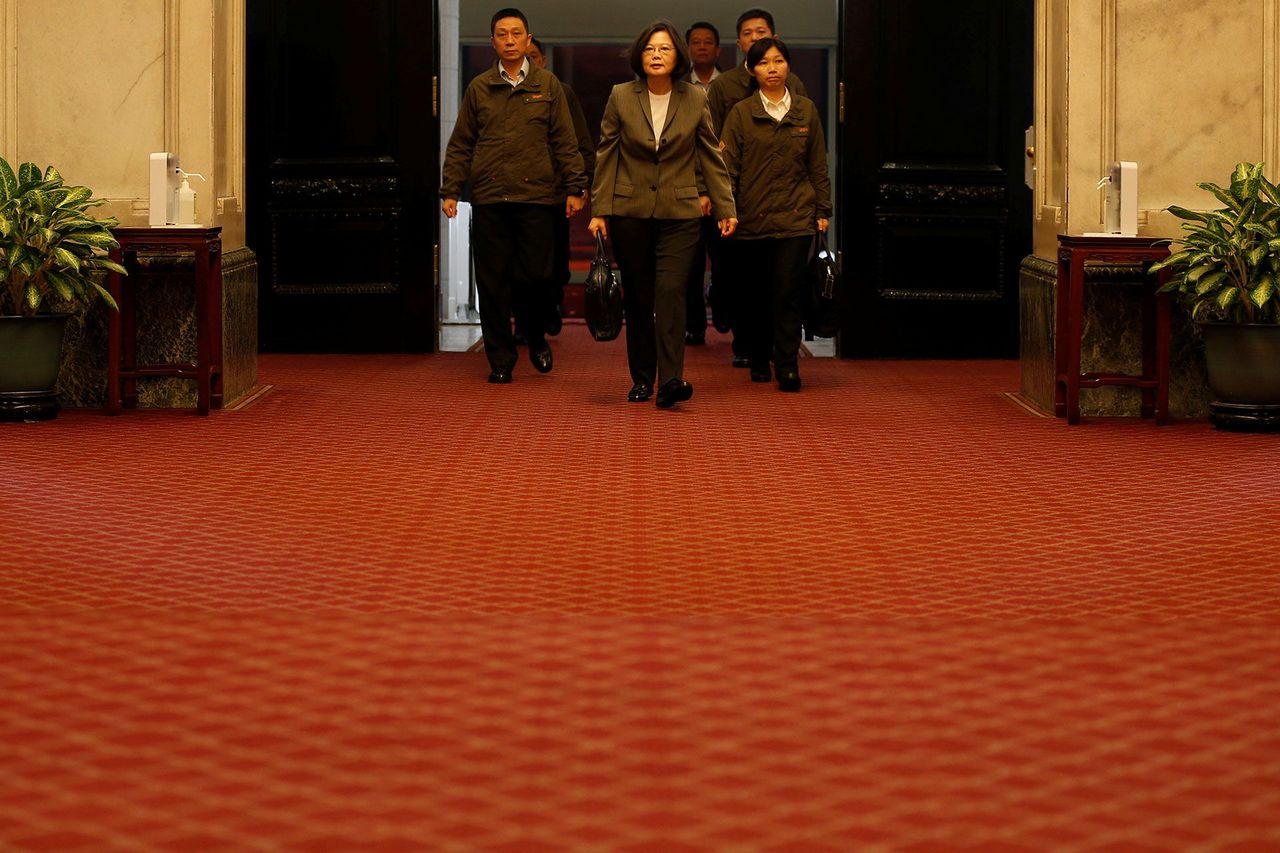 President Tsai Ing-wen arrives at the Presidential Office in Taipei in
2017. The names and phone numbers of security personnel guarding her
office were leaked.
President Tsai Ing-wen arrives at the Presidential Office in Taipei in
2017. The names and phone numbers of security personnel guarding her
office were leaked.
“The repeated cases of the most senior level of Taiwan armed forces officers being convicted of espionage has got to have a psychological effect on the officer corps and in the ranks.”
The information included a hand-drawn organizational chart of the Special Service Center, the unit that protects the president, according to the ruling in the High Court. The two were also charged with leaking the names, titles and work phone numbers of senior security officers guarding the Presidential Office and Tsai's residence in the heart of Taipei, according to court documents reviewed by Reuters and local media reports.
In the past decade, at least 21 serving or retired Taiwanese officers with the rank of captain or above have been convicted of spying for China, according to a Reuters review of court records and reports from Taiwan’s official news agencies. At least nine other serving or retired members of the armed forces are currently on trial or being investigated on suspicion of contacts with spies from China, the review shows.
The 21 convicted officers were found guilty of recruiting spies for China or passing a range of sensitive information to China, including contact details of senior Taiwanese officers and details of Taiwan’s agents in China.
The Taiwan Affairs Office in Beijing did not respond to questions from Reuters about China’s espionage activities in Taiwan.
In Taipei, the Ministry of National Defense told Reuters that pro-active counter-intelligence efforts have stopped China from penetrating the military. The ministry said in a statement that it employs education campaigns to encourage and reward officers and soldiers to report initial contact with “criminals.” These contacts are immediately investigated, and when there is potential for the loss of confidential information, the military acts to block any leak, the ministry said.
This effort, the ministry said, means “there has been no infiltration.”
The Ministry of Justice Investigation Bureau, Taiwan’s lead spycatching agency, said it had no comment on ongoing legal matters.
Other arms of the Taiwanese government, however, greet the spying with alarm. Taiwan’s Mainland Affairs Council told Reuters in a statement that China’s “unceasing expansion of espionage” is one of the “malicious political operations” that Beijing is conducting, undermining “the normal development of cross-strait relations.”
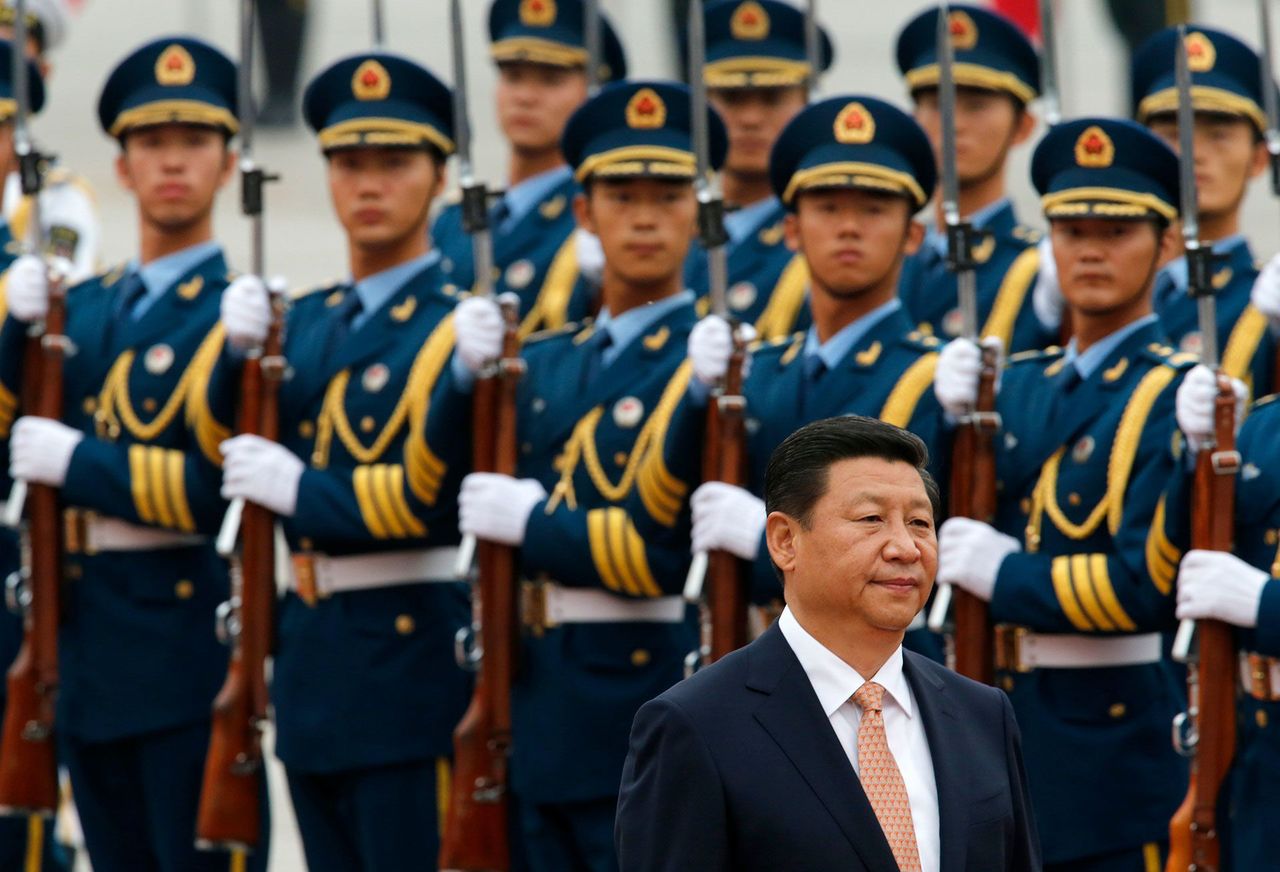 Chinese President Xi Jinping has said that Beijing prefers peaceful
unification with Taiwan but has not ruled out the use of force to
achieve this goal.
Chinese President Xi Jinping has said that Beijing prefers peaceful
unification with Taiwan but has not ruled out the use of force to
achieve this goal.
Well-placed spies in the ranks of the Taiwan military could offer a priceless advantage to China if the two sides plunge into open conflict, according to Taiwanese and U.S. military analysts. Tensions have risen sharply this year. China’s military is intensifying its gray-zone warfare against the island, a campaign of menacing air and sea patrols that falls short of open warfare. The People’s Liberation Army is also steadily accumulating the firepower required to seize Taiwan and prevent the United States from intervening.
The ruling Communist Party in Beijing regards Taiwan as a Chinese province that must be unified with the mainland. President Xi Jinping says China would prefer peaceful unification but refuses to rule out force. President Tsai says Taiwan is an independent country called the Republic of China, its official name, and has vowed to defend its democracy and freedom.
“China is conducting a very targeted infiltration effort towards Taiwan,” said retired Taiwanese navy Lieutenant Commander Lu Li-shih. Espionage cases, he said, show that Beijing has compromised almost all ranks, including top-level generals, despite intensive internal education campaigns in the military warning of the dangers of Beijing’s espionage efforts.
Lu, who has studied Chinese spying operations, said Beijing’s agents often begin softening their targets with offers of small gifts, drinks and meals. Handlers typically pay richly for the first piece of secret information extracted from current or retired officers, Lu said. This payment would later be used to blackmail them into supplying further intelligence at a much lower price, he said.
A powerful weapon
This year alone, Taiwanese courts have upheld the convictions of the two men who revealed secrets about President Tsai’s security and found a retired lieutenant colonel from the armaments bureau guilty of building espionage networks for China. A retired major general and three retired colonels from the Military Intelligence Bureau are on trial for allegedly recruiting spies for China. Reuters was unable to reach the defendants and their lawyers in these cases for comment.
In July, Taiwan’s Mirror Media reported that the island’s former deputy defense minister, General Chang Che-ping, was questioned in a national security investigation.
Three people familiar with the matter confirmed a probe is under way. Two of the people told Reuters that General Chang was being questioned for having had contacts with Xie Xizhang – the alleged Chinese agent who presented himself as a Hong Kong businessman. The defense ministry said Chang had been interviewed as a witness in the case.
Contacted by Reuters, Chang replied: “Inconvenient to comment. Hope you understand.”
According to the official documents reviewed by Reuters, Xie allegedly reported to an office that is part of the Chinese Communist Party’s intelligence apparatus and serves as a front for China’s Central Military Commission. President Xi chairs the commission, which is China’s top military decision-making body.
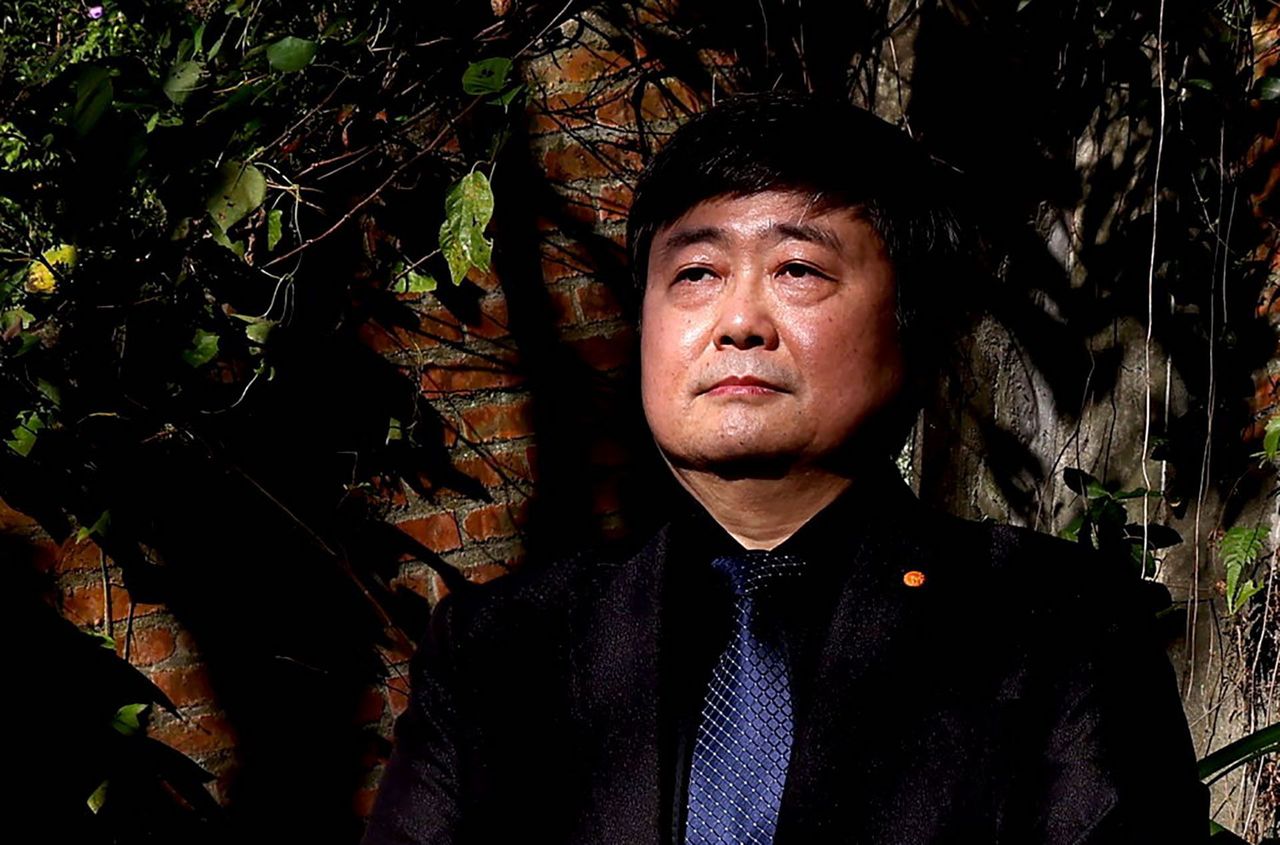 Retired navy Lieutenant Commander Lu Li-shih said that espionage cases
in Taiwan revealed that China has compromised almost all ranks in the
island’s military.
Retired navy Lieutenant Commander Lu Li-shih said that espionage cases
in Taiwan revealed that China has compromised almost all ranks in the
island’s military.
General Chang, Taiwan’s highest-ranking air force general, is now head of the National Defense University. When the media reports of the probe emerged, Chang issued a statement calling them “far-fetched.” He said he had “not talked about military matters without permission.”
The Taipei district prosecutors office said it doesn’t discuss ongoing investigations.
Espionage has long been a powerful weapon for the Chinese Communist Party. In the Chinese civil war, Communist agents and sympathizers played a key role in defeating the forces of the ruling Kuomintang (KMT), or nationalist party, under Chiang Kai-shek, forcing a retreat to Taiwan. In some instances, entire KMT formations were persuaded to change sides and joined the Communists under Mao Zedong, according to multiple accounts of that conflict.
The series of convictions in Taiwanese courts shows cultivating disloyalty in the military remains a high priority for Beijing. Despite China’s vastly stronger forces and serious shortcomings in Taiwan’s military, the island remains a tough target for invasion. Even without outside assistance, Taiwan’s best-trained troops could inflict heavy losses by exploiting well-prepared positions, rugged terrain and the vulnerability of an invasion fleet crossing the Taiwan Strait, say Taiwanese and U.S. military analysts.
For Chinese invaders, advance knowledge of defensive plans, communication codes, weapons sites and troop locations would offset some of these difficulties, according to these analysts. Disloyal officers might also refuse to fight, misdirect their troops or defect to the attackers.
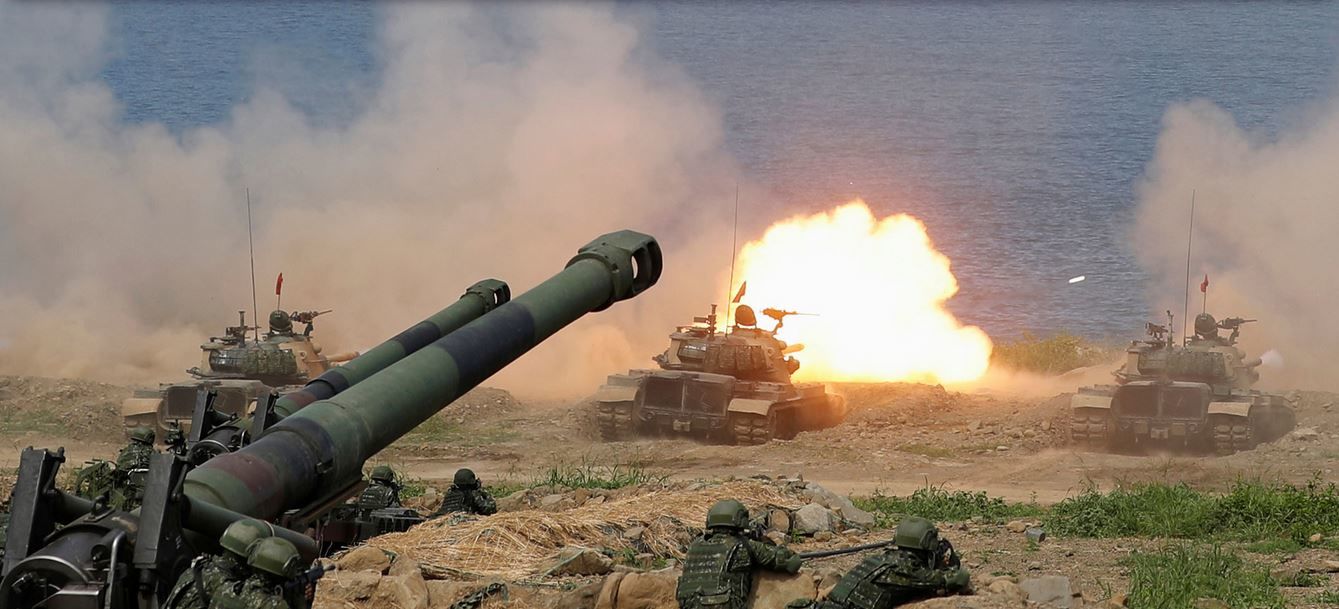 Taiwanese tanks in the county of Pingtung in 2019 fire during the annual
Han Kuang military exercise, which simulates an invasion by the Chinese
military.
Taiwanese tanks in the county of Pingtung in 2019 fire during the annual
Han Kuang military exercise, which simulates an invasion by the Chinese
military.
In a report released in September about the Chinese military, Taiwan's defense ministry acknowledged that in an attack, agents for China “lurking” on the island could strike at command centers to “decapitate” Taiwan’s military and political leadership and demoralize its armed forces.
Even the discovery of Chinese spies in peacetime is a potentially demoralizing blow to Taiwan. “The repeated cases of the most senior level of Taiwan armed forces officers being convicted of espionage has got to have a psychological effect on the officer corps and in the ranks,” said Grant Newsham, a retired U.S. Marine Corps colonel who has studied the island’s defense capabilities. “And, once you can create doubt in the honesty of one’s leaders, the rot sets in and deepens.”
One retired high-ranking officer in Taiwan agreed: Colleagues lose confidence in one another, this person said, and “you make allies lose confidence in you.”
Some Taiwanese military veterans worry that the repeated espionage cases will make the United States, the island’s main ally, unwilling to share advanced weapons or sensitive intelligence for fear of these secrets leaking to Beijing.
“We can’t blame other people. We are the cause of the problem,” said Lu, the retired navy lieutenant commander.
Asked about the potential loss of faith in Washington, Taiwan’s defense ministry said there had been no disruption to normal ties with friendly countries. The U.S. National Security Council declined to comment for this story.
Beijing has succeeded in recruiting spies from the island’s armed forces despite strenuous efforts by the Taiwanese military’s Counter Intelligence and Security Division to alert troops to the danger of Chinese agents. The military even produces soap operas, sometimes starring serving members of the armed forces, with scripts that echo previous spy cases. The soaps are part of an hour-long television program broadcast every Thursday afternoon that is mandatory viewing for all serving officers and soldiers.
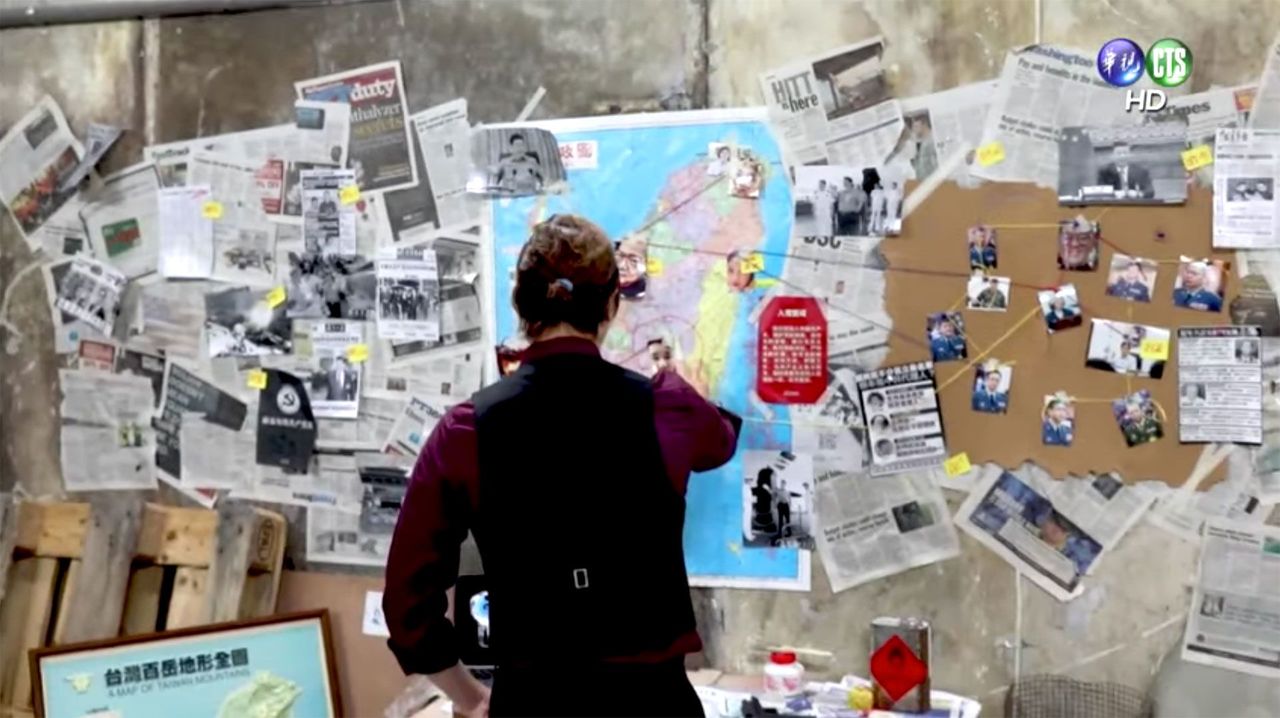 Taiwan’s military produces soap operas to warn troops of the danger of
Chinese espionage efforts. In this screenshot from one episode last
year, a Chinese spy handler surveys a board in his office with
information about an espionage operation.
Taiwan’s military produces soap operas to warn troops of the danger of
Chinese espionage efforts. In this screenshot from one episode last
year, a Chinese spy handler surveys a board in his office with
information about an espionage operation.
 The soap operas echo previous spy cases. In another screenshot from the
same episode last year, a staff sergeant in the Taiwanese military hands
classified information to a female agent working for China.
The soap operas echo previous spy cases. In another screenshot from the
same episode last year, a staff sergeant in the Taiwanese military hands
classified information to a female agent working for China.
In an episode late last year, a staff sergeant working in communications in a combat unit meets a woman in a bar who claimed to work for an investment firm in the defense industry. They start a relationship, and the woman begins to ask for sensitive information. To impress her, the staff sergeant gives her data on missiles at air bases in northern Taiwan. Later he grows suspicious and refuses her further requests, but she threatens to blackmail him with a recording of his earlier indiscretion. The woman is later arrested.
The scene switches to a man who appears to be the woman’s spymaster. On the wall in front of him are clips from Chinese newspapers, including a photograph of Chinese President Xi. “That’s alright,” the handler says, tearing up a photograph of the woman. “We have plenty of other opportunities.”
To reinforce the message, posters and signs on bases exhort Taiwanese soldiers to remain vigilant. Stickers with the number of a hotline for reporting suspected spies have been posted above some urinals. Packs of tissues handed out to troops carry a notice promising a reward of T$5 million ($180,000) for successfully exposing a spy.
Wooing veteran commanders
While Taiwan battles Chinese espionage, it also spies on China as part of a decades-long effort to understand Beijing’s intentions, according to current and retired Taiwanese officers and official documents reviewed by Reuters. China’s official media periodically announces the discovery of Taiwanese spy networks and the arrest of alleged agents.
In October last year, China’s state television broadcaster, CCTV, reported that a Taiwanese academic arrested in China, Cheng Yu-chin, had confessed to spying. The same month, CCTV reported the arrest of Lee Meng-chu, alleging he was an active member of a Taiwan separatist group who posed as a businessman to conceal his espionage role. Lee was arrested when he entered China and was found to have photographs and videos of Chinese military drills in the city of Shenzhen, as well as materials showing he supported the protests in Hong Kong, the report said.
Cheng and Lee could not be reached by Reuters. Asked about their arrests, Taiwan’s Mainland Affairs Council said that Chinese authorities are “arbitrarily arresting our people who engage in cross-strait exchanges” and using official media “to fabricate fictional crimes.”
In its campaign to subvert Taiwan’s military, Beijing has also mounted a longstanding operation to woo senior retired commanders with historic ties to China. These efforts exploit political divisions that have widened in Taiwan over the past two decades between Tsai’s ruling Democratic Progressive Party (DPP) and the main opposition KMT.
The DPP has gained ground with the support of a younger generation that increasingly identifies as Taiwanese rather than Chinese. The KMT, born in China, holds to its old dream of eventually reunifying a free and democratic country. The party also supports closer relations with Beijing, but has denounced the Communist Party’s threats against Taiwan.
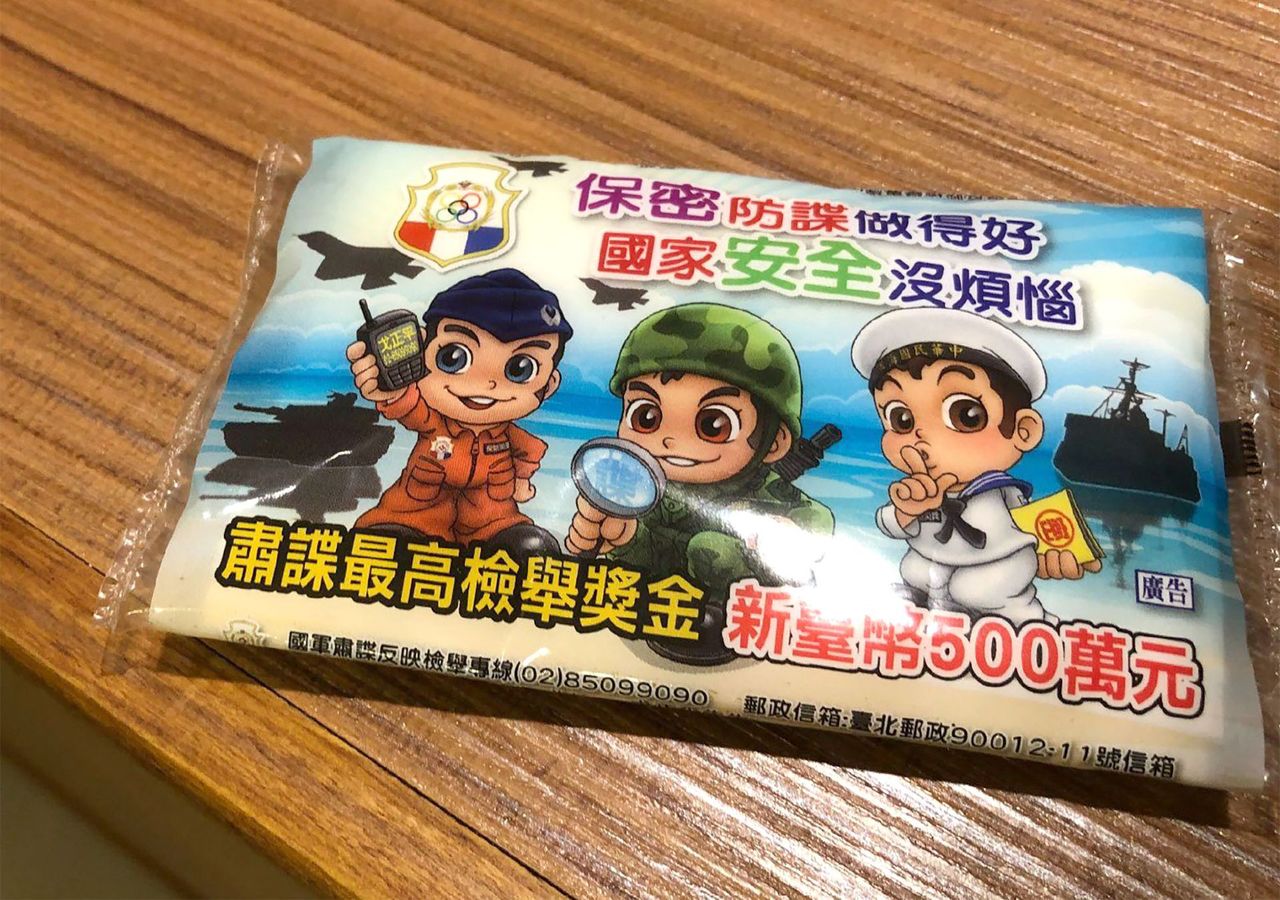 Packs of tissues have been handed out to troops with a notice announcing a reward for exposing a spy.
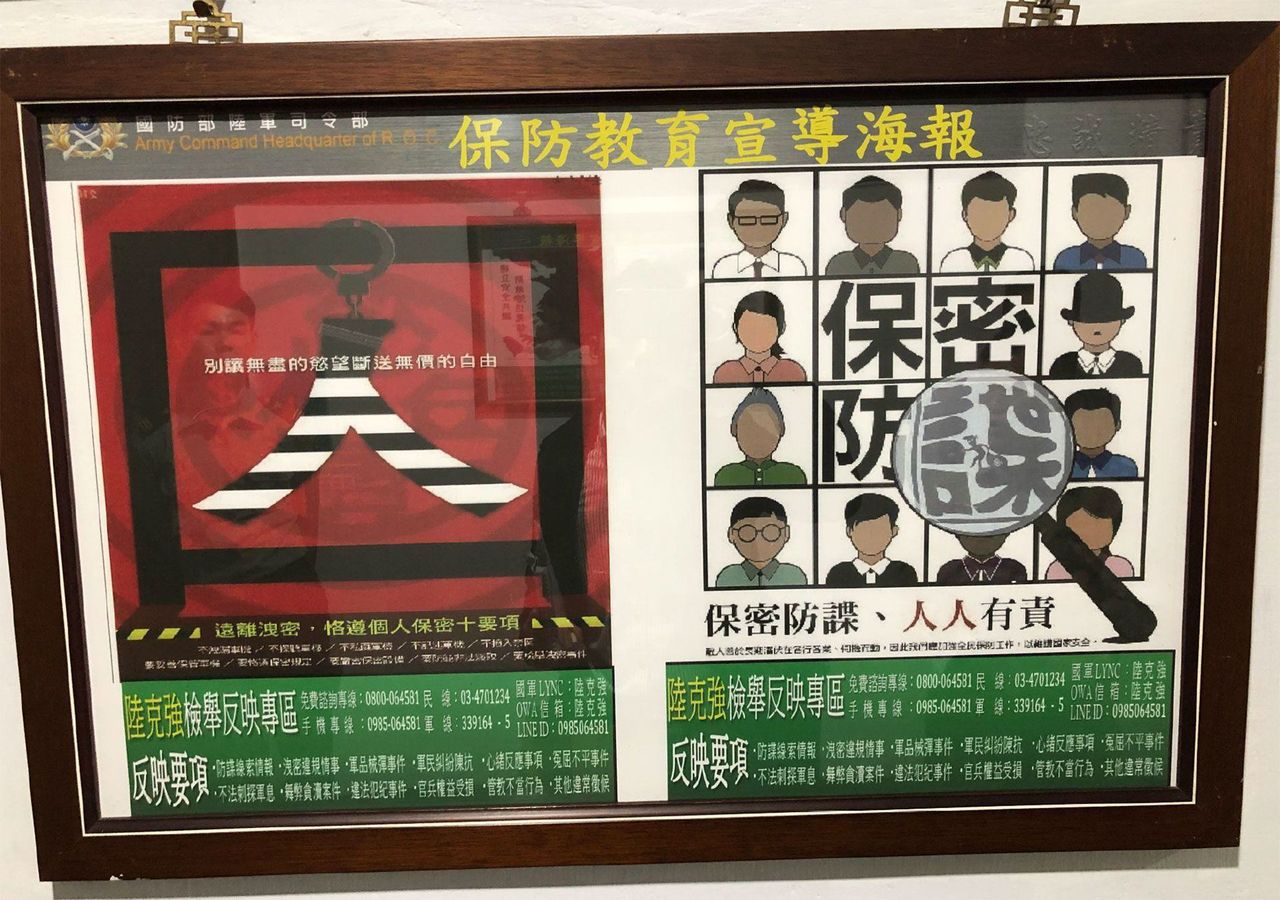 A poster warning soldiers to be alert to espionage efforts in a military
base in 2019. “Don’t let endless greed end priceless freedom,” it
reads.
A poster warning soldiers to be alert to espionage efforts in a military
base in 2019. “Don’t let endless greed end priceless freedom,” it
reads.
Many of Taiwan’s older, retired military officers support the KMT, which ruled the island before it became a democracy and now vies with the DPP for power. Most of these veterans don’t back the Communist Party, but both the KMT and Beijing share the dream of a single China, even if they have different visions of what that means. Some have been welcomed to China to attend seminars and receptions with retired counterparts from the Chinese military.
Though no longer in uniform, these officers still retain influence over a military that is deeply hierarchical, with long-standing networks of patronage and personal loyalty, according to current and former U.S. officials with extensive experience of the Taiwan military.
In November 2016, Beijing scored a dramatic propaganda victory when more than 30 retired Taiwanese generals were seen attending a speech by President Xi at Beijing’s Great Hall of the People. The visitors stood for China’s national anthem, Taiwan’s official Central News Agency reported. The event, broadcast on Chinese state television, sparked an outcry in Taiwan.
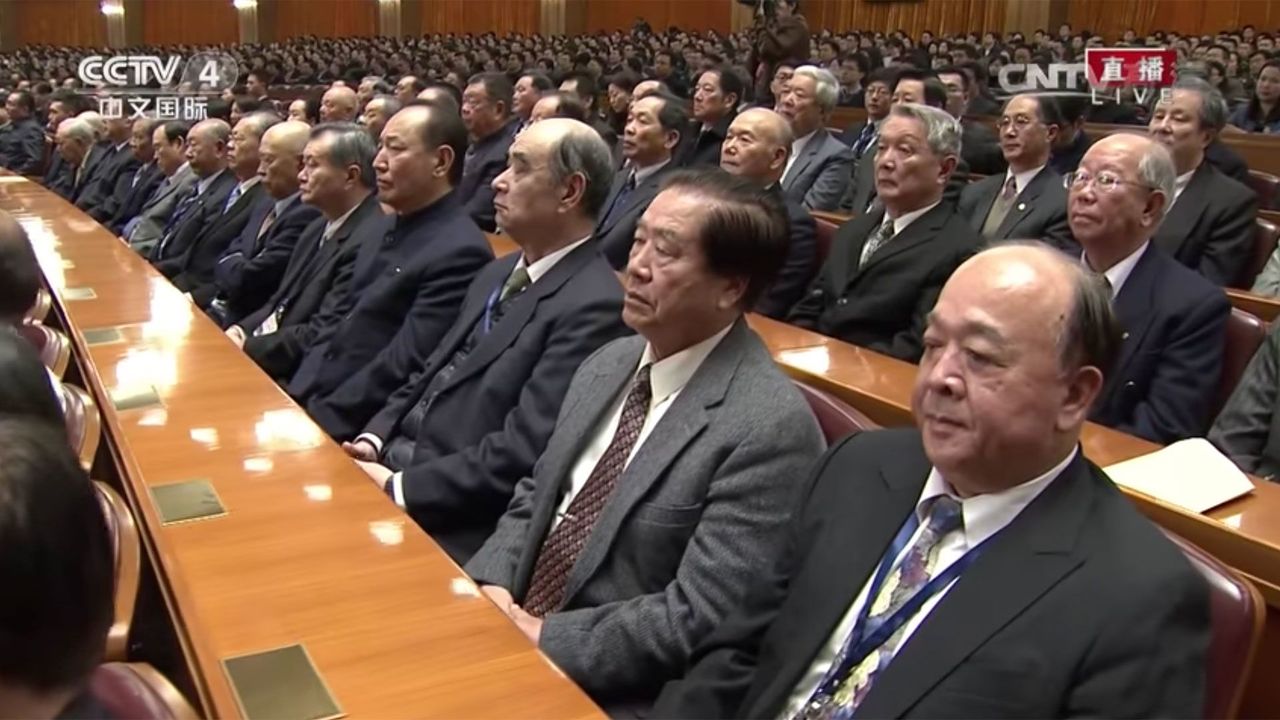 China has also targeted older, retired military officers in Taiwan, who
still exercise influence in the military. In 2016, a group of retired
Taiwanese generals were seen on Chinese state television attending a
speech by President Xi Jinping in Beijing’s Great Hall of the People.
One of the generals, Wu Sz-huai (far right), later apologized.
China has also targeted older, retired military officers in Taiwan, who
still exercise influence in the military. In 2016, a group of retired
Taiwanese generals were seen on Chinese state television attending a
speech by President Xi Jinping in Beijing’s Great Hall of the People.
One of the generals, Wu Sz-huai (far right), later apologized.
One of the retired generals in the audience was Wu Sz-huai, who is now a KMT lawmaker. He apologized in 2019, saying he was unaware that Xi was hosting the event and would have declined to attend if he had known. He said members of the delegation stood for the national anthem but did not sing. Wu declined to comment for this report.
In its statement, Taiwan’s Mainland Affairs Council called on “retired high-ranking generals to maintain the dignity of the country and pay attention to their own words, deeds and the perceptions of society.”
In the aftermath of the visit, Taiwan’s parliament tightened the rules on retired officers’ trips to China. The new penalties include fines of up to T$10 million ($360,000) and the cancellation of pensions for retired senior officers and government officials who attend Chinese political events or “salute” Communist Party flags or symbols.
Some senior retired Taiwanese officers told Reuters that these trips to China hurt the military’s image. But they added that a younger generation of officers now rising through the ranks would not be as susceptible to appeals for a unified China that includes Taiwan.
Free trips abroad
One major challenge for Taiwan’s counter-espionage forces is light penalties for retired officers convicted of spying. Under military law, serving officers can be sentenced to death or life imprisonment for serious offenses. However, former officers who commit crimes once out of uniform can only be tried under the National Security Law, which prescribes much shorter jail terms.
Under public pressure to counter Chinese spying, parliament in June 2019 increased penalties under the security law for the most severe crimes, from a maximum of five years imprisonment to a minimum of seven years and fines of up to T$100 million (about $3.6 million).
The case of alleged Chinese spy Xie Xizhang was first reported earlier this year by local media, but the official documents seen by Reuters provide new details. Xie is accused of inviting current and retired Taiwanese military officers to drinks, banquets and sporting events in a bid to win their friendship and trust, according to the documents.
The operation also allegedly relied on enticing prospective Taiwanese spies to accept free overseas trips where they would meet their Chinese handlers and other Communist Party officials. The official documents allege that six serving and retired officers received all-expenses-paid trips to South Korea, Indonesia, Malaysia, Thailand and Singapore, as well as Chinese cities including Shenzhen, Hong Kong and Macau.
A key objective of the alleged operation was to recruit officers in leading combat units, according to the official documents. In 2008, Chang Pei-ning, the retired navy officer, allegedly introduced Xie to a senior serving Taiwanese Navy officer, Captain Ho Chung-chi, and Ho’s wife, Chuang Hsiu-yun. In the years that followed, Ho and his wife, working under Xie’s guidance, allegedly recruited other officers.
Chang, Ho and Chuang were charged under the National Security Law in November 2019 for recruiting a spy ring for China. The three are currently on trial, according to a spokesperson for the Kaohsiung District Court.
Taiwan’s defense ministry said Chang and Ho had retired before they allegedly became involved in the case. However, official documents accusing the pair of espionage allege that Ho met Xie on multiple occasions before his retirement in August 2015.
Reuters spoke to Ho at his home in Kaohsiung. He declined to comment and said his wife had no comment. Chang didn’t respond to a request for comment left at his home in Kaohsiung.
In a post on his Facebook page when he retired, Ho bid farewell to his navy comrades: “Time to say goodbye!” The post included a picture of a folded Navy uniform, officer’s hat, medals and badges.
The message generated hundreds of likes and comments. “Captain,” wrote one well-wisher. “Thank you for your years of service to the country and the navy!”
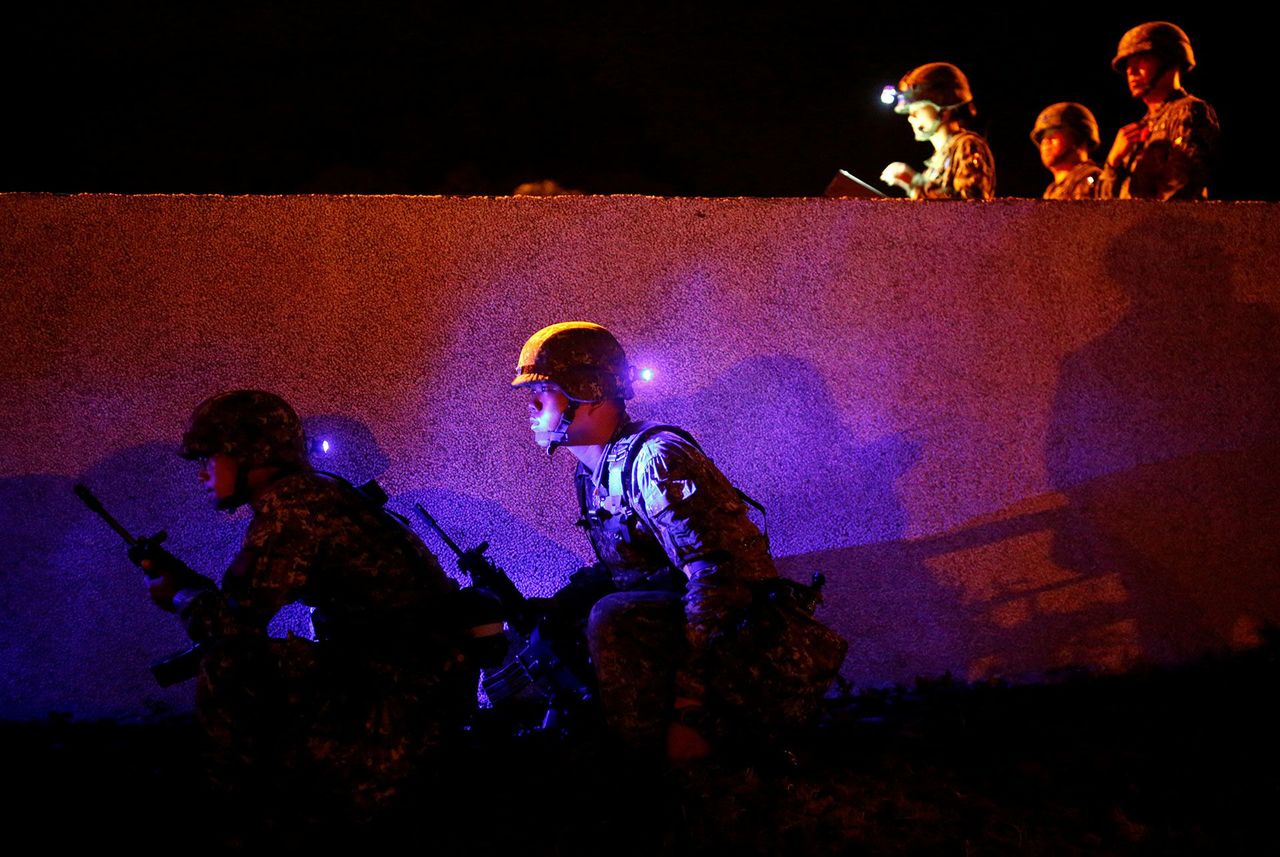 Taiwanese soldiers take part in the annual Han Kuang military drill,
which simulates a Chinese attack, in Yilan in Taiwan’s northeast in
2016. China is steadily building the firepower needed to seize Taiwan by
force.
Taiwanese soldiers take part in the annual Han Kuang military drill,
which simulates a Chinese attack, in Yilan in Taiwan’s northeast in
2016. China is steadily building the firepower needed to seize Taiwan by
force.