London Daily

Focus on the big picture.
Saturday, Jul 04, 2026

Chinese investors, beware: EU targets ‘golden visas’

Chinese investors, beware: EU targets ‘golden visas’

Such passports, which some nations issue in return for investments, are popular because they effectively give freedom of movement among all EU member states.

For years, wealthy Chinese have made investments in Cyprus and Malta in exchange for European Union passports – so-called golden visa transactions. Now, Brussels wants to end the practice.

The call to stop the policy came from the very top of the European Commission, the EU’s executive arm, when President Ursula von der Leyen voiced it during her first state-of-the-union speech earlier this month.

“European values are not for sale,” she said.

“The breaches of the rule of law cannot be tolerated. I will continue to defend it and the integrity of our European institutions – be it about the primacy of European law, the freedom of the press, the independence of the judiciary or the sale of golden passports,” she said.


European Commission President Ursula von der Leyen has declared the EU’s opposition to “golden visa” programmes.


The commission is even considering the possibility of taking EU member states that issue such visas to court, as it applies political pressure on those countries to stop the practice.

A golden visa essentially grants its holder full EU citizenship. The passports are very attractive given the freedom of movement among the nations in the union, since holders of Chinese passports do not enjoy visa-free access to most countries.

In the decade ending 2018, the EU welcomed more than 6,000 new citizens and close to 100,000 new residents through golden visas schemes, according to Transparency International, a German NGO.

Currently, four EU members offer passports and 12 trade residency rights through golden visa programmes. The two lists overlap, with three countries – Bulgaria, Cyprus and Malta – having both schemes. Cyprus and Malta seem to be the most popular with Chinese investors.

“Due to the nature of EU citizenship, such schemes have implications for the union as a whole. The commission is looking at compliance with EU law, and will introduce infringement proceedings, if judged necessary,” a commission spokeswoman said.

“The commission has frequently raised its concerns about investor citizenship schemes and certain inherent risks, in particular as regards security, money laundering, tax evasion and corruption.”

Didier Reynders, the European commissioner for justice, had been in contact with three member states to raise these concerns directly, the spokeswoman said.
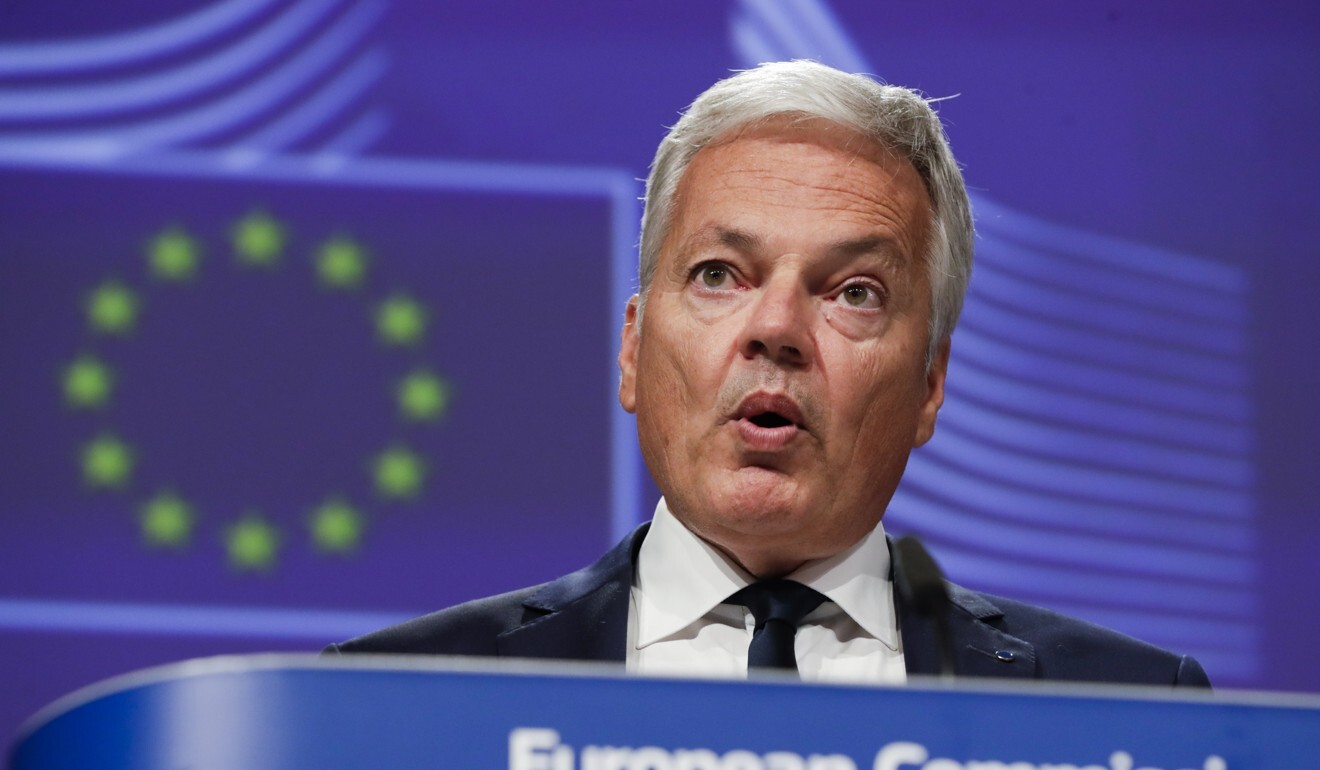

European Commissioner for Justice Didier Reynders has contacted three member states to discuss the EU’s concerns about their investor citizenship programmes.


The EU has been under pressure to act after an investigation by Al Jazeera last month found that dozens of people who obtained golden visa passports from Cyprus between 2017 and 2019 would have otherwise been rejected as “high risk” according to the country’s rules.

Al Jazeera’s report included naming several Chinese businesspeople who had such passports and concurrently served as advisers to the Communist Party in the Chinese People’s Political Consultative Conference.

Despite the EU’s hardening rhetoric, Chinese immigration agents appeared unfazed, with multiple websites continuing to promote this route to EU citizenship.

“The European Union is a loose federation, and the EU [commission] president really can’t speak for the member state governments,” said Crystal Tan, a manager at Cheuk Yuet Migration Consulting Services, an agent in Guangzhou.

Tan said she and other agents did not believe the golden passport programme would end.

“As we can see, such programmes are bringing huge revenues to Cyprus, Malta, Portugal and even Spain,” she said.

The Mediterranean island nation of Cyprus requires an investment of at least €2.2 million (US$2.6 million) but with no obligation to live there; within six months investors can have an EU passport with the right to live and work in all 27 states in the bloc – and visa-free access to more than 170 nations around the world.

In Malta, investors can receive a passport if they make a donation of €650,000 to a government national development fund, invest €150,000 in government-approved stocks or bonds, purchase real estate for a minimum of €350,000 and commit to a residence for at least five years.

Non-EU citizens can likewise be given a route to Portuguese residency if they spend at least €500,000 on a property – or lower price thresholds for less dense areas or areas marked for redevelopment.

The EU cannot ban such programmes by its member states, but is looking at ways to make these schemes illegal, including through the courts. And while there is no specific timeline, von der Leyen’s term lasts five years.

If EU countries did close their programmes, Tan said Chinese investors would have other options.

“Even if some member countries respond to the EU president by ending the golden passport programmes, rich people will just look at other places – for instance, Saint Kitts and Mexico are providing similar programmes.

“For Chinese clients, as long as the new passport can provide travel convenience or help to move wealth abroad, the demand will always be there,” Tan said.


Newsletter

Related Articles

0:00
0:00
Close
UK Government Consults International Partners on Maritime Trade Security and Energy Market Stability
Rare Revolutionary-Era Documents Discovered by UK Archives and Undergoing Authentication
UK Consumer Confidence Remains Deep in Negative Territory as Household Spending Stays Cautious
Transport for London Warns of Severe Disruption as Major Events Converge in Central London
NHS and Social Care Sectors Face Ongoing Recruitment Shortages Amid Persistent Workforce Gaps
Rising Energy Costs Drive Price Pressures Across UK Retail and Service Sectors
Competition and Markets Authority Expands Review of Artificial Intelligence Impact on UK Media Markets
UK Parliamentary Committees Intensify Scrutiny of National Security and Industrial Policy Legislation
Bank of England Faces Persistent Inflation Pressure as Rate Cut Expectations Fade
UK Public Finances Under Pressure as Borrowing Exceeds Forecast and Debt Nears 95% of GDP
Major Police Deployment Across Central London as Mass Demonstrations and Pride Parade Converge
Large-Scale Police Dispersal Powers Activated in Liverpool Ahead of Anti-Immigration Protests and Counter-Demonstrations
Luxury bags take over the World Cup: style, status symbol, or just showing off?
National Productivity Institute Highlights Weak Business Investment Outside Southern England
UK High Court Orders Reassessment of Environmental Impact in Major Highway Project
UK Cyber Security Centre Warns of Rising Threat From State-Sponsored Digital Espionage
UK Education Secretary Launches National Reform of Apprenticeships and Vocational Training
Financial Conduct Authority Tightens Climate Risk Disclosure Requirements for Listed Firms
Rail Union Suspends Planned Strike Action to Enter Formal Negotiations With Operators
Northern Ireland Businesses Seek Clarity Over Post-Brexit Trade Rules
Welsh Government Launches Regional Growth Plan Targeting Transport and Digital Infrastructure
North Sea Wind Sector Attracts £5 Billion Investment Amid Expansion of Offshore Capacity
Scotland and UK Governments Establish New Framework for Coordinated Investment in Energy and Infrastructure
UK Government Launches Major Immigration and Border Policy Overhaul Review
Bank of England Signals Interest Rates to Remain Elevated Despite Easing Inflation Pressures
National Health Service Warns of Severe Winter Capacity Strain Across Hospital Trusts
Chancellor Orders Urgent Treasury Review Amid Concerns Over Structural Public Finance Gap
Prime Minister Unveils Sweeping Legislative Programme Focused on Housing, Health Service Reform and State Energy Plan
UK Parliamentary Committee Launches Inquiry Into Falling Primary School Rolls and Public Service Impact
UK House of Lords Debates Electoral Commission Powers and Political Finance Reform
UK Parliament Considers Expanding Carbon Rules to International Aviation and Shipping Emissions
UK Traffic Commissioner Revokes Hampshire Haulage Operator Licence Over Regulatory Failures
UK Parliament Examines Risks in Public Contracts Awarded to Technology Firm Palantir
UK Competition Watchdog Moves Toward More Flexible Merger Rules to Support Efficiency and Growth
UK Government Seeks Approval for £1.15 Trillion Public Spending Plan Amid Scrutiny Over Department Budgets
UK Parliament Debates Sweeping National Security and Steel Industry Nationalisation Bills
UK Government Issues Formal Apology for Historic Forced Adoption Practices and Announces £4 Million Support Scheme
UK DEFENCE AND TECHNOLOGY STRATEGY TILTS TOWARD SOVEREIGN CAPABILITY AND INDUSTRIAL INVESTMENT
UK ECONOMIC POLICY OUTLOOK SHAPED BY LEADERSHIP TRANSITION AND FISCAL SIGNALS
STERLING STRENGTHENS AMID SHIFTING MONETARY OUTLOOK AND GLOBAL LABOUR MARKET SIGNALS
UK HPV VACCINATION PROGRAM NEARLY ELIMINATES CERVICAL CANCER DEATH RISK IN YOUNG WOMEN
UK EXPANDS PRISON SAFETY REVIEW AS GOVERNMENT SEEKS WIDER SYSTEM REFORM
UK DRIVES DIGITAL ASSETS STRATEGY WITH NEW STABLECOIN REGULATORY MODEL
UK TO EXPAND AI INFRASTRUCTURE THROUGH NEW EUROPEAN TECHNOLOGY PARTNERSHIP
UK LAUNCHES £15 BILLION DEFENCE TECH SHIFT TOWARD ADVANCED MILITARY SYSTEMS
CIVIL SERVICE FACES SHIFT IN POWER STRUCTURE AS REGIONAL GOVERNANCE PLANS EXPAND
WHITEHALL CONSIDERS MAJOR DECENTRALISATION PLAN WITH SECOND GOVERNMENT HUB IN MANCHESTER
UK TARGETS SERVICES EXPORT GROWTH IN TRADE TALKS WITH CHINA AMID GEOPOLITICAL TENSIONS
POLICE WATCHDOG PROBES OFFICERS OVER HANDCUFFING OF DYING TEENAGER IN HAMPSHIRE CASE
UK REGULATORS UNVEIL DUAL OVERSIGHT FRAMEWORK FOR STABLECOINS AND DIGITAL ASSETS
×