

China gains a foothold in Australia's backyard
The leaked draft signalled that China could deploy troops to the Solomon Islands - and potentially establish a naval base there.
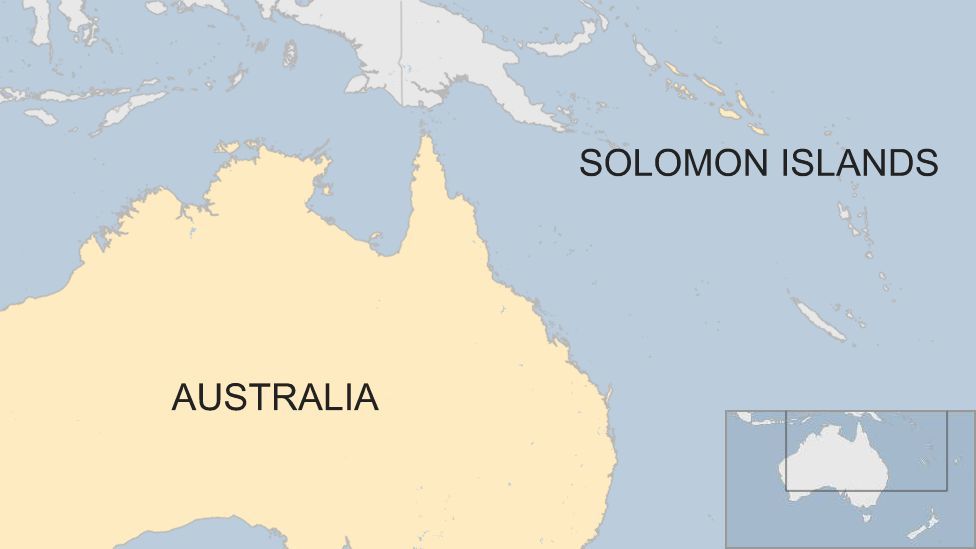
Nowhere was more alarmed than the Solomons' neighbour to the south, Australia - the bedrock regional partner of the Aukus alliance, a new security pact in the Pacific Ocean with the US and UK.
"The details of this deal are still uncertain. But even if it's smaller than the feared military base, it would be China's first foothold in the Pacific," says Prof Alan Gyngell from the Australian Institute of International Affairs.
The Solomon Islands and Australia have long been interlinked. Since World War Two, Australia has been the islands' largest aid donor, development partner and until now the sole security partner.
Australia's government was rocked and likely blindsided by the move, analysts say. Not that it hadn't been warned. Five years ago, Canberra sensed that China was encroaching on its "backyard" with Solomon internal politics at the time also driving up Chinese loans and economic investment.
That prompted Canberra to push back with a "step-up" policy - where it refocused attention on its "Pacific family" and ramped up its own aid flows.
But China's elevation to security partner status alongside Australia, clearly exposes how Canberra's engagement policy has failed, analysts say.
"The objective had to be to stop something like this happening. You can't read it any other way - this is a failure of Australian diplomacy," says Prof Gyngell.
It's not just a big deal for Australia. The Aukus pact, announced only six months ago, is aimed at countering China's ambitions in the Indo-Pacific. The US and other Western allies have all expressed concern about it becoming another potential theatre of conflict.
What is being talked about?
Solomons' Prime Minister Manasseh Sogavare has stridently defended his nation's right to seek security deals with China - on top of existing infrastructure and other business investments.
"We have no intention, Mr Speaker, of pitching into any geopolitical power struggle," he told parliament on Tuesday, saying his nation would not "pick sides".
He has not confirmed if the leaked draft was the finalised version. But the content of that draft was so broad and expansive, it caused immediate alarm.
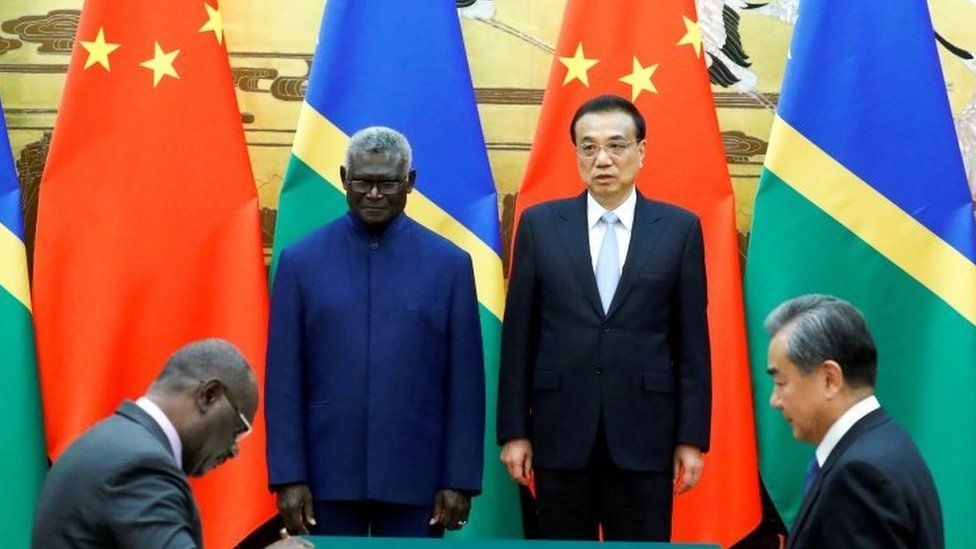 The Solomon Islands ditched links with Taiwan for official diplomatic ties with China in 2019
The agreement set out clauses where China could send navy ships for "stopover and transition" in the islands - raising concerns about a potential military base.
It also allows for Beijing to deploy forces to protect Chinese people and Chinese projects on the islands. The Solomons could request China send "police, armed police, military personnel and other law enforcement and armed forces", according to the draft.
"You have the scope for China to deploy any kind of personnel… and it's not clearly defined the parameters of deployment or the authority those forces would have," said Mihai Sora, a Pacific Islands analyst from the Lowy Institute in Australia.
Compared to the Solomon's only other security agreement - with Australia - it's much more far-reaching.
Australia's arrangement is largely to do with peacekeeping, allowing for a rapid deployment of troops, when requested, to the Solomon Islands, which has a long history of violent unrest.
Last year, it was activated again when deadly riots broke out in the capital Honiara - prompting troops to be sent over from Australia, as well as New Zealand, Fiji and Vanuatu.
China 'edge' raises hackles
The proposed security deal with China could alter the balance in the region.
"Security agreements have significance beyond just the terms they capture. They imply a degree of closeness, co-operation and trust between countries," said Mr Sora.
A Chinese military presence in the Pacific will also completely disrupt the "benign" environment that's been enjoyed by nations for decades - and which is currently collectively maintained by Australia, New Zealand and the Pacific Islands Forum nations.
Australia has raised concerns on how it could "undermine the stability and security of our region", while New Zealand spoke out against a "potential militarisation of the region".
Analysts say the threat of China on Australia's doorstop isn't about invasion; it's about much more immediate short-term concerns, such as Beijing improving intelligence gathering and monitoring.
Even a small Chinese military presence giving it a foothold in the South Pacific would be a consideration for Australia and a potential drain on its military resources.
"It's not so much about what would China's base in the Solomon Islands contribute in a time of conflict - we're nowhere near that," said Mr Sora.
"When you establish a military presence in a region, it excludes that region, excludes access to that region for other countries."
He said a worst case scenario could be an escalation in tensions to the dynamics of the South China Sea, where Beijing has built artificial islands in contested waters and placed military installations on them to deny passage for other nation's naval and air forces.
"Up until now, Australia and other Pacific countries have enjoyed being in a benign zone and having the freedom to move within our zone in the Pacific.
"So this brings in a clear, hard strategic edge to that competition."