

Brexit: Lord Frost proposes 'entirely new' NI protocol
In a speech to diplomats in Portugal on Tuesday, he described his new legal text as "a better way forward".
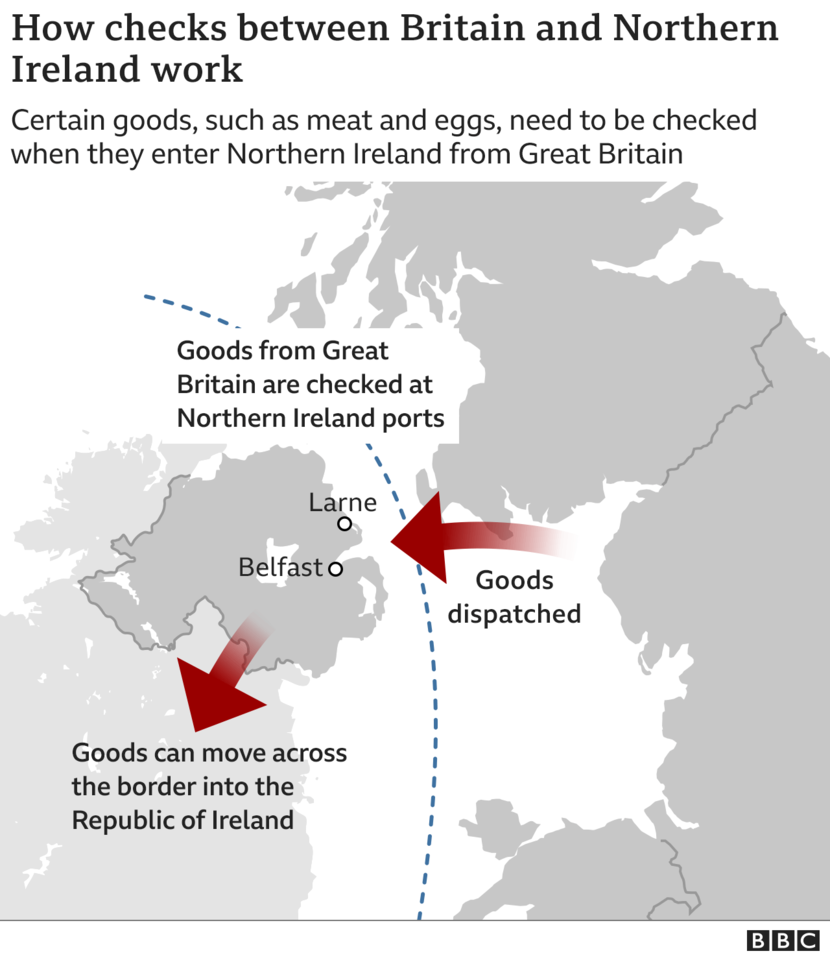
The protocol is the special Brexit deal agreed for Northern Ireland to prevent a hard border on the island of Ireland.
Unionists argue it undermines Northern Ireland's constitutional position in the UK and creates a trade barrier.
In a plea to the European Union to allow for "significant change" to post-Brexit rules governing trade with Northern Ireland, Lord Frost said his proposed text would support the Good Friday Agreement.
He said it was forward-looking, improved on the current "excessively rigid" protocol, and would allow the EU and UK to "get back to normal" by removing "the poison" from their relationship.
With the EU expected to put forward proposals on Wednesday, Lord Frost again warned Brussels London could unilaterally waive some of the terms of its agreement if the bloc failed to budge.
"We have a short, but real, opportunity to put in place a new arrangement, to defuse the political crisis that is brewing, both in Northern Ireland and between us," Lord Frost said.
However, Shadow Northern Ireland Secretary Louise Haigh said the move to replace the protocol was "stoking tension while solving nothing".
In a tweet, the Labour MP said Lord Frost's speech "sets the stage for another destabilising stand-off, with the agreement businesses and communities need further away than ever".
"Stability, jobs and livelihoods depend on real progress in Northern Ireland in the coming weeks," she said.
"It would be a serious abdication of responsibility to block a pragmatic way forward and provoke more poisonous instability."
Lord Frost urged the EU to look carefully at the UK's new legal text, and said the existing protocol could not survive, as it did not have support right across Northern Ireland.
He also warned the UK could still trigger Article 16 - which allows either side to effectively override large parts of the agreement - if the EU and UK could not agree on changes to the existing protocol.
"We would not go down this route gratuitously or with any particular pleasure but it is our fundamental responsibility to safeguard peace and prosperity in Northern Ireland and that is why we cannot rest until this situation is addressed," said Lord Frost.

There are two schools of thought about how this latest negotiation is shaping up.
The first is that Lord Frost's hard line on the European Court of Justice (ECJ) is standard pre-negotiation tactics, aimed at grinding out another concession or two.
After all the Brexit process has always delivered a deal, even at times when it seemed improbable.
The UK government wants to remove the ECJ from its oversight role as part of the Northern Ireland Protocol, saying as long as it continues the protocol will never survive.
The EU, on the other hand, has said it would be very hard for the protocol to continue without the court's oversight.
Irish Foreign Minister Simon Coveney has warned that the UK's demands on the protocol could cause "a breakdown in relations" with the EU.
He has hinted that maybe the UK doesn't want a deal unless it's total victory.
Under that scenario, the UK would go through the motions before triggering Article 16.
It would use this to gut the protocol while calculating that the EU's ability to retaliate is limited or or at least would take a long time to amount to anything.
We should find out which view is right by the end of this year.
The Brexit minister said the protocol represented "a moment of EU overreach when the UK's negotiating hand was tied" and that it could not "reasonably last in its current form".
UK Prime Minister Boris Johnson signed up to the protocol as part of his Brexit agreement in 2020, but has since argued it was agreed in haste and was no longer working for the people of Northern Ireland.
The EU has repeatedly said it would not renegotiate the protocol, criticising the UK for reneging on an agreement that both sides signed in good faith.
More instability for Northern Ireland?
The UK government also wants to reverse its previous agreement on the oversight role of the European Court of Justice (ECJ), which is the EU's highest court.
Lord Frost said his new text proposed reliance on "international arbitration instead of a system of EU law ultimately policed in the court of one of the parties".
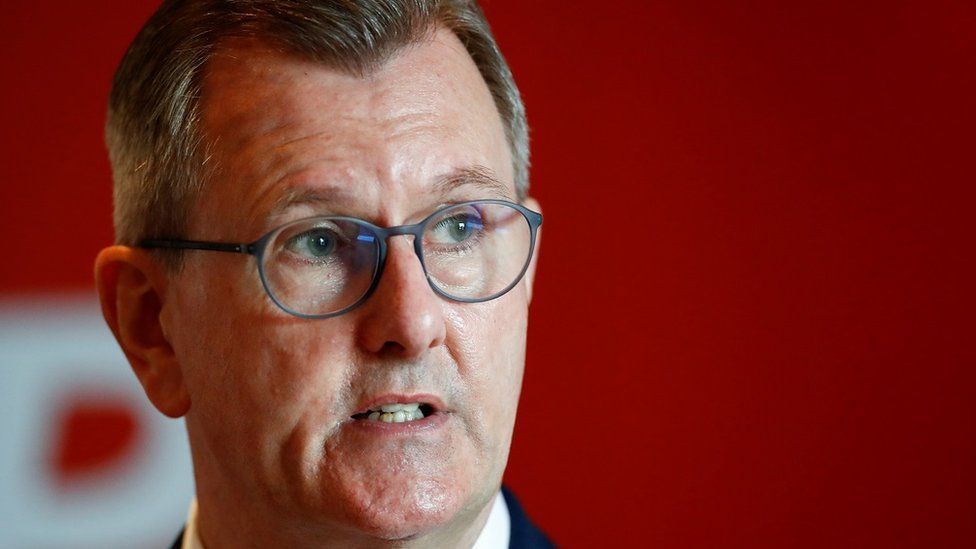
Sir Jeffrey Donaldson, the leader of the Democratic Unionist Party (DUP) - Northern Ireland's largest unionist party - said if the current protocol was not replaced with a long-term solution Northern Ireland would be exposed to "further harm and instability".
The DUP leader has previously warned his party may quit Stormont if its demands over the protocol are not met.
But Northern Ireland's Deputy First Minister Michelle O'Neill said the protocol was an international treaty that "recognises the special status of this island."
Its implementation, the Sinn Féin vice-president added, was "not negotiable".
"The conduct of the British government throughout these negotiations has been duplicitous and disgraceful and is an effort to break yet another international agreement".
She said: "The attempts by the Tories and the DUP to undermine the protections and opportunities of the Protocol and impose a hard border must be opposed".
A layer of delusion?
Ulster Unionist assembly member Steve Aiken said it was "self-evident" the existing protocol was not working.
He said the party would consider the UK government's legal text and the EU proposals due on Wednesday.
These will focus on easing practical problems, rather than changing oversight arrangements.
But Alliance deputy leader Stephen Farry MP said Lord Frost had "chosen to enter into another layer of delusion".
Mr Farry said short of the UK "rejoining the Customs Union and Single Market, there is no alternative than for the UK to work with the EU in a spirit of partnership to achieve as many mitigations and flexibilities as possible."
SDLP MLA Matthew O'Toole said Lord Frost's remarks represented a "deliberate distortion of facts and contempt for people here".
He said Lord Frost had negotiated the protocol, agreed to its terms and "backed Boris Johnson's campaign to sell it during the last general election".
Traditional Unionist Voice leader Jim Allister said: "If, as Lord Frost says, it is the UK that governs Northern Ireland, then, there must be an end to the European Union's writ in this part of the United Kingdom.
"Put simply, it requires an end to the Protocol in all its parts."
Irish Foreign Minister Simon Coveney said he hoped the UK government was "serious about moving on in partnership".
He said Wednesday's EU proposals "will deliver practical solutions to make the Protocol work better".
On Monday, Mr Coveney accused the UK of repeatedly dismissing EU proposals for the protocol ahead of their publication.