

Boris Johnson says he will find it ‘very difficult’ to vote for Northern Ireland deal
Boris Johnson has said he will find it “very difficult” to vote for Rishi Sunak’s revised deal for post-Brexit trade arrangements in Northern Ireland, arguing that the plan ties the UK to EU regulations that will crush efforts to innovate and diverge.
The former prime minister’s first public comments since the Windsor framework was unveiled on Monday came as Ian Paisley, one of the Democratic Unionist party’s most high-profile MPs, said he did not see how the party could support the plan.
Making a speech at a commercial summit in London, Johnson did not explicitly say he would oppose Sunak’s plan; rather, he said he hoped it would work, but that he had serious reservations about its impact.
Johnson also accepted blame for the fact his original plan for Northern Ireland border arrangements did not, as he had promised, avoid checks in the Irish Sea – although he ultimately blamed the European Union for this.
He also called on Sunak not to drop a bill, currently going through parliament, that would allow the UK to unilaterally change elements of the Northern Ireland protocol, arguing this was the best way to win concessions from the EU.
On the Windsor plan, Johnson said: “I’m going to find it very difficult to vote for something like this myself, because I believed that we should have done something different, no matter how much plaster came off the ceiling in Brussels.
“I hope that it will work. And I also hope that if it doesn’t work, we will have the guts to deploy that bill again. Because I’ve no doubt at all, that that was what brought the EU to negotiate seriously.
“In the meantime, I will continue to campaign for what I thought of, and what I think of, as Brexit and the logic of Brexit, because this is nothing if it is not a Brexit government. And Brexit is nothing if we in this country don’t do things differently. We need to take advantage of it, and we need to be seen to take advantage.”
The not unexpected but still unwelcome news for Sunak came shortly after Paisley, a Westminster MP for the DUP, placed pressure on his party to reject the deal, on which it is seeking legal advice.
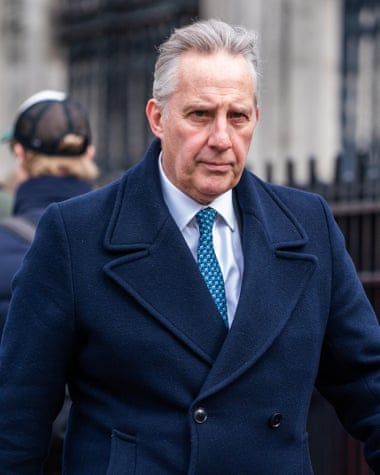 Ian Paisley, the DUP MP for North Antrim.
“I don’t believe it meets our tests. And there’s probably six or seven reasons why, for example, EU law will continue to apply in Northern Ireland,” Paisley told BBC One Northern Ireland’s Nolan Live programme.
One issue was that the Stormont brake, which allows Northern Ireland’s devolved assembly to block new EU regulations in some circumstances, “only applies to future law, not to existing EU law”, Paisley said, adding: “This is not, of course, a legal agreement. This is a political statement.”
The core of Johnson’s speech and subsequent Q&A session was the argument that Brexit was pointless without significant divergence from Brussels orthodoxy. He said the EU feared the UK “actually taking advantage of Brexit freedoms so as to be more competitive”.
It was this fear, Johnson argued, that made the EU interpret his own Northern Ireland plan rigidly, “as a way of keeping us more or less where they wanted”.
“This is all my fault. I accept full responsibility,” he continued. “Beneath the paint and plasters, there was the cold steel reality of EU control. The commission was in charge, not the UK. And contrary to my hopes, they did not apply it sensibly.”
Arguing against Sunak’s revision of the plan, which retains elements of EU legal oversight for goods entering Northern Ireland that are bound for the Republic of Ireland, and thus the single market, Johnson said he had always argued “there was no point in being a vassal state, there was no point in being a rule-taker”.
“We must be clear about what is really going on here. This is not about the UK taking back control,” he said. “This is the EU graciously unbending to allow us to do what we want in our own country, not by our laws, but by theirs.
“In that sense, this deal helps to accomplish the key objective I spoke of, in that it acts as a drag anchor on divergence. And there’s no point in Brexit unless you do things differently.”
While arguing there was no point in the UK “just emulating the high-tax, high-spend, low-growth European model”, Johnson said he accepted the argument had probably moved on from his objectives.
“People wanted change in their lives. They wanted to see things done differently,” he said. “I’ve got to put my hands up for this as much as anybody. We haven’t done enough yet to convince them that it can deliver the change they want to see.”
Johnson said he wished that as prime minister he had slashed corporation tax to “outbid the Irish”, adding: “What I wish we had done is put a big ‘Invest here’ sign over Britain as soon as we were out of Covid.”
Asked about a potential return to frontline politics, Johnson was typically opaque, saying only that he had several books to complete: “I got a big budget of words I have to write, and I’m churning it out.”