London Daily

Focus on the big picture.
Sunday, Jul 19, 2026

Boris Johnson’s plan to ‘fix the crisis in social care’ is no game changer

Boris Johnson’s plan to ‘fix the crisis in social care’ is no game changer

Documents published by the government show the reality of the deal the prime minister is offering

If Boris Johnson thought his 12-minute statement to parliament on Tuesday made good on his two-year-old promise to “fix the crisis in social care once and for all”, few in the care sector agreed.

Yes, the prime minister was radical, in contrast with the inaction of successive governments, when he more than quadrupled the means test threshold for social care recipients to £100,000.

And plans for £36bn to be raised in three years from new taxes, shared between the NHS and social care, provided hope. Plus here was a substantive statement on reforming social care, something that veterans in the sector have awaited for decades.

But in supporting documents published by the government was the reality of the deal Johnson was so far offering: £1.8bn a year extra for social care instead of the more than £6bn extra that the Health Foundation thinktank calculates will be needed by the end of this decade just to keep up with demand. Improving services in the often threadbare social care sector could cost an extra £14bn a year.

The deal “falls well short”, said Vic Rayner, chief executive of the National Care Forum, although she had the feeling there is “everything to play for”. She said the newest offer did nothing to fix a real-time crisis with staff leaving the sector at levels previously unseen.

Silver Voices, which represents older people, labelled it “an unambitious and meagre response”. The Royal College of Nursing said ministers “continue to bury their heads in the sand” about the staffing crisis. The union was among many pointing out the absurdity that already underpaid care staff will be among those losing money because of the levy, which is partly intended to improve staffing.
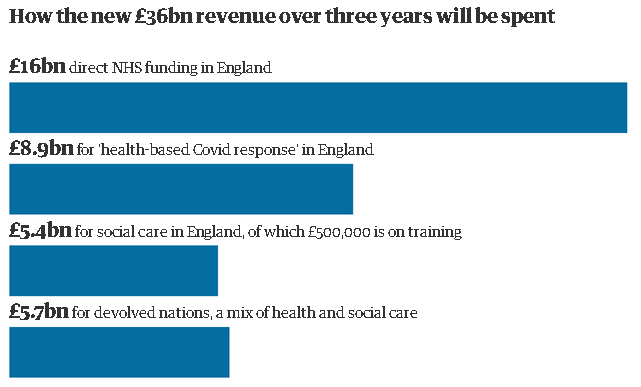

It is understood that of the £5.4bn for social care over three years, £2.5bn could be used to fund the new higher means test threshold and £86,000 ceiling on lifetime costs.

That leaves about £1bn a year to improve services including investing in the workforce and training, and starting closer integration of the system with the NHS – something that has been widely welcomed. This amount of money isn’t a game changer. Health analysts say similar amounts of extra funding have been awarded to social care fairly routinely in recent years.

The NHS, which has a longer track record at the negotiating table, did better though it still needs more to clear its elective surgery backlog, the Health Foundation said. In England, the NHS is expected to benefit from about £25bn from the levy over the next three years.

And yet there is hope for those who want a better future for elderly people and working-age disabled people for whom social care is essential to leading fulfilled lives. The forthcoming spending review will provide a new settlement for councils, key funders of social care, that could offset Tuesday’s disappointment. And the acknowledgment – and earmarking of some funds – to tackle pay, training and service quality is better than the years of silence on social care reform that has frustrated many.

“At last, there’s some hope for a better future,” said Caroline Abrahams, director of Age UK. The Association of Directors of Adult Social Services said that after 25 years of waiting, the announcement was “a significant step forward”. They feel the door is at last ajar for negotiation, which is something that may not have happened had the pandemic not hit care homes so hard.

Newsletter

Related Articles

0:00
0:00
Close
Brothers Andrew and Tristan Tate Who Turned "Toxic Masculinity" Into a Brand Arrested in Miami as Britain Seeks Their Extradition
Passenger Bound for Germany Refused to Sit Beside a Woman on a Plane — Then Slapped a Flight Attendant
Ukrainian Drone Barrage Kills Eight and Strikes Russian Logistics Network
Key Trends to Watch
Financial Conduct Authority Warns Cloud and Digital Risks Are Becoming a Financial Priority
Jeffrey Donaldson Appeals Sexual Abuse Conviction as Democratic Unionist Party Opens Review
Welsh Health Authorities Launch Emergency Meningitis Vaccination Programme for Students
Scottish Business Activity Falls for Third Month as Companies Face Rising Costs
Bank of England Regulators Demand Better Access to Digital Banking Services
United Kingdom Cuts Bilateral Aid to Several African Countries by Up to Ninety Per Cent
United Kingdom Introduces Tougher Deportation Rules After Rochdale Exploitation Scandal
NHS England Launches Wearable Technology Plan to Reduce Sepsis Deaths
Amazon Web Services Billing Error Sends Trillion-Dollar Invoices to British Companies
Bank of England Takes Direct Regulatory Role Over Major Global Cloud Providers
Extreme Summer Heat Drives Record Fire Risk and Rising Deaths Across Britain
United Kingdom Nationalisation of British Steel Sparks Diplomatic Dispute With China
United Kingdom Economy Shows Weak Growth Ahead of Major Autumn Budget
Andy Burnham Set to Become United Kingdom Prime Minister After Labour Leadership Victory
The Ten World Cup Finals That Defined Football History
Smartphones Are Getting More Expensive, Sales Are Collapsing, and Even Apple Admits: "Prices Will Rise"
The Monaco Bombing Has Become a Test of Ukraine’s Intelligence Accountability
Leadership Change and Strategic Rivalry Redraw the Political Map
Energy Risk, Uneven Growth and the New Geography of Global Capital
The AI Race Enters Its Infrastructure Era
Security and resilience remain long-term national priorities
Britain balances growth ambitions with public finance pressures
Regional devolution becomes a defining theme of the next Labour era
Industrial strategy returns to the centre of British economic policy
Political Instability Remains a Challenge for UK Investment Confidence
Brexit Economic Debate Continues as Public Concerns Over Long-Term Impact Remain
UK Climate Risks Rise as Met Office Warns Extreme Weather Is Becoming More Common
Housing Shortages and Regional Inequality Become Key Priorities Under Incoming Labour Leadership
National Health Service Reform Remains One of Britain’s Biggest Political Challenges
Bank of England Remains at Centre of UK Economic Debate Over Inflation and Growth
UK Economy Shows Recovery Signs but Households and Businesses Remain Under Pressure
Britain Deepens European Defence Cooperation as NATO Allies Seek Stronger Security Capabilities
United Kingdom Expands Sanctions Against Russian Cyber Networks Over Security Threats
UK Industrial Strategy Faces Test After Government Takes Control of British Steel
British Businesses Seek Policy Clarity as Andy Burnham Prepares to Lead Labour Government
Andy Burnham’s Labour Leadership Signals Major Shift Toward Regional Power and Devolution
British Steel Nationalisation Creates New UK-China Tensions Over Control of Strategic Industry
For 36 Years, He Scammed About 300 Luxury Hotels — Until He Was Caught
England's World Cup Exit Expected to Cost Hospitality and Retail £334 Million
Former ICC Prosecutor Aide Speaks Publicly About Allegations Against Karim Khan
Opposition Raises Questions Over June Heatwave Power Grid Pressures
Mastercard Explores Sale of Majority Stake in UK Payments Operator Vocalink
Boeing Forecasts Global Commercial Aircraft Fleet Will Double by 2045
London GP Surgeries Receive £18 Million to Expand Primary Care Capacity
Health Advisers Recommend Nationwide Meningitis B Vaccination for Teenagers
OECD Warns UK Economy Faces Slower Growth and Weak Productivity
×