

Boris Johnson pledges to send more arms during surprise visit to Kyiv
Boris Johnson made a surprise trip to Kyiv yesterday to meet the Ukrainian president, Volodymyr Zelenskiy, pledging a major new infusion of British arms and financial aid to help counter the expected deadly new phase in Russia’s military offensive.
After the meeting, the prime minister said: “Ukraine has defied the odds and pushed back Russian forces from the gates of Kyiv, achieving the greatest feat of arms of the 21st century.
“It is because of president Zelenskiy’s resolute leadership and the invincible heroism and courage of the Ukrainian people that Putin’s monstrous aims are being thwarted. I made clear today that the United Kingdom stands unwaveringly with them in this ongoing fight, and we are in it for the long run.
“We are stepping up our own military and economic support and convening a global alliance to bring this tragedy to an end, and ensure Ukraine survives and thrives as a free and sovereign nation.”
Last night No 10 said Britain would send 120 armoured vehicles and new Harpoon anti-ship missile systems to Ukraine. The missiles can do serious damage to Russian warships and could be used to tackle the Russian navy siege of Black Sea ports. The UK pledged £100m in military assistance last week, including another 800 anti-tank missiles, more anti-aircraft weapons, “suicide drones”, which hover over the battlefield before attacking a target, and helmets, body armour and night-vision goggles.
Johnson has been praised by Zelenskiy, who contrasts the fulfilment of a promise to deliver vital anti-tank weapons to its army with the more timid responses from other Nato member countries such as Germany.
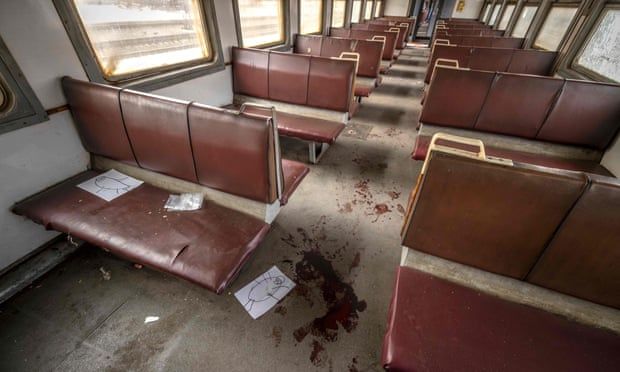 A train car after a rocket attack at a train
station in Kramatorsk, eastern Ukraine, on Friday that was being used
for civilian evacuations.
A train car after a rocket attack at a train
station in Kramatorsk, eastern Ukraine, on Friday that was being used
for civilian evacuations.
The security situation in Ukraine’s capital has stabilised since Russia withdrew from its positions around the city on 29 March to regroup its forces and consolidate territorial gains in Ukraine’s south and east.
European Commission president Ursula von der Leyen also visited Ukraine’s capital on Friday, as well as the nearby town of Bucha, where overwhelming evidence suggests that civilians were raped and murdered by Russian troops.
Johnson’s visit comes a day after Zelenskiy called on western allies to provide more military aid and step up sanctions on Russia in the wake of a missile attack on a train station in the eastern city of Kramatorsk that killed 52 people, including five children.
Russia’s defence ministry has denied responsibility for the strike, but western intelligence officials believe a Russian short-range ballistic missile was fired indiscriminately towards the town centre. At the time of the attack the station was packed with civilians who had been ordered by the Ukrainian government to evacuate the town in the face of the Russian advance from the south-east.
“I have already left Kramatorsk, because when a missile hit a school very close to my house, we were very scared,” said Sofiya Ruban, 17, who fled to the Kyiv area with her family.
“When we heard about yesterday’s airstrikes at the railway station we were shocked and very saddened.”
Russian shelling and missile attacks have intensified in several areas across eastern Ukraine as Moscow moves its “special military operation” away from toppling the government to focus on building a corridor connecting the Russian-occupied region of Crimea with Luhansk and Donetsk – also de-facto controlled by Moscow – with the Russian mainland.
The besieged city of Mariupol, together with the southern city of Mykolaiv, which has faced significant shelling, are major Kremlin targets, the UK Ministry of Defence has said.
With trains not running out of Kramatorsk on Saturday, panicked residents boarded buses or looked for other ways to get out, fearing the kind of unrelenting assaults and occupations by Russian invaders that delivered food shortages, demolished buildings and death to other cities in Ukraine.
Zelenskiy called the station attack the latest example of war crimes by Russian forces and said it should motivate the west to do more to help his country defend itself.
“All world efforts will be directed to establish every minute of who did what, who gave what orders, where the missile came from, who transported it, who gave the command and how this strike was agreed,” Zelenskiy said in his nightly video address.
In response to the shelling of Kramatorsk, a curfew in the southern port city of Odesa went into effect on Saturday evening until Monday evening.
Ten humanitarian corridors to evacuate people from embattled areas across the country had been agreed on Saturday, Ukraine’s deputy prime minister Iryna Vereshchuk said, but by nightfall it was unclear whether civilians had been able to make it to Ukrainian-controlled territory.
Several attempts to evacuate 150,000 people still in Mariupol, which has been under constant fire since 24 February, and bring in vital provisions such as food and medicine, have ended in failure after Russian shelling of safe routes. Two UN agencies also called for urgent action to help an estimated 1,000 seafarers stranded in Ukrainian ports and waters with dwindling supplies.
The US-based Institute for the Study of War said that Ukrainian forces retain control of defensive positions in eastern and south-western Mariupol, and Russian forces are continuing to attempt to redeploy units in eastern Ukraine. Russian forces are “unlikely to enable a Russian breakthrough and face poor morale”, ISW said.
Last week, Dmitry Peskov, a Kremlin spokesperson, said the country had “significant losses of troops and it’s a huge tragedy for us”.
The conflict may be in danger of becoming a gruelling war of attrition. The Pentagon estimates that Russia’s combat power is between 80% and 85% of pre-invasion levels.