

Another silly season for Nobel Peace Prize nominations
Every year, it’s silly season when it comes to nominating candidates for the Nobel Peace Prize. Given the nature of the honour, it cannot but be political in its selection process.
Genuinely universal peacemakers are hard to come by. One person’s hero is another’s villain. And given the complexity of contemporary politics, even real peacemakers take a long time before their efforts bear fruits. Unless of course, you are Barack Obama, who got the prize just for being elected US president!
So, every year, we have to put up with people who grandstand – those with an obvious agenda, scores to settle, an axe to grind. Nine American lawmakers of the Congressional-Executive Commission on China, the most hawkish anti-China wing of the US Congress, have nominated Hong Kong’s pro-democracy movement. No surprise there.
Among the nine is Republican Senator Marco Rubio, who previously nominated Joshua Wong Chi-fung, the movement’s international poster boy, for the prize. The man is at least consistent.
However, does the movement include those who carried out wholesale vandalism, arson and mayhem across the city for more than six months; the ones who set a man on fire, stoned another to death and beat up countless innocent bystanders? Or is it only the peaceful element of the movement?
That, however, may be hard to identify. Many if not most pan-democratic politicians have expressed support, or at least no objections to the wanton destruction. After all, the movement’s signature slogan has been “no criticism, no infighting”, even if you disagree with your comrade’s actions.
Who in Hong Kong would qualify to represent the movement? Jimmy Lai Chee-ying, its biggest known financial backer, perhaps? Or Anson Chan Fang On-sang, who has declared she has quit politics for good? Oh wait, I almost forgot: it should be self-exile Nathan Law Kwun-chung, who has replaced Wong as the new international face of the Hong Kong movement.
But what of those who don’t support the movement and loath to see their city set on fire? Are they not Hong Kong people too? Or are they all communist criminals in Rubio’s eyes?
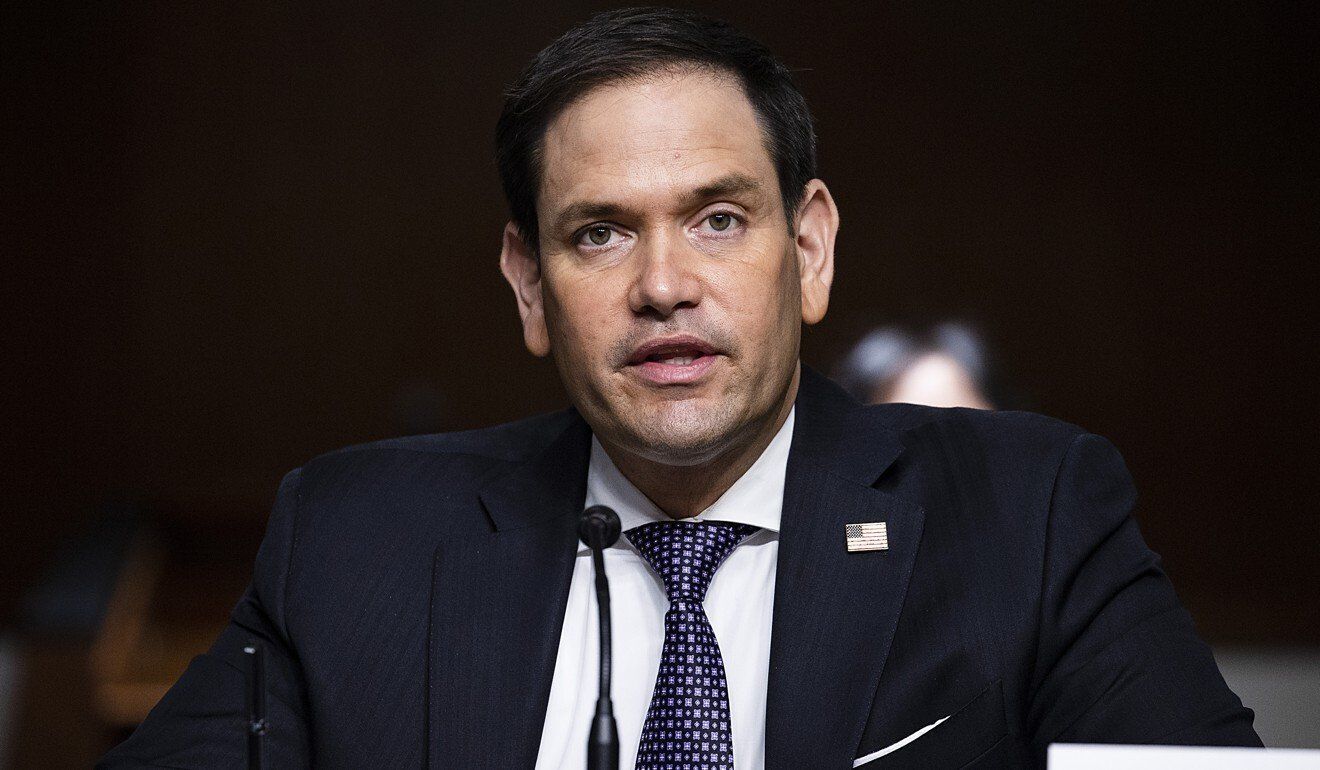 Senator Marco Rubio, seen in December, is among the US politicians who have nominated the protesters for the Nobel prize.
China could conceivably nominate Black Lives Matter (BLM) as a tit-for-tat. But either it has no time for the silly game, or it has been beaten to it by Petter Eide, a Norwegian politician and member of the country’s parliament. BLM ostensibly fights for social justice, and against institutionalised racism and police brutality and murders, especially of unarmed black civilians.
It has been noted, though, that some of its supporters have committed acts of violence. Even Eide acknowledged that, but added: “Of course there have been incidents, but most of them have been caused by the activities of either the police or counterprotesters.”
According to a September study of 7,750 demonstrations over four months from last year by the Armed Conflict Location and Event Data Project, a US-based NGO, more than 93 per cent of BLM protests were peaceful.
If the study is correct, it is certainly a lot more peaceful than the pro-democracy movement in Hong Kong during the 2019 riots. Even so, the Hong Kong movement has been practically sanctified by the entire mainstream media and political class of the West.
Meanwhile, other luminaries being nominated include twice impeached president Donald Trump, his son-in-law Jared Kushner, actress turned princess turned not princess Meghan Markle, Turkey’s strongman Recep Tayyip Erdogan and Covid-19-hit British Prime Minister Boris Johnson.
The problem is not just about those who nominate, but those who end up judging. Unlike the hard science prizes which are judged by reputable fellow scientists, the peace prize is decided by a bunch of Norwegian politicians. The prize committee has five members appointed by the Norwegian parliament, and its composition must reflect the relative strengths of the political parties in the parliament.
If there have been so many weird and questionable winners over the decades, well, we know why. As economist John Maynard Keynes once observed, the winner in a beauty contest is not necessarily the most beautiful, but the one the judges think other judges think other people consider the most winsome.
But given all these drawbacks, it’s a wonder that the committee can still usually come up with a worthy winner, often an organisation rather than a person.
This time round, my bet is on the World Health Organization over Covid-19. For all its flaws, at least it has been trying to help everyone, even those governments that refuse to help themselves and try to discredit the WHO in the process, most notably the United States.
A win would be a big snub to Trump and his lackeys with the US set to rejoin the WHO under the new Joe Biden White House.
The Norwegians, I bet, can’t resist that.

