London Daily

Focus on the big picture.
Wednesday, Jul 15, 2026

Winters past: Bitcoin plunge brings back memories of 2018

Winters past: Bitcoin plunge brings back memories of 2018

Memories of 2018 are sparking fears that a repeat is playing out now after the world’s largest cryptocurrency plummeted 50 percent from its most recent high of almost $69,000 in November.

There are few things scarier for investors than a bear market — unless you’re involved in crypto, in which case a winter is worse.

The chilling term refers to a sharp slump, followed by a drop-off in trading and months of market doldrums — a phenomenon that memorably befell the crypto market in 2018. Bitcoin’s price plunged by more than 80% to as low as $3,100 from the end of 2017 through December of the following year, a period characterized by the boom-and-bust of initial coin offerings and several big banks shelving their plans to start cryptocurrency trading desks. Bitcoin wouldn’t reach a new high until December 2020, according to data compiled by Bloomberg.

Memories of 2018 are sparking fears that a repeat is playing out now after the world’s largest cryptocurrency plummeted 50% from its most recent high of almost $69,000 in November. The crypto universe has shed more than $1 trillion in market value on growing conviction that the Federal Reserve is set to start ratcheting back the ultra-accommodative policy settings that fueled a boom in risk assets. The pullback has hit all corners of the crypto ecosystem, from Bitcoin to memecoins and publicly listed crypto exchanges. While the collapse has been rattling enough on its own, it has spawned an even bigger concern that the pain may persist for many months, according to UBS.

“There’s this question of how do we characterize that and the nearest analogy is probably 2018, which is this idea of a crypto winter,” James Malcolm, head of foreign exchange research at UBS, said by phone. “It looks likely to be a fairly difficult and potentially prolonged period and therefore, the crypto winter analogy is quite good. Remember, the crypto winter in 2018 wasn’t just over the Northern Hemisphere winter months. It basically extended for a whole year — so it was a crypto winter that lasted effectively a year.”
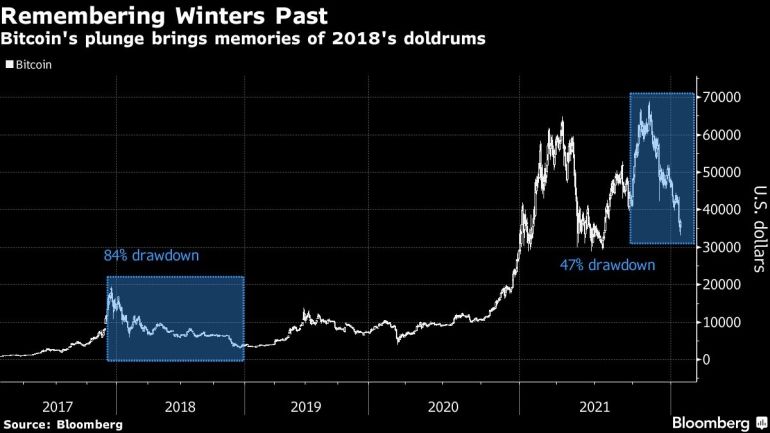

Bitcoin on Tuesday continued to decline, falling as much as 3% to trade at $35,721. The coin has spent more than 60% of the year so far trading lower, posting only nine sessions in the green.

Mentions of “crypto winter” and “crypto ice age” have flooded social media amid the latest drop. “Gm gm — make sure you stay warm, crypto winter is in full force,” Twitter user @brycent_ posted on Monday, using the crypto shorthand for “good morning” to start his tweet. “Enjoy this #bitcoin winter,” user @mir_btc tweeted over the weekend.

To Antoni Trenchev, co-founder and managing partner at Nexo, there’s a definite chill in the air. Bitcoin has already satisfied half of his two-part crypto-winter definition: a sharp decline in prices.

“I’m not looking for a re-run of the last ‘crypto winter,’” he said. “Undeniably, there are regulatory and macro storms ahead, and another leg down to $28,000-$30,000 can’t be ruled out in the current risk-off climate.”

Unlike the winter of three years ago, investment in the crypto-sphere remains robust — at least for now. In January alone, crypto-exchange FTX announced the launch of a $2 billion venture fund to target Web3 opportunities, while the Financial Times reported that Andreessen Horowitz is looking to raise $4.5 billion for crypto funds. Of course, a prolonged slump could douse enthusiasm for the sector.

Outside of venture capital, companies are also looking to expand into corners of the crypto ecosystem. Filings with the U.S. Patent and Trademark Office show that Walmart Inc. is preparing to create its own cryptocurrency and non-fungible tokens. Meanwhile, GameStop Corp. reportedly is also planning to launch an NFT marketplace for gamers by the end of the year.

To Tacen Inc.’s Budd White, that momentum is a sign that the crypto complex is in the midst of repricing, rather than a freeze.

“I don’t believe we are entering a crypto winter because there is still increasing momentum on the build-side — we are just seeing more realistic pricing of what is currently built,” said White, chief product officer and co-founder at the software development company that builds open-source, blockchain-based software.

The looming threat of intensified regulatory action adds to the risks embedded in the crypto complex. The Fed is considering the launch of its own digital currency, while crypto mining’s energy use has attracted scrutiny from the U.S. Congress and foreign governments.

“The White House may soon unveil some national security challenges posed by cryptocurrencies and the Fed’s paper on central bank digital currencies didn’t answer any questions on if we will see a digital dollar or how they could work with stablecoins,” said Edward Moya, a senior market analyst at Oanda Corp. “The regulatory environment got a lot cloudier now.”

Comments

Oh ya 4 year ago
Hey crypto is like the stock market, pay your money take your chances. This crap does not need to be every second article in the news. It has no assets, it produces nothing, it has no backing other than a bigger sucker than you buying for a higher price.

Newsletter

Related Articles

0:00
0:00
Close
Harvard Astrophysicist to Lead U.S. Scientific Advisory on Unidentified Aerial Phenomena
On the Island That Did Not Yield to Trump, There Is No Electricity, and 10 Million Live in Darkness
Key Trends to Watch
United Nations Expert Calls for Full Implementation of Supreme Court Ruling on Legal Definition of Sex
Industry Coalition Urges Labour Lawmakers to Back Continued North Sea Oil and Gas Production
Parliamentary Committee Calls for Tougher Restrictions on Unhealthy Food Advertising
Government Expands Awaab's Law to Cover Heat and Additional Housing Hazards
Energy Regulator Opens Independent Investigation Into National Grid Operator
United Kingdom and European Union Sign Landmark Gibraltar Border Agreement
Chancellor Unveils Financial Services Reform and Artificial Intelligence Strategy at Mansion House
Counterterrorism Police Take Over Investigation Into Killing of Former Minister Ann Widdecombe
Beer Industry Warns UK Rules Could Limit Growth of Alcohol-Free Market
Home Office Faces Legal Challenges Over Asylum Seeker Accommodation Closures
UK Heatwaves Linked to More Than Two Thousand Seven Hundred Deaths as Climate Debate Intensifies
Home Secretary Faces Pressure Over Political Security After Ann Widdecombe Murder Investigation
United Kingdom Opens Trade Consultation With Indonesia, Philippines, United Arab Emirates and Uruguay
Robert Jenrick Joins Reform UK After Leaving Conservative Party Leadership Role
Counter-Terrorism Police Take Over Investigation into Murder of Former MP Ann Widdecombe
Andy Burnham Secures Strong Labour Backing in Race to Succeed Keir Starmer
Global Markets Slide as Middle East Conflict Escalation Sends Oil Prices Higher
UK Prime Minister Keir Starmer Offers Condolences Following Death of Qatar’s Father Amir
UK Regional Innovation Policy Focuses on Research Clusters Across Scotland, Wales, and Northern England
UK Corporate Transparency Rules Set to Become More Strict Under Modern Slavery Reform Plans
UK Civil Service Estate Strategy Shifts Government Activity Away From London
UK Strengthens National Security Powers Through New Threat Designations
Greater Manchester Police Conduct Drink and Drug Driving Operations After Football Events
UK Government Advances Darlington Economic Campus With Construction Milestone
UK Authorities Increase Football-Related Security Operations After Tournament Fixtures
UK Invests Fifty-One Million Pounds in National Cryogenics Facility and Regional Innovation Hubs
UK Moves Toward Tougher Modern Slavery Reporting Rules With Corporate Penalties
UK Government Reports Forty-Three Million Pounds in Savings From Office Estate Reform
UK Government Expands Civil Service Regional Strategy With Manchester and Darlington Campus Projects
UK Designates Iran’s Islamic Revolutionary Guard Corps as National Security Threat
United Kingdom Financial Markets Monitor Business Response to Economic Policy Changes
Scottish Renewable Energy Expansion Highlights Need for Faster Grid Development
Wales and Regions Strengthen Focus on Economic Development Through Tourism and Investment
Retail Industry Warns High Street Businesses Remain Under Pressure
Police Chiefs Highlight Growing Challenges Managing Protests and Public Order
Agriculture Leaders Seek Clarity on Post-Brexit Farming Support and Environmental Rules
Transport Unions Warn of Further Industrial Action Over Pay and Working Conditions
Welsh Tourism Sector Reports Strong Growth Driven by Domestic and International Visitors
National Infrastructure Review Gains Support as Leaders Seek Faster Project Delivery
Financial Markets Assess Impact of United Kingdom Corporate Tax Policy Changes
Northern Ireland Assembly Debates Cross-Border Trade and Infrastructure Cooperation Plans
Government Opens Consultations on Housing Reform and Planning System Changes
Scottish Government Faces Pressure to Accelerate Offshore Wind and Grid Expansion
National Energy System Operator Warns Grid Investment Is Needed for Future Electricity Demand Growth
United Kingdom Research Council Invests in Artificial Intelligence and Biotechnology Innovation Hubs
United Kingdom Expands Oversight of Skilled Worker Visa Sponsors Amid Migration Debate
Cross-Party MPs Call for National Infrastructure Strategy Review to Accelerate Economic Growth
×