

Welcome to Liz Truss’ Britain. Everyone’s going on strike
As Liz Truss gets down to work as Britain's new prime minister, she faces an immediate problem. Half the British workforce appears to be going on strike.
Across the country, rail workers, barristers, dockhands, bus drivers, garbage collectors, Amazon employees, and even journalists at the infamously anti-union Daily Express newspaper are walking out over stagnant wages in the face of soaring inflation — not to mention the size of their bosses' pay packets, and the crumbling state of public services.
Postal workers are joining the mass walkout too, and have even employed Postman Pat, the mild-mannered children's TV icon beloved by generations of British kids, to flip the bird at his bosses over a pay deal far below the rate at which the cost of living is rising.
And on Tuesday, even as Truss flew north to Scotland to be invited by Queen Elizabeth to form a new government, Britain's firefighters were throwing their hats into the ring, with the Fire Brigades Union announcing 32,500 members would vote on industrial action.
“What we're hearing is that workers should take the hit, while shareholders shouldn't,” argued Kate Bell, head of economics at the Trades Union Congress, an umbrella group representing the country's labor unions. Workers, she argues, have simply "had enough of that message.”
A scorching summer of drought, soaring energy bills, labor shortages, and even controversial sewage discharges have added to a sense of crisis in the U.K., where inflation currently sits close to 10 percent and is expected to climb further as Russia’s war on Ukraine puts the squeeze on the global economy.
All this awaits Truss as she enters 10 Downing Street — and there's more to come.
NHS nurses, teachers and civil service workers are waiting in the wings with their own ballots on industrial action next month, heralding a fall roiled by worker discontent. Train drivers' union Aslef has announced its latest round of action too. Major union Unite is pressing the TUC for coordinated strike action.
And “it's almost certain that some museum and gallery workers will go out on strike in the autumn, along with the rest of the public sector,” said Steven Warwick, a young millennial trade unionist and secretary in the civil service union PCS's Culture Group.
The union, which represents rank-and-file public servants as well as private sector workers on government contracts, “expect a big yes vote on a high turnout in our ballot in September," he said, if ministers "refuse to move” on an average 2 percent pay rise cap in place for government employees.
Fighting talk
Collectively, the mass strike action feels more befitting of the stereotype Brits love to share of neighboring France than of the relatively timid organized labor unions in the U.K.
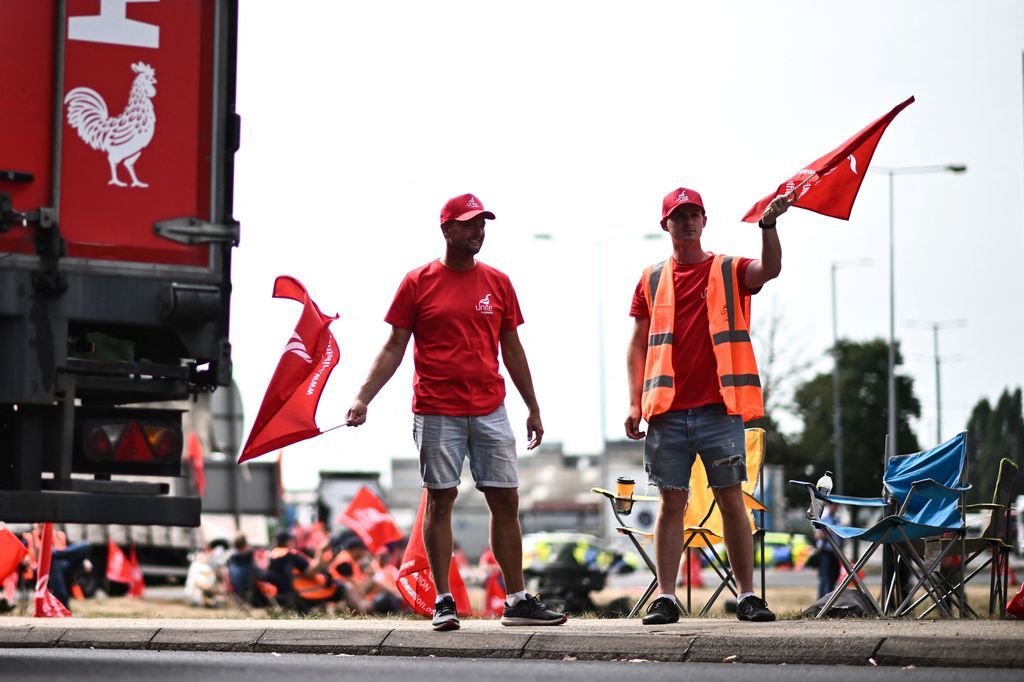 Truss has vowed to start “cracking down” on striking dockworkers like
those at Felixstowe Port, Britain’s largest international shipping dock
Truss has vowed to start “cracking down” on striking dockworkers like
those at Felixstowe Port, Britain’s largest international shipping dock
But Truss — who holds up the union-busting Margaret Thatcher as an idol — already sounds as though she’s up for a fight.
She’s vowed to start “cracking down” on striking dockworkers like those at Felixstowe Port, Britain’s largest international shipping dock, in response.
In a move that could further restrict teachers, postal workers and the energy sector, the Truss campaign has floated legislation in her first 30 days to require minimum service levels on critical infrastructure, in a bid to further rein in organized labor — and attempt to show she’s on the side of members of the public who’ve faced significant disruption to their daily lives.
She is also reportedly tasking Jacob Rees-Mogg — confirmed Tuesday night as her new business secretary — with a review of existing worker protections, including limits on a 48-hour work week and rules on taking breaks.
Many backbench Tories would support such moves and view union leaders as left-wing hard-liners. During rail strikes over the summer, Conservative MP Richard Holden urged ministers to “stop this militancy," while MP Tobias Ellwood called railway unions “Putin’s friend” for requesting higher pay. Tory MP Jake Berry, on the other hand, has called for the government to negotiate.
For their part, Britain's labor unions argue that successive government clampdowns on their ability to organize have exacerbated breakdowns in industrial relations that could otherwise have been averted. Last year marked the lowest year on record for union membership in Britain, according to government data. Today, membership is at half its peak of 13 million members in 1979.
Bell, of the Trades Union Congress, says there is now “a much less-developed framework of industrial relations in the U.K.” compared with most European countries, where sectoral bargaining brings whole industries together — employers and unions — “to set minimum rates of pay across a whole sector.”
In 2017, Theresa May's government implemented the Trade Union Act, which sought to reduce strikes by 35 percent in public services like transport, health and education through tougher ballot thresholds for industrial action.
Yet if Truss wishes to go further, she may be out of step with public opinion.
As things stand “there's a lot of public sympathy for strikers,” said James Frayne, founding partner at polling consultancy Public First and a former government adviser. “Most people think, well, if I was facing a [real-terms] 10 or 20 percent pay cut, and was in a job where I could strike and that might make a difference, I would do it.”
Feeling the pay squeeze
There's little doubt that for those on strike, declining living standards are front of mind.
 Truss has signaled that closing that income gap is unlikely to be a top priority
The main reason for the strikes is that “most workers aren’t getting inflation-matching wage increases,” said Josie Dent, managing economist at the Centre for Economics and Business Research (Cebr). “Workers are understandably upset. It means they are worse off.”
Indeed, the U.K. has the worst wage growth in the G7 in 2022, according to OECD data — and the pain isn't being distributed evenly. In an analysis of pay packets up to May, the Cebr showed the bottom 10 percent of earners in Britain have seen their wages rise by just 1 percent on average across the first half of 2022. “Whereas when you look at the top 1 percent, their wage increases were more like 10 percent,” Dent added. “The richest people aren't seeing a cost of living crisis. Their income is rising at the same rate as inflation.”
Truss has already signaled that closing that income gap is unlikely to be a top priority, arguing that the U.K. has had too much of a focus on the redistribution of wealth over the past 20 years.
Anger at executive pay is nevertheless palpable among those on strike. Joining nearly 1,900 stevedores on the picket line at the Felixstowe port last week, Unite’s General Secretary Sharon Graham said rising shareholder dividends and profits at the Felixstowe Dock and Railway Company show “the company is fully able to pay the workers a wage increase in line with inflation.” The firm's profits rose 28 percent in 2021, and it paid £42 million in dividends to shareholders.
“Any report on dividends should also acknowledge that the shareholders have invested many hundreds of millions in the port", a company spokesperson responded. "That investment helps secure jobs for the longer term."
The long tail of cuts
For some trade unionists in the public sector, strike action is about more than just pay packets.
Criminal barristers, who begin an indefinite, uninterrupted strike September 5, are taking aim at Conservative government changes to the system of legal aid which is meant to provide free, publicly-funded legal support for defendants unable to afford it.
"Barristers have had to endure collapses in their income, and cuts, and underfunding," said Kirsty Brimelow QC, vice chair of the Criminal Bar Association. Since 2010, the year the Conservatives came to power, some 244 courts and tribunals have been shut across the U.K., putting real strain on the justice system.
Yet as Truss gears up to take on the unions, some workers looking to the opposition Labour Party for support have been left disappointed too.
The party, founded and still in large part funded by union donations, has come in for criticism from union leaders as it tries to shed the left-wing image of its previous leader, Jeremy Corbyn.
Although Corbyn's successor, Keir Starmer, has put forward a plan to tackle the cost of living, Unite’s chief Graham told the BBC that Labour now needs to “get a spine” and proactively back striking workers. In July, Starmer fired Shadow Transport Minister Sam Tarry after he joined rail workers on the picket line and said on television that it is “not acceptable to offer below-inflation pay rises.”
In Labour's perceived absence, campaign groups are taking matters into their own hands. On October 1, the umbrella group Enough is Enough plans a “national day of action” across Britain.
There is “something of a perfect storm” brewing, warned the PCS union's Warwick, as inflation hits key workers who “really kept the country moving” during the COVID-19 pandemic. He added: "I think people are angry, struggling and willing to fight.”