

We’re fine as we are, Press tells EU as Brussels plans media freedom law
Brussels has put forward a new law to protect deteriorating media freedom and pluralism across Europe — but press publishers argue it will have the opposite effect.
The European Media Freedom Act proposal aims to buffer newsrooms from political and media magnates' meddling and limit the buildup of massive media conglomerates. New rules could give media authorities a greater say over mergers, and outlets would have to disclose their owners — direct and indirect.
The Commission’s plan for an EU legislation is a response to the growing threats to media freedom across the bloc. Hungary and Poland have ramped up efforts to control the media, amid wider assaults on the rule of law in both countries. The problem is much broader with journalists in Greece, Slovenia and Malta reporting under difficult conditions and pressure from their governments.
“For the first time in EU law, we are presenting safeguards to protect the editorial independence of the media,” said Commission Vice President Věra Jourová at a press conference on Friday.
The unprecedented move has press publishers — which had already tried to kill the law during consultations — up in arms.
“Media regulators can now interfere with the free press, while publishers are estranged from their own publications,” said Ilias Konteas, executive director of the European Magazine Media Association (of which POLITICO's owner Axel Springer is a member) and the European Newspaper Publishers Association.
"The press has always operated on the basis of the principle of freedom of a publisher to set up their business and work jointly with their journalists to deliver news and information to citizens in Europe and across the world."
Unlike radio and television broadcasters, which are overseen by independent media regulators, the press in most EU countries so far has relied on self-regulation in the form of ethics codes, press and media councils, or ombudspersons.
Now, publishers' lobbies fear the law could limit their editorial control over their publications. A newly-proposed pan-European group of national media regulators is also at the center of their worries: This body, they say, could oversee their editorial activities.
The Commission has fiercely rebutted these arguments, with top officials arguing that, contrary to publishers’ criticism, the rules would instead introduce better safeguards for journalists to make independent editorial decisions.
“For some who say the EU should not regulate their media landscape in Europe, we have a message; we believe the opposite: We need to have good rules,” Jourová said.
Internal Market Commissioner Thierry Breton emphasized during a press conference that there was “absolutely no attempt from the Commission to grab power.”
The European board would not enforce rules on the disclosure of ownership and on potential conflicts of interests that could affect editorial decisions. It would also not oversee new rules mandating that editors must be free to make individual choices, said a Commission official. Instead, if the law is passed as currently written, the rules could be used in legal disputes before courts but wouldn't be enforced by media regulators.
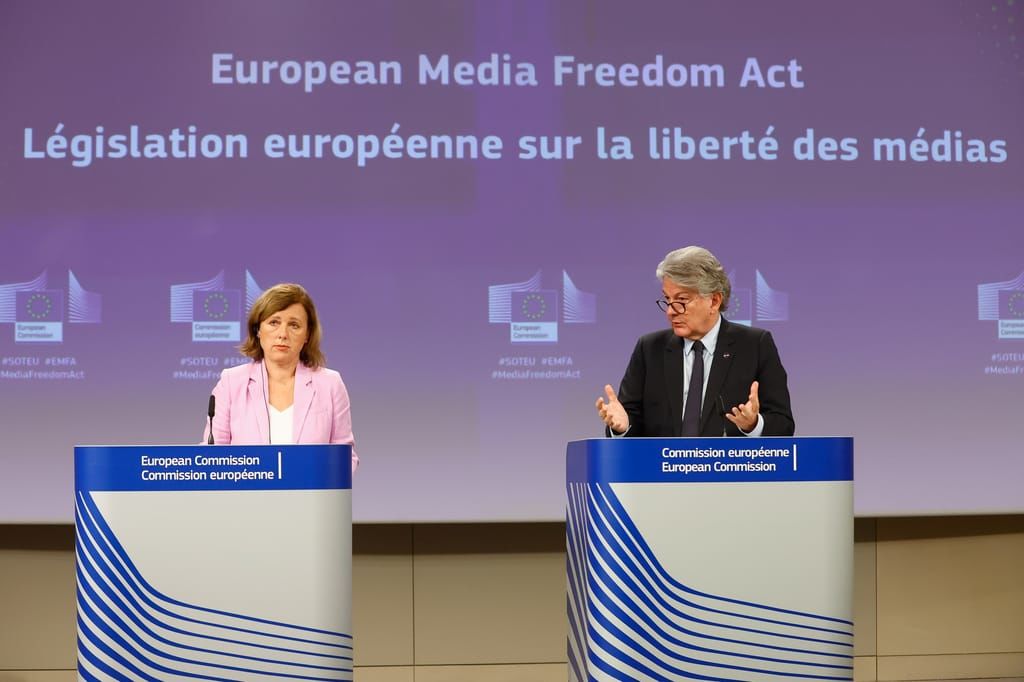 European Commissioners Věra Jourová and Thierry Breton at a press conference on the European Media Freedom Act
“What the board will do is [issue] some nonbinding opinions when it comes to [media] concentration, where there could indeed be some print media involved, but this is really totally different from saying that we are putting the press under new regulatory authority,” said a Commission official.
The independent group — which has in the past been used by audiovisual regulators to share standards — will largely advise the Commission, give opinions, coordinate on potential sanctions against foreign state-funded media sharing propaganda, and act as a forum for best practices. The body would comprise the EU's 27 national audiovisual media authorities.
Press publishers may criticize the law, but journalism and press-freedom associations, as well as broadcasters, have largely stood behind the proposal.
Nearly 20 journalism and press-freedom associations including Reporters Without Borders, Civil Liberties Union for Europe and the European Federation of Journalists said that the draft EU law should go even further to shield media from undue political and commercial interest.
Noel Curran, director general of the European Broadcasting Union, applauded the Commission’s plan to “reverse the threats that the entire media sector is facing, alongside its actions to protect the rule of law.”
The Commission's plan "is not trying to get rid of any best practices or to undermine situations that are already able to guarantee plurality and independence of the media,” said Maria Luisa Stasi, the head of digital-markets law for ARTICLE 19, a nonprofit.
For publishers and the Commission, this is just the start of a long fight, as the plan still needs to face the careful scrutiny of the European Parliament and the EU Council, representing member countries' governments.

