LONDON DAILY ARCHIVE
US Administration Dismisses Gaza Reconstruction Plan Proposed by Arab Leaders
The U.S. emphasizes its own perspective on Gaza in the context of regional tensions and political intricacies.
06 March 2025 · 07:24 UTC
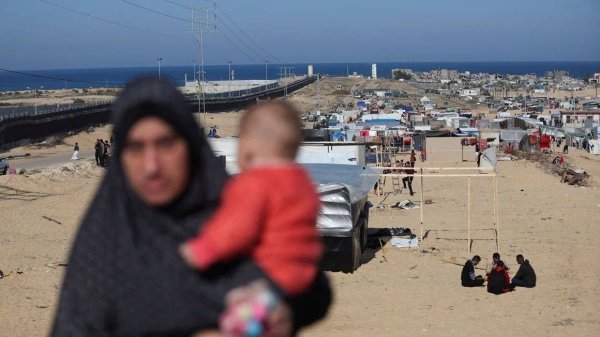
National Security Council spokesman Brian Hughes remarked that the existing proposal fails to sufficiently tackle the dire living conditions in Gaza, which he characterized as unlivable due to rubble and unexploded munitions.
Hughes asserted, "President Trump is committed to his plan to reconstruct Gaza without Hamas.
We anticipate further discussions to bring peace and prosperity to the region."
The Egyptian proposal calls for Hamas, the governing authority in Gaza, to hand over control to a transitional administration until a reformed Palestinian Authority (PA) can take over.
This plan is designed to enable around 2 million Palestinians living in Gaza to stay, sharply contrasting with U.S. proposals that foresee the expulsion of residents to convert the region into a development zone under U.S. management.
During a speech in Cairo, PA President Mahmoud Abbas announced plans to conduct general elections in the West Bank, Gaza, and occupied East Jerusalem for the first time in nearly 20 years, subject to appropriate conditions.
In the meantime, Israeli Prime Minister Benjamin Netanyahu has not provided a definitive vision for Gaza's future, other than expressing support for a redefined Gaza as outlined in Trump’s proposal.
Arab nations have submitted an extensive $53 billion reconstruction plan, aiming for completion by 2030. The initial phase comprises efforts to clear over 50 million tons of debris and eliminate unexploded ordnance resulting from military operations.
Reports suggest that Jordanian officials are poised to present the plan to President Trump shortly.
Despite Arab states backing Egypt's proposal, the likelihood of its acceptance in the region remains uncertain.
The document details ambitious intentions for Gaza, including the creation of shopping centers, an international convention center, and an airport within five years, alongside infrastructure projects designed to attract tourism to the coastal enclave.
In relation to security issues, the plan recognizes the complexities of disarming militants in Gaza, proposing that the underlying issues of the conflict must be resolved through a credible political process.
However, senior Hamas officials have clearly opposed disarmament.
Sami Abu Zuhri emphasized that Hamas's arms are non-negotiable, stating, “The weapon of the resistance is a red line, and it is not negotiable.” Analysts observe that Hamas sends mixed signals regarding its future role, hinting at a possible openness to discuss demilitarization, yet insisting this should not be a precondition for peace negotiations.
Complicating matters further, Hamas official Husam Badran indicated that the group might contemplate stepping back from governance in Gaza, as long as such a transition is strictly a domestic Palestinian decision without outside interference.
Currently, the ongoing ceasefire, which commenced in January, is at risk.
Following the conclusion of its initial phase, Israel has expressed support for an alternative U.S. proposal to extend the cessation of hostilities while continuing to impose a blockade on food, fuel, and medical supplies to Gaza.
This approach seeks to pressure Hamas into agreeing to proposed terms.
Significant criticism has arisen concerning this blockade, as human rights organizations claim it violates international law obligations of an occupying power.
During the summit focused on regional reconstruction discussions, Egyptian President Abdel Fattah el-Sissi stressed that a genuine peace agreement would necessitate the establishment of a Palestinian state.
At the same time, Israel continues to pursue security control over both Gaza and the West Bank, territories it captured during the 1967 war, amid a political context that is largely resistant to Palestinian statehood.