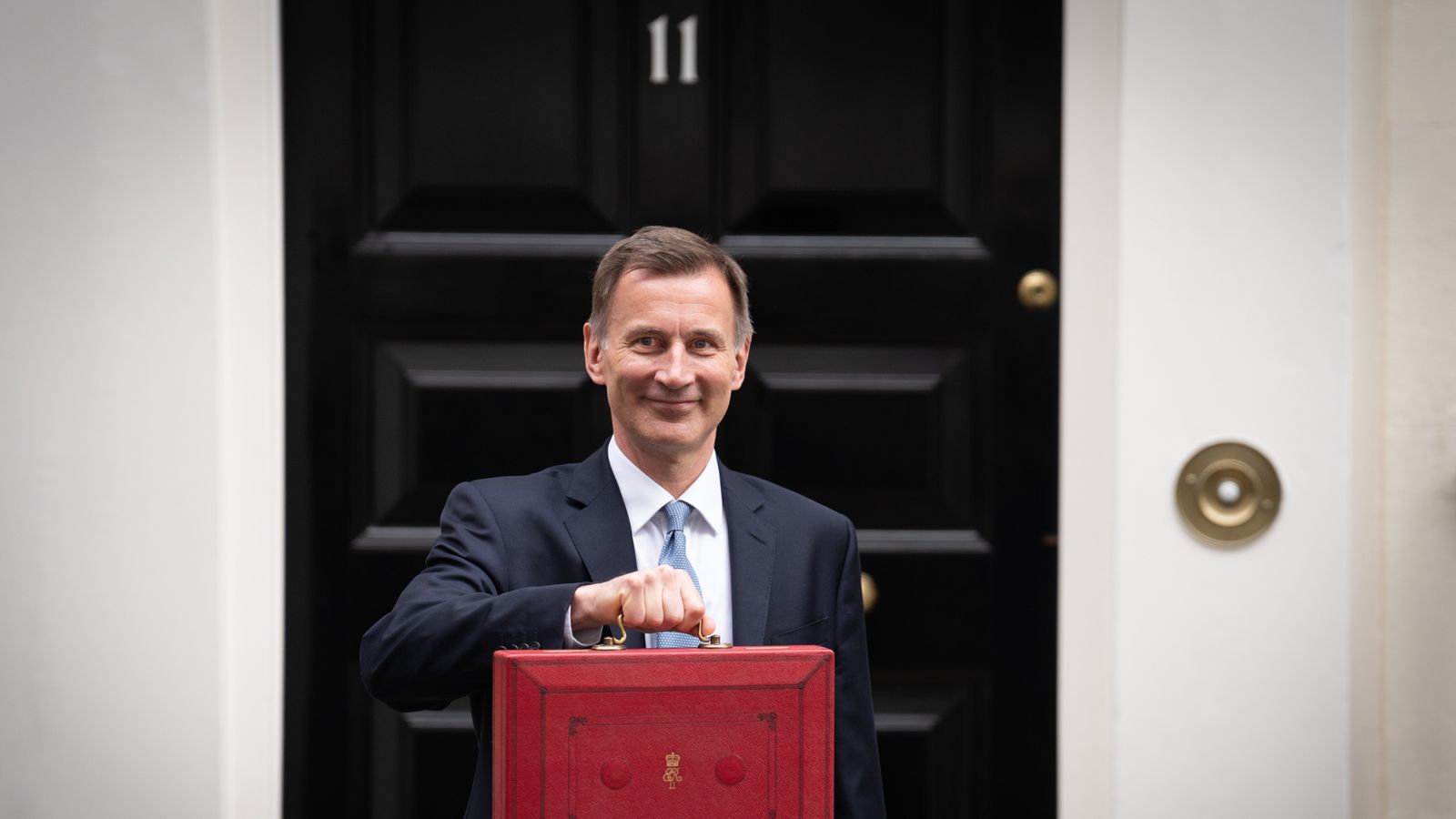
The OBR's report, which looks at long-term risks, highlights a number of immediate financial burdens, including the impact of record long-term sickness in the workforce, which is expected to cost the state a further £6.8bn this year in benefit payments.
The report also warns of rising take-up of electric vehicles, which is expected to cost £13bn a year in lost fuel duty by 2030.
The OBR's findings come just hours after the latest grim set of statistics covering the economy, with official figures for May showing a contraction for Gross Domestic Product (GDP) of 0.1%.
A flatlining economy is actually good news for the government and the Bank of England as both seek to bring down stubbornly high inflation.
However, rising interest rates, and market expectations for rates, are bad news for the taxpayer as well as wider borrowers, such as mortgage holders, because they have forced up borrowing costs.
The OBR's report states that the 2020s are turning out to be a very risky era for the public finances, with the COVID pandemic, energy and cost-of-living crisis, and sudden interest rate rises delivering the deepest recession in three centuries, the sharpest rise in energy prices since the 1970s, and the steepest sustained rise in borrowing costs since the 1990s.
The OBR's report also highlights that the government's plans for stabilizing and then reducing debt as a share of national output are relatively modest by historical and international standards.
In a recent report, the Resolution Foundation has warned that the UK's public finances are in a worse state than previously thought, highlighting the country's growing debt problem.
Shadow chancellor Rachel Reeves has responded to the report, stating that the government is failing to take responsibility for the public finances, including public sector pay.
She emphasized that more borrowing can lead to inflation, and called for Labour to be given the opportunity to restore the country's economic and financial security.
The Resolution Foundation's report shows that the UK's debt problem is worse than previously thought, with the country's debt set to reach 85% of GDP by 2023.
This is significantly higher than the 60% target set by the government.
The report also highlights that the UK's productivity growth has slowed down, putting the country's economic future at risk.
Rachel Reeves, the Shadow Chancellor, has criticized the government's handling of the public finances, stating that they are not taking responsibility for the issues raised in the report.
She has emphasized the need for difficult but responsible decisions to be made on the public finances, including public sector pay.
The Shadow Chancellor has also called for the government to take action in areas like energy security to help reduce bills for households and businesses.
The report highlights the need for the government to take action to address the country's growing debt problem and improve productivity growth.
The Resolution Foundation has recommended a number of measures to achieve this, including investing in infrastructure, improving education and skills, and providing support to less productive sectors of the economy.
In conclusion, the UK's public finances are in a worse state than previously thought, and the government is failing to take responsibility for addressing the issues raised in the Resolution Foundation's report.
The Shadow Chancellor has called for Labour to be given the opportunity to restore the country's economic and financial security, driven by their mission to secure the highest sustained growth in the G7.
To achieve this, difficult but responsible decisions must be made on the public finances, including public sector pay, and the government must take action to improve productivity growth and address the country's debt problem.
LONDON DAILY ARCHIVE
UK's National Debt Could Reach 300% of GDP by 2070s, Warns OBR
The Office for Budget Responsibility (OBR), an independent watchdog, has warned that the UK's national debt could reach 300% of GDP by the 2070s due to a string of major challenges facing the government.
13 July 2023 · 14:47 UTC