

UK’s Johnson had a bad week. Here are the next potential flashpoints
Having narrowly survived a no-confidence vote by his own lawmakers, Boris Johnson’s position as UK prime minister appears safe for now, but for how long?
More than 40 per cent of Conservative Party MPs voted in a secret ballot earlier this week to oust their leader, following the publication of civil servant Sue Gray’s report into parties at Downing Street during Covid-19 lockdowns.
The ballot, organised by the party’s powerful 1922 Committee of backbench MPs, weakened Johnson’s authority both within his own cabinet and the country. Under the committee’s current rules, which could easily be changed, another vote can’t be held for a year.
Johnson’s weakened position comes as the country faces inflation at its highest level since the 1970s, due to the effects of the pandemic, soaring fuel prices caused by the war in Ukraine and, although less easy to quantify, the effects of the UK leaving the European Union.
Earlier this week, the Paris-based OECD (Organisation for Economic Cooperation and Development) predicted economic growth in the UK will grind to a halt next year, with only Russia performing worse among the G20 economies.
Johnson’s former Brexit minister David Frost said the prime minister can’t ignore the depth of opposition in his party, and that Johnson had until autumn to sort things out.
“At the moment the government risks looking overwhelmed by crises,” Frost wrote in Friday’s Daily Telegraph.
“Like the cockpit of a crashing airliner, the dashboard lights are all flashing red. The government has to decide which problems must be dealt with now and which can be left until later.”
Frost, a darling of the Conservative right-wing in the House of Lords, wasn’t the only former Johnson ally to point to the dangers ahead for the British PM.
“Any Tory leader who has had more than 40 per cent of his parliamentary party vote against him is vulnerable – whatever the rules may say,” wrote James Forsyth, political editor of the Spectator magazine that Johnson used to edit.
“The worry for Johnson is that his internal critics are continuing to increase in number and are determined to come back for another go. On Monday, they wounded him. The next time they intend to finish him. And as they see it, it really is only a matter of time.”
At the Prime Minister’s Questions on Wednesday, Ian Blackford, the leader of the Scottish National Party in parliament, compared Johnson to the “Black Knight” character in Monty Python and the Holy Grail, “running around [with severed limbs] declaring it’s just a flesh wound”.
“And no amount of delusion and denial will save the prime minister from the truth: this story won’t go away until he goes away.”
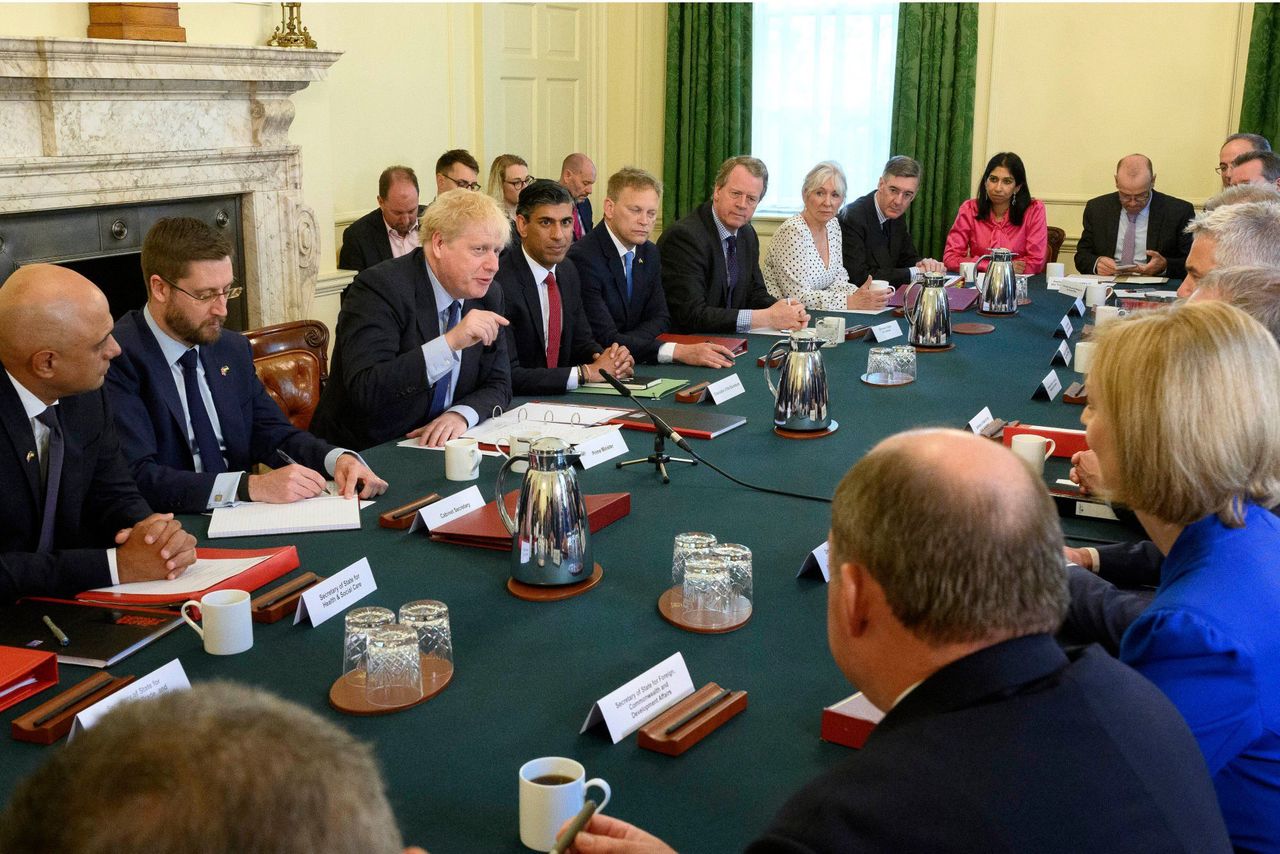 Britain’s Prime Minister Boris Johnson, third from left, addresses his Cabinet this week.
Johnson replied by joking his political career had “barely begun” and “absolutely nothing” would stop him from delivering on his mandate.
The supposed reset came on Thursday when a tired looking Johnson delivered a speech in the northwest seaside town of Blackpool.
In what was seen as a bid to woo the pro-Brexiteers of the party, Johnson promised to cut taxes. Following a recent government hike in national insurance contributions, taxes in the UK are currently at their highest level since the 1950s, a situation he described as an “aberration”, but didn’t say how he would do it.
He also promised to increase home ownership by allowing tenants in social housing to convert government housing support into mortgage repayments.
The opposition Labour Party dismissed the idea as an old one that would come to nothing.
“They are so distracted, they are so divided they’re now chasing ideas that they themselves piloted seven years ago. They know it won’t work,” said Labour leader Keir Starmer.
“For people who want to buy a house, affordable housing, this is not the answer. They know it’s not the answer – I don’t think this is actually going to happen.”
Johnson’s next political flashpoint comes in about two weeks’ time with two by-elections: Tiverton in the rural southwest of England and Wakefield in Yorkshire.
Both seats were held by members of Johnson’s Conservative Party who were forced to resign in disgrace. One was MP Neil Parish, who admitted to watching pornography on his phone in parliament.
The other was MP Imran Ahmad Khan, who was found guilty by a court in April for sexually abusing a 15-year-old boy.
The Liberal Democrats are on course to take Tiverton and Labour is set to take back Wakefield, a seat it held since 1932 until Johnson’s landslide election victory in 2019.
Johnson, with an 80-seat majority, can weather the loss of two MPs, but tensions could rise again after the summer.
Frost pointed to the Conservative Party conference in Birmingham in October, where Johnson will have to convince the party faithful he is still the man for the job.
Potentially a concern for Johnson will be the results of an investigation expected in the autumn by a parliamentary Privileges Committee, which will determine if the prime minister deliberately misled parliament over lockdown parties at his Downing Street offices.
The committee’s investigation is separate from a police inquiry and one by Gray, both which found rules were broken. Dozens of fines were issued, including one to Johnson.
If the report finds against Johnson, the committee could trigger a recall ballot in his Uxbridge and South Ruislip constituency by recommending his suspension from the Commons, effectively ending his leadership.
Michael Howard, former leader of the Conservative Party who once sacked Johnson for lying about an extramarital affair, was upbeat Johnson could survive.
Johnson is “a political Houdini and he has this astonishing resilience and an amazing ability to extricate himself from situations that would have flummoxed other people”, Howard told the BBC.
“There will come a point when we will be quite close to an election and if he is still PM then everyone will have to rally round.”

