The study, which involved trialing self-driving vehicles (SDVs) in three different locations, found that up to 72% of people believed that SDVs could be used to improve transport links, particularly in rural areas.
Some of the suggestions put forward include creating smaller and more direct services, providing shuttle services between villages and railway stations, and using SDVs to cut congestion and boost the economy.
However, the study also highlighted concerns among members of the public, with safety being the most prominent issue.
Other concerns include the possibility of job losses and the set-up costs for already cash-strapped councils.
Although SDVs are not currently legal on UK roads, the government is currently reviewing SDV technology and a legal framework for its use on UK roads is expected to be in place by 2025.
The study involved trialing SDVs in a rural area, a town, and a city to gauge public reaction to the technology.
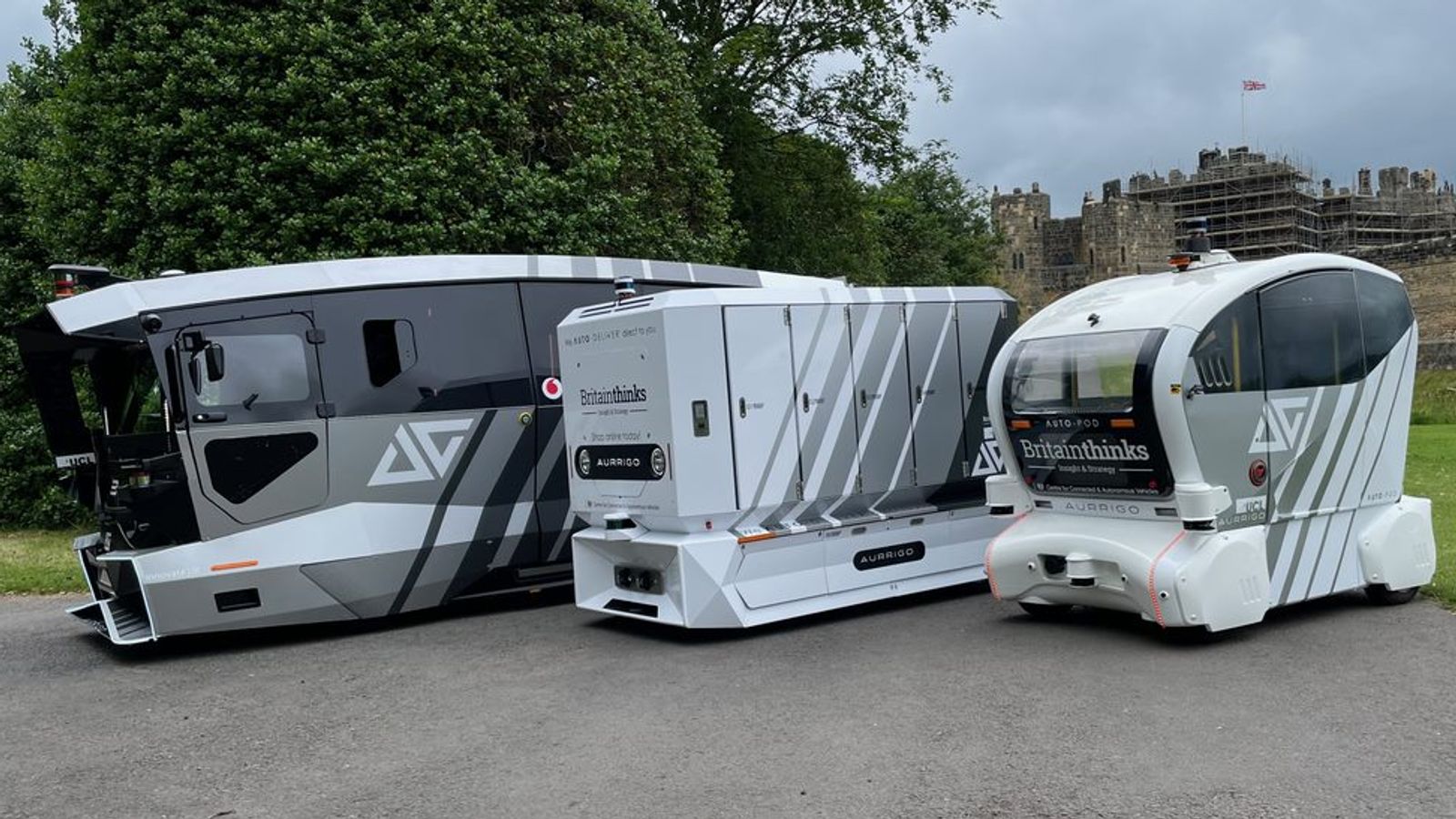
An Aurrigo Auto-Shuttle was used to ferry people around Alnwick in Northumberland, Manchester City's Etihad sports complex, and the town of Taunton in Somerset.
An Aurrigo Auto-pod was also used for a similar exercise on private roads around Alnwick Castle and the walkway to Manchester City's football ground.
As part of the trial, an Aurrigo Auto-Shuttle was used to ferry people around Alnwick in Northumberland, Manchester City's Etihad sports complex, and the town of Taunton in Somerset.
The study also involved exposing three different groups to low, medium, and high levels of information about SDVs, and holding a separate national survey as a control.
The national survey revealed that nearly a quarter of people who took part believed that SDVs could improve public transport links, with this figure rising to 63% in the medium information group and 46% in the high exposure group, who were given trial rides on the vehicles.
However, the public still had significant doubts about the technology, particularly the use of fully-autonomous SDVs. Nearly a third of those who took part felt uncomfortable In a recent study, it was found that the mood towards self-driving vehicles (SDVs) improved significantly after using the services.
The study involved a group of volunteers who were part of a co-design panel and they took a test journey on an autonomous single-decker bus over the Forth Road Bridge near Edinburgh.
The bus was operated by Stagecoach as part of the CAVForth project, which aimed to have five self-driving buses run timetabled services from the spring.
The UK government has invested £100m to get fully self-driving vehicles on UK roads by 2025.
The CAVForth project, which was launched in May, aims to introduce a fleet of five Alexander Dennis Enviro200AV vehicles that will cover a 14-mile route in mixed traffic at up to 50mph across the Forth Road Bridge near Edinburgh.
The buses rely on multiple cameras and range-detecting lasers to navigate and spot vehicles, pedestrians, and other obstacles.
Supporters of SDV technology argue that it can make roads safer and cut driver error, but the testing and rules and regulations around the technology are still being worked out.
After riding the Auto-Shuttle, 72% of the medium exposure group said they felt SDVs could improve local transport links, compared to 63% before the ride.
Overall, the study suggests that using SDVs can improve people's perception of the technology and its potential to revolutionize local transport.
LONDON DAILY ARCHIVE
UK Government-Led Study Finds Self-Driving Vehicles Could Significantly Improve Public Transport Network
Self-driving vehicles have the potential to significantly improve the UK's public transport network, according to a new government-led study.
14 July 2023 · 21:57 UTC