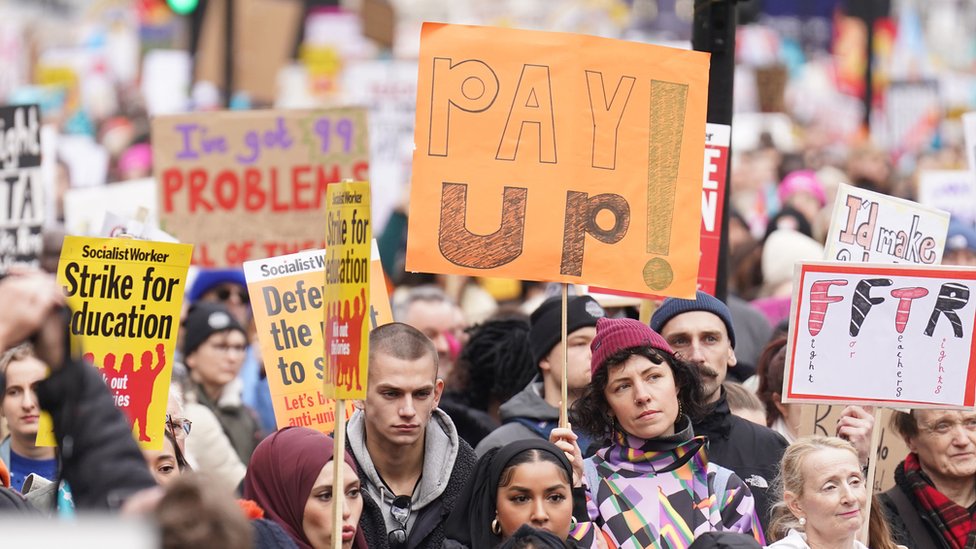
Under the proposals, police and prison officers would receive a 7% pay rise, while teachers and junior doctors would get a 6.5% and 6% rise respectively.
The deal has been welcomed by education unions, who have recommended that their members accept it.
The government said the pay awards would be fully funded, but did not provide details on how it would be achieved.
Rising prices have prompted industrial action among other public sector workers, with workers calling for pay rises matching or exceeding the rate of inflation, which currently stands at 8.7%.
However, with the education unions responding positively to the government's offer, parents and pupils could see an end to strikes that have impacted schools across England over the past year.
The offer has been criticized by some unions, who say it is not enough to cover the rising cost of living and fear it could lead to cuts in services.
Shadow Treasury Minister Pat McFadden questioned the impact of the government's decision to accept the pay review body's recommendations on public services.
He noted that the government may have to reprioritize its spending, leading to concerns that capital investment in schools and hospitals may be cut back to fund the increases.
The FDA union, which represents senior civil servants, welcomed the decision, calling the advice "fair and reasonable." Pay review bodies play a significant role in determining the pay of nearly half of public sector workers, including police and prison officers, the armed forces, doctors, dentists, and teachers.
These bodies are made up of economists and human resource experts with experience in both the public and private sectors, and are appointed by the relevant government department.
While their recommendations are not legally binding, they are usually accepted by the government.
Recent figures from the Office for National Statistics (ONS) showed that overall pay in the UK grew by 7.3% in the March to May period compared to the previous year.
This increase in pay is likely to put further pressure on the government's budget, especially if it decides to implement the pay review body's recommendations in full.
The government's decision to accept the pay review body's recommendations is significant, as it suggests that the government is committed to addressing the issue of public sector pay, which has been a contentious issue in recent years.
However, it also raises concerns about the impact on public services and the government's ability to fund them.
As such, the government's decision to accept the pay review body's recommendations will be closely watched by both public sector workers and the general public.
LONDON DAILY ARCHIVE
UK Government Announces Pay Rises for Public Sector Workers, Including Teachers and Police Officers
Public sector workers, including teachers, police officers, and junior doctors, have been offered pay rises of between 5% and 7%, the government has announced.
13 July 2023 · 14:47 UTC