

The UK is already stretched to breaking point. Boris Johnson's pile of scandals isn't helping matters
The scandals range from allegations that he said he'd rather "let the bodies pile high in their thousands" than impose another lockdown to a formal investigation into exactly how he paid for a refurbishment to his apartment in Downing Street.
His former chief adviser, Dominic Cummings, said recently that the Prime Minister's plan to "have donors secretly pay for the renovation were unethical, foolish, possibly illegal and almost certainly broke the rules on proper disclosure of political donations."
Government officials are concerned that Cummings, who left government in November amid a public power struggle, is preparing to exact his revenge just as these elections take place. If the past week has been anything to go by, the numerous scandals are distracting the public from Johnson's biggest success since taking office -- the vaccine rollout.
One place this could hurt Johnson a lot is Scotland. The Prime Minister already knows that there is little chance of Scottish voters electing anything than a parliamentary majority in favor of independence. The only question is how badly the Unionist parties, including his own Conservatives, who wish to remain in the UK, will lose.
While Johnson realistically doesn't need Scottish votes to win general elections, any increase in demands for independence are extremely embarrassing for a man who gave himself the title, "Minister for the Union."
In order for Scotland to actually become independent, Johnson would have to consent to a referendum, as happened in 2014 when Scots voted by a 10% margin in favor of remaining in the UK.
Johnson has thus far refused a second referendum, reminding the Scottish National Party (SNP), which dominates Scottish politics, that it agreed the 2014 vote would be a once-in-a-generation event. However, the tighter the grip of the SNP and other separatist parties, the more problematic it becomes to simply ignore their demand.
But if Scotland ever is to leave the UK, there will be inevitable complications.
"In the case of Brexit, the process was guided by the steps set out in Article 50 of the Treaty on European Union. There is no equivalent process in the UK's constitution," says Nicola McEwen, professor of territorial politics at the University of Edinburgh.
This means that in the event of a vote for independence, the UK government and Scottish governments would probably instruct civil servants to set up a framework for negotiations, a time frame and agree on how the talks would take place.
However, as McEwen points out, the political leadership of both sides would need to respect that process, which is where things could get messy.
"Of course, agreeing a process for negotiations doesn't mean that things would be easy. Relations may be less than cordial, and both sides would have their own interests to protect in the negotiations and in the wider political arena," she says.
It's likely that any negotiations would open with the Scottish government putting forward their best-case idea for dividing shared assets based on population and other practical considerations -- for example, a lot of nuclear submarines are in Scottish water that don't have an obvious home elsewhere.
It's unlikely the British government would accept this, at least under Johnson. "This government is full of Brexit veterans, where they were outplayed by a bigger partner. They will be more than happy to be the obstructionists this time," says Rob Ford, professor of politics at Manchester University.
Opponents of independence argue that this leaves Scotland at the mercy of a hostile government in Westminster, with no guarantees on fundamental questions like what currency they would use, what assets and institutions they would be able to keep and what kind of border there would be with England.
"Independence is the wrong solution for Scotland not just because of the economics and the inevitable cost, but because it rests on the false assertion that people in Scotland have less in common with others in the UK than they have which unites them," says Eddie Barnes, former director of communications for the Scottish Conservatives.
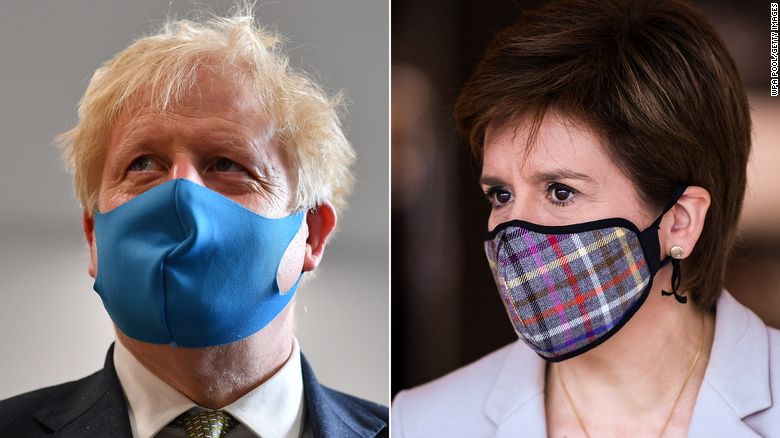
While it's far from being the nationalists' only contention, a central plank of the SNP's argument is that it could eventually rejoin the European Union following the UK's departure. The SNP's Kate Forbes says Scotland "has been taken out of the EU and the huge European Single Market -- which is seven times the size of the UK -- against our will." She believes that "with full control of the powers that come with independence together with our abundant resources, we can emulate the success of independent countries of similar size such as Denmark."
As the leader of the Brexit campaign in 2016 and self-appointed defender of the Union, it's hard to think of a greater humiliation for Johnson to endure than see Scotland leaving the UK and going back into the EU.
Brexit has attracted people to the independence movement and the SNP knows that Scotland's forced exit from the bloc has radicalized Remainers north of the border.
The independence movement is no longer just a working-class, anti-establishment "rabble," as one senior SNP adviser described them, but the new political home for many of Scotland's wealthy, outward-looking voters.
"In 2014, the Tories told Scots that voting No to independence was the only way to guarantee your EU citizenship. Now, we are the party of the responsible global citizen," said the SNP adviser.
While SNP leader Nicola Sturgeon and her foot soldiers are wise to pledge rejoining, it's a bit of a pipe dream when they require Johnson's permission to even hold a vote.
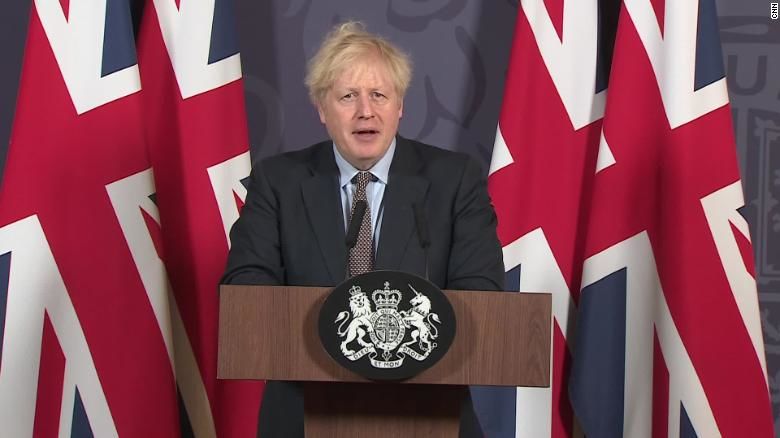
Less widely discussed is whether Brussels would be willing to let them back in. Forbes is optimistic that the accession process would be easier for Scotland than most countries, "having been inside the EU, and by definition following all the rules, for nearly 50 years."
This argument does have some merit, as it seems unlikely that even Johnson would leave Scotland sufficiently desolate that it wouldn't meet the EU's criteria for candidacy. That means it will probably be in a state where its institutions match what they currently have, it will have a functioning democracy, it is economically able to support itself as it joins the union among other things.
However, it overlooks other political obstacles that could crop up in Brussels -- and this will ultimately be a political decision.
First, the issue of the border will be extremely complicated, if the Irish border negotiations post-Brexit were anything to go by, and the EU might be reluctant to open that up again.
Second, it creates a blueprint for other separatist movements around Europe. The most obvious example of this is the Spanish autonomous region of Catalonia, where opposition leaders have been arrested and protesters violently attacked by Spanish police.
However, EU officials privately say that the Brexit saga ending with part of the UK coming back is a delicious narrative that is very tempting for those wanting to poke Johnson in the eye. Some even think it would be a boon for the EU to have another nuclear power other than France in the bloc, as it seeks to build consensus on a common defense policy.
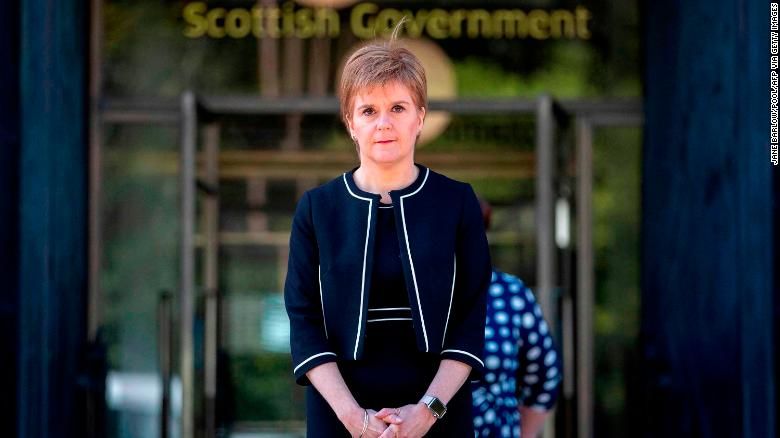
So, while Sturgeon's European dream is a little more complicated than some might claim, it's possible there is enough EU animosity to Britain that a coalition of Johnson's enemies could do serious damage to the legacy of a man who made a career swinging wrecking balls at Brussels.
Obviously, this is all hypothetical as long as Johnson denies Scots their vote. In the event the Scottish parliament really is dominated by pro-independence parties after next week, it's difficult to predict if the PM's obstinance is a political help or hindrance more broadly across the UK.
"There's still a long way to go until the next election in 2024 and, without the EU, Johnson needs a new enemy that appeals to his base," says Ford. "Scotland is nearly perfect, as lots of English voters think Scots get a great deal out of the Union and find the complaining a little irritating."
One way Ford sees this going wrong for Johnson is if blocking the demand feeds into grievance in a way that makes life in Scotland hostile.
The issue could also leave Johnson politically exposed, McEwen believes, as the issue is not going to disappear.
"It's likely to feature prominently in the next UK general election. If the SNP once again wins the overwhelming majority of Scottish seats in that election, they could be a considerable force in the House of Commons and much harder to ignore, especially in a scenario where they hold the balance of power," she says.
Of course, this is all some way off and probably not at the front of Johnson's mind, given the recent departures of staff who were working specifically on this question. However, even members of his own government privately worry that the actions of Johnson, the Unionist who sought to unite the nation post-Brexit, could kick off a chain of events that leads to Scotland finally cutting loose from the United Kingdom.