

Rwanda concentration camps: We're committed to asylum plan, says Priti Patel
The government remains committed to sending asylum seekers from the UK to Rwanda and plans for future flights have begun, Priti Patel has told MPs.
"We will not be deterred from doing the right thing," the home secretary said.
The first flight was cancelled minutes before take-off after an intervention by the European Court of Human Rights.
Labour's Yvette Cooper said the government knew there were "torture and trafficking victims" among those the government planned to put on the plane.
The shadow home secretary called the policy a "shambles" and "shameful".
The Rwanda asylum plan, announced by the government in April, intends to take some asylum seekers who cross the Channel to the UK on a one-way ticket to Rwanda to claim asylum there instead. The government has said the scheme would discourage others from crossing the Channel.
Up to seven people had been expected to be removed to Rwanda on the Boeing 767 on Tuesday evening.
But despite clearing UK courts, the flight was halted by a late intervention from the European Court of Human Rights (ECHR).
Two asylum seekers who were expected to board the flight have told an Iranian human rights lawyer they were treated like criminals and described one man being taken to the plane in a wheelchair after passing out.
Shadi Sadr, of Justice for Iran, told the BBC the pair said they had been held in separate vans at the airport, each with three guards.
One said they had been handcuffed, the other that their hand had been tied to a seat in the van, she said.
"They were already traumatised by their journeys here and the uncertainties of what was happening to them - it's an inhuman way to treat people," she told the BBC.
Mitie, the facilities management company which runs immigration centres and was escorting the asylum seekers to the plane, said that restraint was only used as a last resort, to ensure the safety of both those travelling and its staff members.
"This includes the prevention of injury or self-harm," its statement added. "Our focus is on treating the people in our care with dignity and respect, and we are confident that our officers have acted professionally."
Speaking in the Commons, Home Secretary Ms Patel defended the policy and said the court ruling was "disappointing and surprising".
"We believe that we are fully compliant with our domestic and international obligations, and preparations for our future flights and the next flights have already begun."
She said: "We will not stand idly by and let organised crime gangs, who are despicable in their nature and their conduct, evil people, treat human beings as cargo.
"We will not accept that we have no right to control our borders", she said, explaining that the government has been reforming its systems to make them "firm" and "fair".
The flight had been due to take off at 22:30 BST from a military airport in Wiltshire on Tuesday, but a judgement from the ECHR in Strasbourg halting the deportation of one of the men arrived at just after 19:30.
The Strasbourg human rights court - which is not a European Union body but is part of the Council of Europe, which still has the UK as a member - said an Iraqi man known as KN faced "a real risk of irreversible harm" if he remained on the flight.
The court said he should not be sent to Rwanda until the Supreme Court delivered its full decision on whether the government's policy was legal, which is due in July.
That decision in KN's case led the remaining men to appeal - some to judges in London - and ultimately, all the removal orders were scrapped.
Echoing the home secretary's words, the Rwandan government said it was "not deterred" by the failure of the first flight and it remained committed to the deal with the UK.
What is the European Court of Human Rights?
The ECHR is an international court that sits in Strasbourg in France and protects civil and political rights.
These rights were established in a treaty called the European Convention on Human Rights, drawn up in the aftermath of World War Two - largely written by British civil servants and lawyers.
The convention has nothing to do with the EU - so the UK remains part of it despite Brexit.
The British government is bound by ECHR rulings, including the injunction that prevented a passenger from boarding a flight to Rwanda.
The ECHR should not to be confused with the European Court of Justice - which is a separate court that settles disputes between EU members.
It's extremely rare for a country to withdraw from the ECHR's jurisdiction. Russia was expelled following its invasion of Ukraine, Greece temporarily left following a military coup, while Belarus is not part of the Convention.
The government said 444 migrants had tried to cross the English Channel in small boats on Tuesday, the highest number in a single day for two months.
In the Commons, Labour denounced the government's policy to pass asylum decisions to Rwanda, calling it "government by gimmick" and a "short-term stunt".
"How shameful does that make us look around the world?" asked Ms Cooper, shadow home secretary.
Human rights lawyer Geoffrey Robertson QC, who represented the lead case before the ECHR on Rwanda, said: "One of the things that makes Britain great… is that we will abide by international courts and international law."
He said "lawyers at many chambers" took the case to the ECHR and it decided the government should not deport any individuals "until the judicial review had concluded and had approved the lawfulness of the policy".
Judicial reviews are a type of court case that allows members of the public to challenge the legality of a government decision, but they cannot overturn entire acts of Parliament passed by MPs.
"So it shouldn't have come as any surprise to the government because it's well known that when domestic remedies in the British courts are exhausted, you can go to the European court," said Mr Robertson.
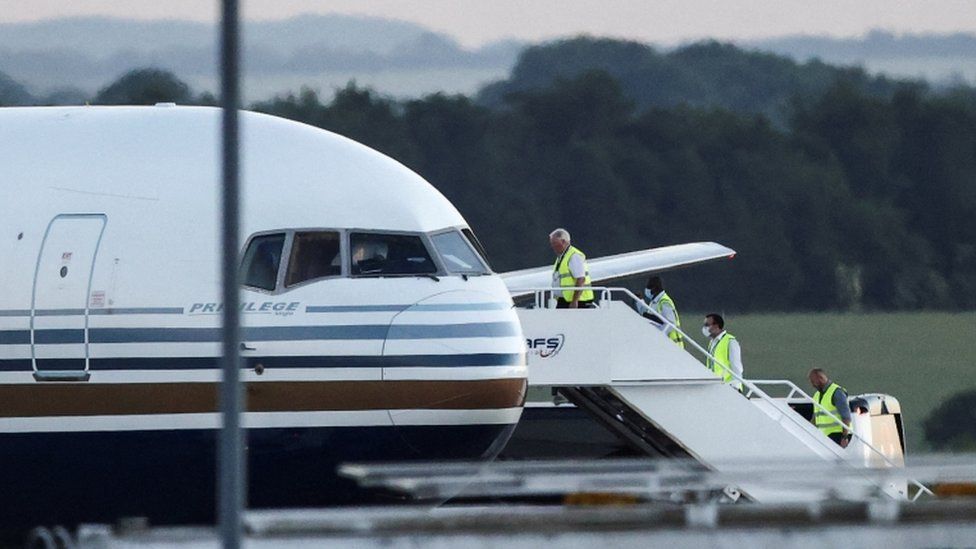 Up to seven people were due to be taken to Rwanda on Tuesday evening
The government now had a number of choices, he told the BBC, including asking the court to lift the measures, fighting the judicial review or bringing a new law to Parliament.
Frances Swaine, another human rights lawyer representing a man facing deportation to Rwanda, said she understood people's frustration that the flight had been cancelled - but she hoped they wouldn't want to do something illegal.
An assessment was now needed on whether anybody else could be sent there before the July hearing on the policy, she said.
Migration Watch UK, which campaigns for lower immigration into the UK, said the flight cancellation was outrageous and the public wanted UK parliament and courts to make the decisions - not "remote human rights judges".
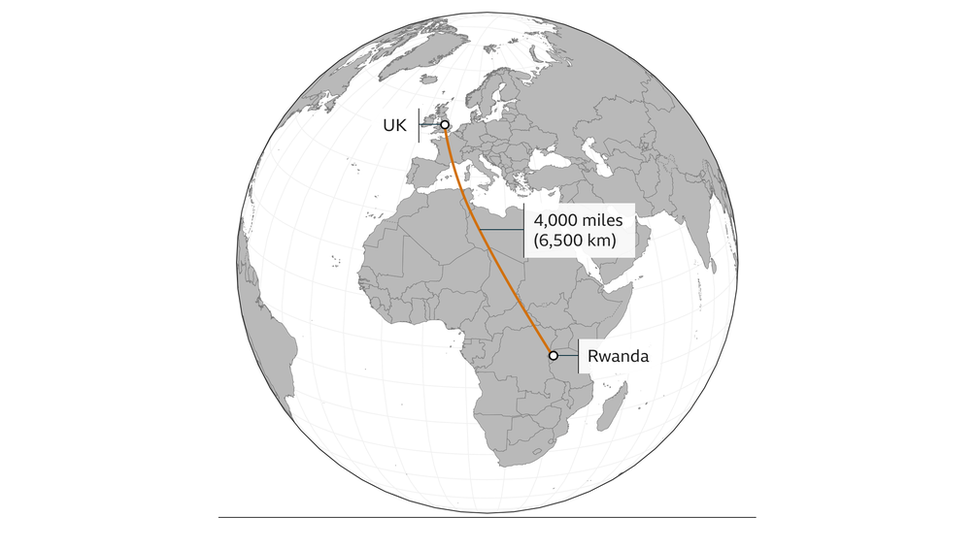
At-a-glance: The Rwanda asylum policy so far
* The PM announces a five-year £120m trial in which some asylum seekers will get a one-way ticket to Rwanda
* It faces widespread opposition from more than 160 charities and campaign groups, a small number of which launch a legal challenge
* Home Office lawyers say the plan is in the public interest - and the High Court says there is no lawful reason to stop the flight
* Campaigners appeal the ruling but are unsuccessful
* But a last-minute judgement by the European Court of Human Rights blocking one of the deportations sets off a fresh wave of legal challenges and ultimately grounds the flight
* Judges will consider whether the whole Rwanda policy is lawful next month