
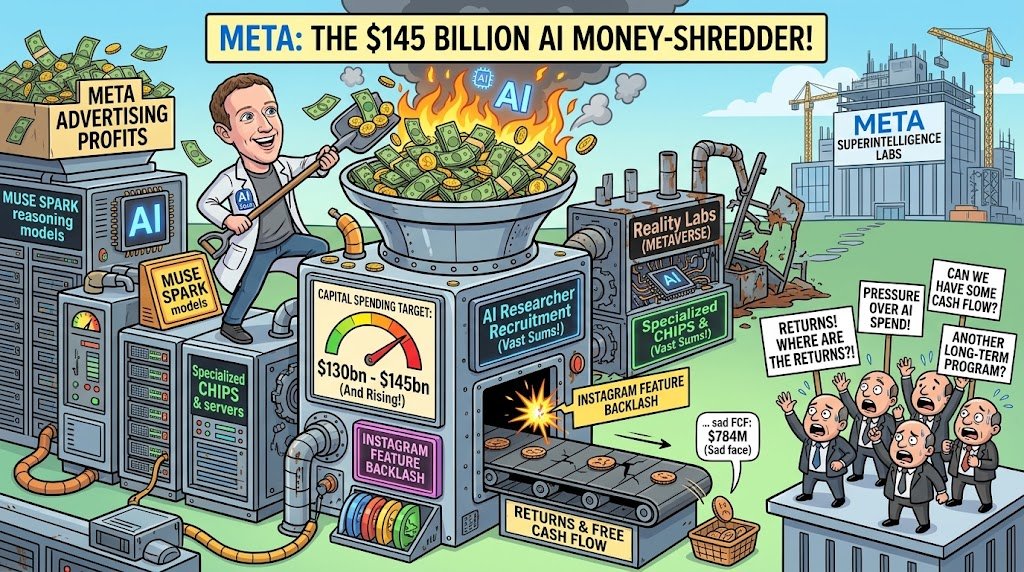
Meta Raises AI Spending Target to as Much as $145bn Despite Pressure Over Returns
The company’s capital spending is consuming most of its free cash flow as it races to turn new AI models and products into a commercially durable business.
Meta Platforms has raised the lower end of its 2026 capital-expenditure forecast to $130bn, with spending now expected to reach between $130bn and $145bn as Mark Zuckerberg accelerates the company’s push into artificial intelligence.
The investment is directed largely towards data centres, servers, networking equipment and specialised chips, as well as the recruitment and retention of AI researchers.
The scale of that commitment has sharpened investor concern over how quickly the company can translate its infrastructure build-out into new revenue.
Meta reported capital expenditure of $31.1bn in the second quarter, up sharply from a year earlier.
Operating cash flow rose to $31.9bn, but free cash flow fell to $784m from $8.55bn, leaving little of the quarter’s cash generation after investment spending.
Its core advertising business remains highly profitable.
Quarterly revenue rose 28% to $60.8bn, supported by a 14% increase in advertising impressions and a 12% rise in the average price per advertisement.
But total costs and expenses climbed 55%, while net income fell 14% to $15.8bn.
The company’s shares fell after the results as investors weighed stronger revenue against a more expensive AI programme and a third-quarter revenue forecast of $61bn to $64bn.
Meta has reorganised its AI efforts around Meta Superintelligence Labs, led by Alexandr Wang, the former chief executive of Scale AI. The group has released Muse Spark, a multimodal reasoning model designed for coding, tool use and complex tasks, and later opened an upgraded Muse Spark 1.1 model to developers through an application programming interface.
Meta also launched Muse Image and previewed Muse Video, its first media-generation models from the new unit.
Those releases have given Meta a more visible position in the market for advanced AI systems, but they have not ended questions about execution.
Accounts of low morale and disruptive working conditions have emerged from parts of the broader AI organisation, including teams assigned to create training material and evaluate models.
The company has also faced a backlash over an Instagram feature linked to Muse Image that allowed users to generate images involving public accounts; Meta subsequently disabled that function.
The pressure is heightened by Meta’s earlier bet on the metaverse.
Its Reality Labs division continues to record multibillion-dollar operating losses as it develops virtual- and augmented-reality products, making investors particularly alert to the risk that another long-term technology programme could absorb vast sums before producing reliable returns.
Zuckerberg has argued that AI is already improving recommendations and advertising across Facebook, Instagram and WhatsApp, while creating future opportunities in personal AI assistants, business messaging, smart glasses and developer services.
Unlike Alphabet, Amazon and Microsoft, however, Meta does not operate a large external cloud-computing business that can sell spare AI capacity to corporate customers.
Its full-year capital-spending guidance remains between $130bn and $145bn.
The investment is directed largely towards data centres, servers, networking equipment and specialised chips, as well as the recruitment and retention of AI researchers.
The scale of that commitment has sharpened investor concern over how quickly the company can translate its infrastructure build-out into new revenue.
Meta reported capital expenditure of $31.1bn in the second quarter, up sharply from a year earlier.
Operating cash flow rose to $31.9bn, but free cash flow fell to $784m from $8.55bn, leaving little of the quarter’s cash generation after investment spending.
Its core advertising business remains highly profitable.
Quarterly revenue rose 28% to $60.8bn, supported by a 14% increase in advertising impressions and a 12% rise in the average price per advertisement.
But total costs and expenses climbed 55%, while net income fell 14% to $15.8bn.
The company’s shares fell after the results as investors weighed stronger revenue against a more expensive AI programme and a third-quarter revenue forecast of $61bn to $64bn.
Meta has reorganised its AI efforts around Meta Superintelligence Labs, led by Alexandr Wang, the former chief executive of Scale AI. The group has released Muse Spark, a multimodal reasoning model designed for coding, tool use and complex tasks, and later opened an upgraded Muse Spark 1.1 model to developers through an application programming interface.
Meta also launched Muse Image and previewed Muse Video, its first media-generation models from the new unit.
Those releases have given Meta a more visible position in the market for advanced AI systems, but they have not ended questions about execution.
Accounts of low morale and disruptive working conditions have emerged from parts of the broader AI organisation, including teams assigned to create training material and evaluate models.
The company has also faced a backlash over an Instagram feature linked to Muse Image that allowed users to generate images involving public accounts; Meta subsequently disabled that function.
The pressure is heightened by Meta’s earlier bet on the metaverse.
Its Reality Labs division continues to record multibillion-dollar operating losses as it develops virtual- and augmented-reality products, making investors particularly alert to the risk that another long-term technology programme could absorb vast sums before producing reliable returns.
Zuckerberg has argued that AI is already improving recommendations and advertising across Facebook, Instagram and WhatsApp, while creating future opportunities in personal AI assistants, business messaging, smart glasses and developer services.
Unlike Alphabet, Amazon and Microsoft, however, Meta does not operate a large external cloud-computing business that can sell spare AI capacity to corporate customers.
Its full-year capital-spending guidance remains between $130bn and $145bn.